

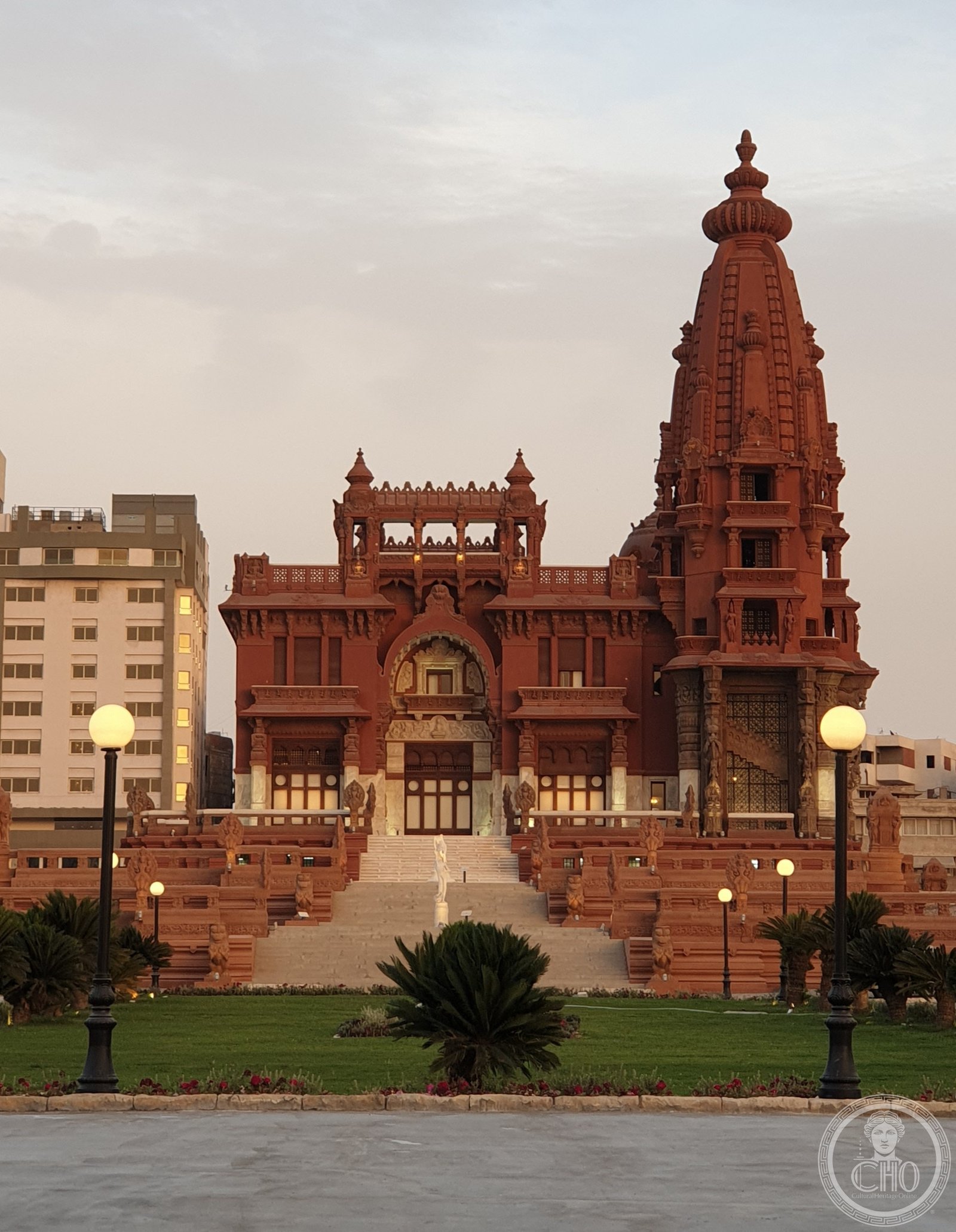
Baron Empain Palace is one of the most extraordinary private residences ever built in Africa: a full-scale recreation of a Hindu-Khmer temple rising from the streets of Heliopolis, the garden city that Belgian industrialist Baron Edouard Empain constructed on the desert east of Cairo in the early twentieth century. Commissioned in 1906 and completed around 1910, the palace was designed by French architect Alexandre Marcel, who combined elements from the temple complexes of Angkor Wat, the Orissan temples of India, and Khmer architecture with Beaux-Arts planning principles and a rotating solarium that allowed Empain to track the sun from his bedroom. The building is clad in reinforced concrete cast in deeply carved relief panels depicting Hindu deities, apsaras, and mythological scenes of extraordinary detail. After Empain death in 1929 the palace passed through a succession of owners and uses; it was abandoned in the 1990s and deteriorated severely over two decades, its interior stripped and its gardens encroached upon by informal settlements. A comprehensive Egyptian government restoration, completed in 2020 after years of work by the Ministry of Antiquities, returned the building to something close to its original appearance. It is now open as a museum dedicated to Empain and to the intertwined history of Heliopolis and Cairo.
At a glance
- Type
- Private palace and museum
- Period
- 1906-1910
- Style
- Hindu-Moorish Eclectic / Orientalist
- Location
- Al-Orouba Street, Heliopolis, Cairo, Egypt
- Coordinates
- 30.0884 N, 31.3338 E
- Architect(s)
- Alexandre Marcel
Overview
The palace sits on Al-Orouba Street in Heliopolis, surrounded by what was originally a formal garden and is now a public park. The building is constructed in reinforced concrete and rises approximately 34 metres, with the main tower crowned by a small rotating observatory that was Empain personal solarium. The exterior surfaces are covered in high-relief carved panels reproducing the iconography of Hindu and Khmer temple sculpture with considerable accuracy. The palace is now operated by the Egyptian Ministry of Tourism and Antiquities and functions as a museum of the history of Heliopolis and of Baron Empain role in its development.
History
Baron Edouard Louis Joseph Empain (1852-1929) was a Belgian financier and engineer who built railways and tramways across Europe, Russia, China, and Egypt. In 1905 he acquired a concession from the Khedive Abbas II to develop a new suburb of Cairo on desert land east of the city. The resulting garden city of Heliopolis, with its wide boulevards, eclectic palaces, and hybrid Moorish-Byzantine-European architecture, was one of the most ambitious private urban development projects of the Edwardian era. Empain commissioned his personal residence as the crowning statement of the development, choosing a deliberately exotic aesthetic. After his death the palace was used as a private residence, then as offices, then was abandoned. The restoration project, begun under the supervision of the Egyptian Ministry of Antiquities after 2018, consolidated the structure, replicated missing decorative elements from historical photographs, restored the rotunda, and furnished the interiors with period-appropriate objects. The palace opened to the public in February 2020.
Architecture and Design
Alexandre Marcel (1860-1928) was a French architect known for his orientalist and historicist commissions, including the Cambodian Pavilion at the 1900 Paris Exposition Universelle. For the Baron Empain Palace he drew directly on his studies of Angkor Wat and the great Orissan temple complexes of Bhubaneswar and Konark to produce a building that captures the visual density and sacred character of its sources with remarkable effect. The facade is organised around a central tower flanked by lower wings, all clad in carved concrete panels. The interior featured a grand staircase, reception rooms, and the famous rotating solarium on the roof, operated by a mechanical system that allowed the room to revolve in synchrony with the sun. The use of reinforced concrete for the carved decorative surfaces was technically innovative for its period.
Cultural significance
The Baron Empain Palace is the most visible surviving monument of the Heliopolis project and a physical record of the colonial-era imagination of the Orient: a European financier vision of India and Cambodia transplanted to Egypt, built with Egyptian labour, using French design, for a Belgian patron. This layering of cultural references makes it one of the most complex and contested buildings in the African continent. The palace also became, during its decades of abandonment, a site of urban mythology in Cairo: it acquired a reputation for being haunted and was the subject of popular Egyptian films and television programmes. Its restoration and opening as a museum represents an Egyptian reclamation of the building history on Egyptian terms.
Visiting today
The museum is open Wednesday through Monday from 09:00 to 17:00; closed Tuesdays. Admission is charged. The exhibition covers the history of Empain, the development of Heliopolis, and the restoration project itself, including a display of before-and-after photographs that documents the scale of the conservation work. The surrounding Al-Orouba Street and the Heliopolis district retain significant quantities of the original early-twentieth-century eclectic architecture, including the Basilica of Notre-Dame d Heliopolis and the former Heliopolis Palace Hotel. Guided tours in Arabic and English are available.
Getting there
The palace is in the Heliopolis district of Cairo, approximately 15 kilometres northeast of the city centre. Cairo Metro Line 3 connects downtown Cairo with Heliopolis in approximately 25 minutes; the palace is a short taxi ride from the nearest metro station. Cairo International Airport is approximately 5 kilometres from the palace, making it a possible first or last stop for visitors arriving or departing. Taxis and ride-sharing apps are the most practical transport option within Heliopolis.
Sources and resources
Find it on the map
See this place and what’s around it →Record researched and written by Luigi De Marchi for Cultural Heritage Online, 2026.
📷 Become a Cultural Heritage Online photographer
Share your photos of places: they stay published under your name as the author. The more they're seen, the more you get noticed — and soon a contest will reward the most appreciated photos.
Log in or sign up free to add a photoIs this page about you?
This page is read by travellers and heritage enthusiasts who find it on Google. Tell us how you are connected to this place and we will take it from there.