

One of the largest and most remote temples of the Khmer Empire — built by Jayavarman VII as a royal funerary monument, with the last substantial multi-faced Avalokitesvara towers outside Angkor Thom still standing in the Cambodian jungle.
At a glance
In the remote Banteay Meanchey province of northwestern Cambodia, approximately 60 km north of Sisophon and 170 km northwest of Siem Reap near the Thai border, the temple complex of Banteay Chhmar ("temple of the small fortress") ranks among the largest and most ambitious monuments built by Jayavarman VII (r. 1181–1218 AD) — the Khmer king who also commissioned the Bayon, Ta Prohm, and Preah Khan. Despite its exceptional scale and artistic richness, Banteay Chhmar remains among the least visited major Angkorian sites, its remoteness from the Siem Reap tourist circuit preserving both its atmospheric isolation and, more than once, its vulnerability to looting. The temple enclosure covers roughly 2 square kilometres and is surrounded by a moat approximately 9 km in perimeter. Its outer gallery walls carry some of the most extensive bas-reliefs in Khmer art, including multi-armed Avalokitesvara figures and naval battle scenes on the Tonlé Sap.
Key facts
- Period: late 12th – early 13th century AD; Jayavarman VII (r. 1181–1218)
- Location: Thmar Puok district, Banteay Meanchey province, northwestern Cambodia
- Enclosure: outer moat approximately 9 km in perimeter; temple precinct approximately 2 km²
- Dedication: funerary temple for Prince Indravarman and four generals fallen in battle
- Heritage status: nationally protected monument; on Cambodia's tentative UNESCO list
- Conservation: Global Heritage Fund stabilisation works since early 2000s; ongoing Cambodian authority works
- Subsidiary temples: 6 satellite temples within the wider complex area
History
Banteay Chhmar was built in the late 12th or early 13th century by Jayavarman VII as a funerary temple for his son Indravarman (also called Srindrakumara) and four commanders who died defending the king in battle against the Cham (the rival maritime kingdom of central Vietnam whose forces briefly occupied Angkor in 1177 — an event that traumatised the Khmer state and galvanised Jayavarman's extraordinary building programme). Like the Bayon at Angkor Thom, the temple is iconographically dedicated to Avalokitesvara, the Bodhisattva of Compassion, whose face — merged with the royal visage of Jayavarman VII in a policy of divine identification — originally looked out from multiple towers of the sanctuary. The temple appears in the same inscriptions that record the construction of Jayavarman VII's other great funerary foundations, and it shared the network of royal rest houses and hospital chapels that the king built along the empire's road system.
The post-Angkorian history of Banteay Chhmar is a story of progressive abandonment, forest encroachment, and episodic looting. The most dramatic documented incident occurred in 1998, when units of the Cambodian Royal Army reportedly dismantled and removed several of the finest multi-armed Avalokitesvara bas-relief panels from the outer gallery walls, transporting them across the Thai border for sale on the international antiquities market. Six panels were intercepted by Thai customs and returned to Cambodia; they are now in the Phnom Penh National Museum. The panels remaining in situ are now among the most closely monitored heritage objects in Cambodia. Conservation and community tourism programmes, supported by the Global Heritage Fund and local NGOs since the early 2000s, have stabilised several collapsed sections and developed community homestay infrastructure in the adjacent village.
Archaeological investigation of the wider Banteay Chhmar landscape has revealed an extensive hydraulic system — canals, reservoirs, and field systems — that supported a substantial medieval population in what is today one of the most sparsely settled regions of Cambodia. The landscape archaeology of the Khmer frontier is still an active research area.
What you see
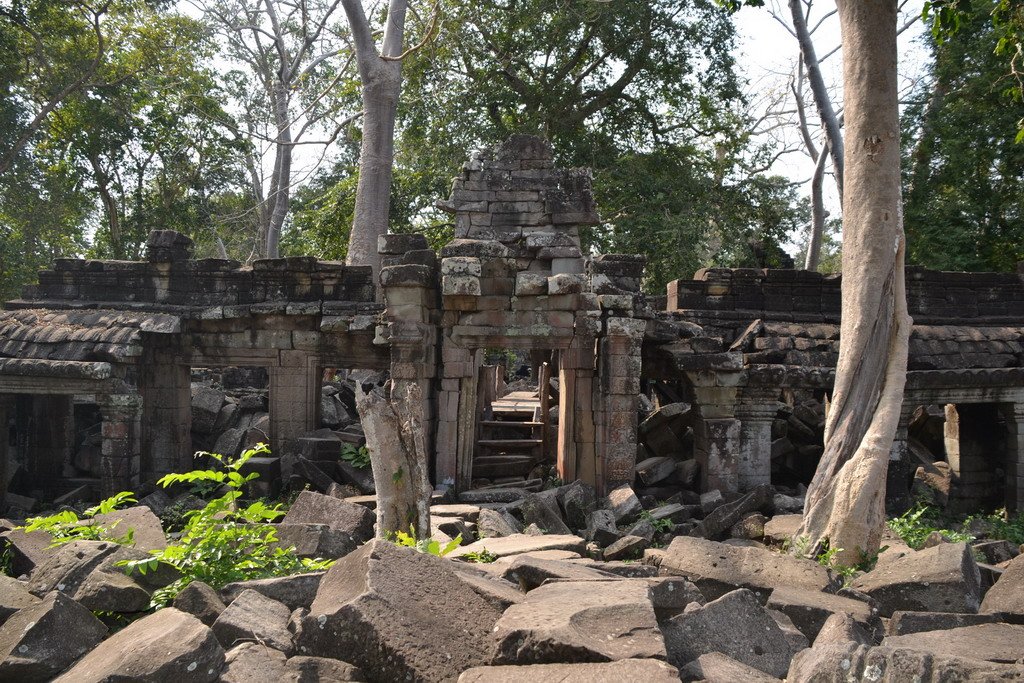
The central temple, enclosed within a laterite wall, is built on the Jayavarman VII pattern: a central sanctuary surrounded by concentric galleries and subsidiary shrines, with gopura (entrance towers) on each axis and the characteristic four-faced towers of Avalokitesvara rising from the prasats (tower-shrines). Of the original complement of towers, several survive intact or partly intact at Banteay Chhmar — among the most extensive remaining examples of this iconographic programme outside Angkor Thom. The outer gallery walls, where legible, carry bas-reliefs of exceptional quality: the multi-armed Avalokitesvara panels (the remaining in-situ examples show the Bodhisattva with 32 arms), naval battle scenes with Khmer and Cham vessels, scenes of Khmer daily life and processions, and depictions of the Buddhist hell realms. The forest has reclaimed much of the complex; mature trees grow through collapsed masonry, and several gallery sections remain inaccessible.
The site experience is substantially one of ruin: roofless galleries, collapsed vaults, and sections held up only by the root systems of the trees that have destabilised them. This is simultaneously the site's fragility and its great atmospheric power. The moat, still holding water on three sides, and the approach through the flat Cambodian plain give a strong sense of the original hydraulic landscape the Khmer engineers created here. The adjacent community homestay village offers the only local accommodation.
Practical information
- Entry fee: small fee payable at the site; community tourism programme operates a ticket booth
- Local guides: community-trained guides available at the site entrance; strongly recommended for orientation
- Accommodation: community homestay programme in Banteay Chhmar village; booking via the CBT (Community-Based Tourism) organisation
- Best time to visit: dry season November–April; roads can be difficult in wet season
- Photography: respectful photography permitted; do not climb on fragile structures
Getting there
Banteay Chhmar is approximately 60 km north of Sisophon (Serei Saophoan) on a road that has improved significantly in recent years but remains partly unpaved. Sisophon is reachable by bus from Siem Reap (approximately 2.5 hours) and from Phnom Penh (approximately 5 hours via Pursat). From Sisophon, shared taxis or hired tuk-tuks cover the road to Banteay Chhmar in approximately 1.5–2 hours depending on road conditions. The Community-Based Tourism programme in Banteay Chhmar village can assist with transport arrangements; contact via the organisation's Facebook page or local guesthouse referrals in Sisophon.
Nearby
- Angkor Thom and the Bayon: 170 km south-east; the metropolitan counterpart to Banteay Chhmar's provincial ambition, sharing the same iconographic programme of four-faced towers
- Ta Prohm: Siem Reap area; another Jayavarman VII funerary foundation, famously left partly consumed by forest — a more accessible analogue to the Banteay Chhmar experience
- Preah Khan: Siem Reap area; the largest Jayavarman VII foundation after Angkor Thom itself
- Poipet border crossing: 60 km south-west; the main Thai-Cambodian crossing; Banteay Chhmar is frequently combined with a Thai border itinerary
Sources
- Coedes, G. (1968). The Indianized States of Southeast Asia. University of Hawaii Press.
- Freeman, M. & Jacques, C. (2003). Ancient Angkor. River Books.
- Global Heritage Fund project documentation: Banteay Chhmar Conservation Programme (2003–2012).
- Wikipedia: Banteay Chhmar
- Wikipedia: Jayavarman VII
Find it on the map
See this place and what’s around it →📷 Become a Cultural Heritage Online photographer
Share your photos of places: they stay published under your name as the author. The more they're seen, the more you get noticed — and soon a contest will reward the most appreciated photos.
Log in or sign up free to add a photo