
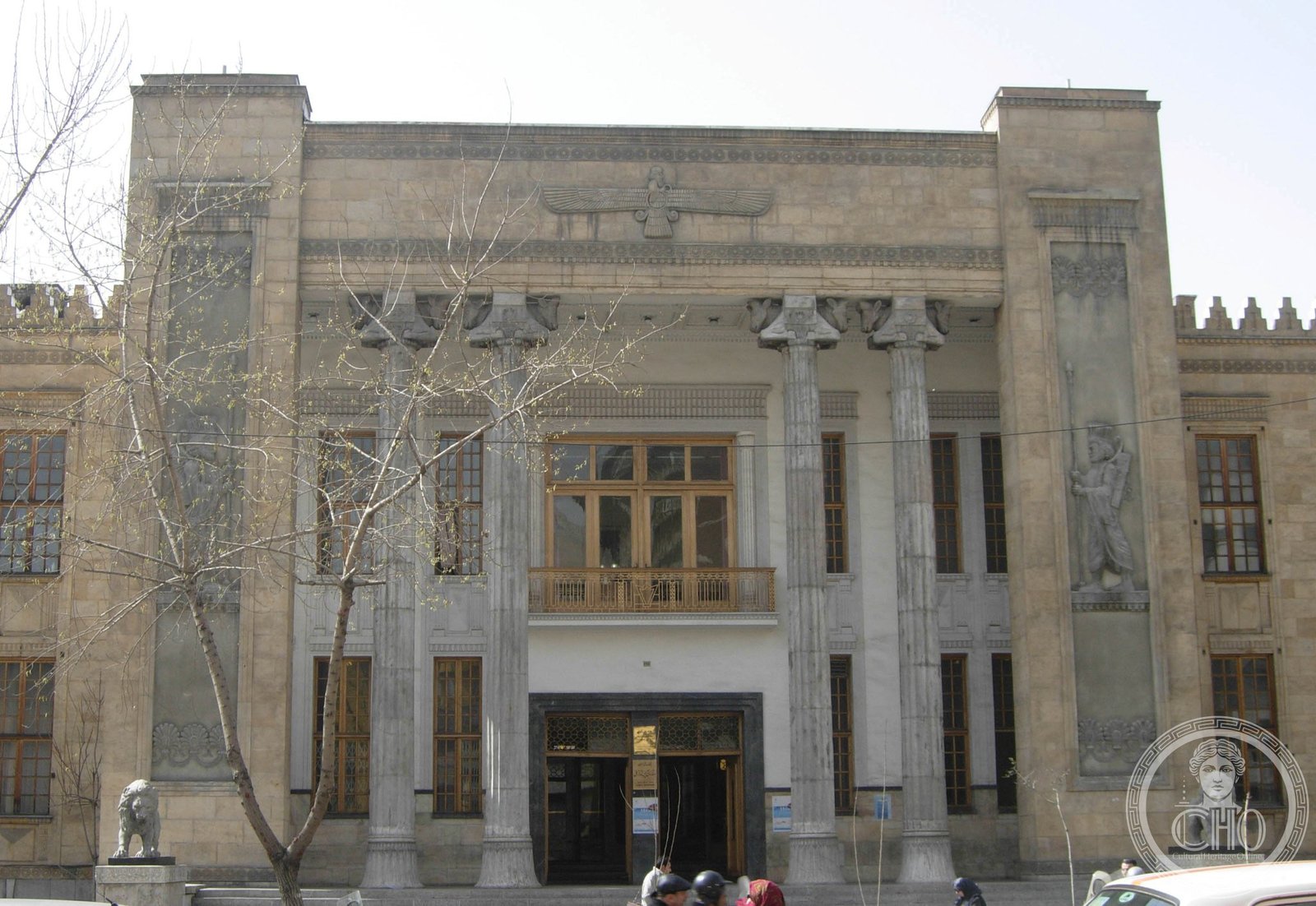
On a prominent corner of central Tehran, the original Bank Melli Iran headquarters stands as one of the most ambitious works of architectural synthesis in twentieth-century Iran. Designed by German architect Heinrich Moser and French-Armenian Gabriel Guévrékian and completed in 1937, the building was commissioned during Reza Shah’s sweeping modernization programme as a deliberate statement of national identity. Its steel-reinforced concrete frame is articulated through a vocabulary drawn simultaneously from Western Art Deco geometry and a deep repository of Persian ornament: Achaemenid column capitals support projecting cornices, muqarnas friezes ring the upper storeys, and Sassanid relief panels line the entrance loggia. The colour palette — warm limestone cladding offset by deep-carved shadow — reads as unmistakably Iranian even as the massing and setbacks follow 1930s international practice. The result is a rare monument where European modernity and Persian cultural continuity are held in genuine equilibrium, not pastiche.
At a glance
- Type
- Bank headquarters
- Period
- Completed 1937
- Style
- Art Deco / Persian Revival
- Location
- Ferdowsi Avenue, central Tehran, Iran
- Coordinates
- 35.6910° N, 51.4218° E
- Architect(s)
- Heinrich Moser (German); Gabriel Guévrékian (French-Armenian)
Overview
The Bank Melli Iran Building was constructed as the headquarters of Iran’s National Bank during the first Pahlavi period, a time of rapid top-down transformation. The building’s design brief was explicit: it had to project both modernity — reassuring foreign investors and diplomatic counterparts — and Persian heritage, affirming that Iran’s national bank was rooted in a great civilisation. The two European architects brought in by Reza Shah’s government fulfilled this dual mandate through a carefully layered architectural language, producing a headquarters that remains a reference point for subsequent Iranian attempts at identity-conscious modern architecture.
History
Bank Melli Iran was founded in 1927 as the first fully Iranian-owned national bank, replacing the British-controlled Imperial Bank of Persia as the country’s note-issuing institution. Reza Shah’s deliberate preference for German and French expertise over British involvement — a pattern visible across his infrastructure projects — led to the commission of Moser and Guévrékian in the early 1930s. Construction proceeded through 1937 under close state supervision. The building opened as a symbol of financial sovereignty at a moment when Iran was renegotiating oil concessions with Anglo-Persian and asserting independence on the world stage. It remained the bank’s central Tehran branch through the Islamic Republic period and is today designated a heritage property of Iran.
Architecture & Design
The facade is organized around a tripartite vertical scheme common to Art Deco civic architecture, but every major surface is modified by Persian ornamental systems. Muqarnas — the geometric stalactite vaulting associated with Seljuk and Safavid interiors — appear as carved stone friezes wrapping the cornice and entrance bay. Achaemenid-style column capitals derived from Persepolis are reinterpreted in reinforced concrete for the entrance portico. Sassanid-era relief motifs — winged figures and royal hunt scenes rendered in a flattened, linear idiom — run along the ground-floor spandrels. The overall massing retains the strict symmetry and bold horizontal banding of 1930s international modernism, making the Persian ornament read as applied cultural identity rather than structural logic, a deliberate choice that reflects the building’s political programme.
Cultural significance
The Bank Melli headquarters is a key document in the history of architectural nationalism in the twentieth century. It demonstrates how a state can instrumentalize architecture to project a dual image — modern and ancient, open and rooted — in a single building. The collaboration between a German, a French-Armenian, and the Iranian state also reflects the complex web of European expertise, anti-British geopolitics, and Persian cultural pride that shaped Reza Shah’s Iran. Later generations of Iranian architects — particularly during the 1960s and 1970s — returned to this building as a precedent when seeking to articulate a modern Iranian identity.
Visiting today
The building operates as a working branch of Bank Melli Iran on Ferdowsi Avenue, one of central Tehran’s principal commercial streets. Exterior viewing is unrestricted; the ornamental facades are best seen from the pavement directly opposite. The interior public banking hall retains decorative elements from the original construction. Ferdowsi Avenue is lined with historic coin and stamp dealers, making the area a destination for cultural and numismatic heritage tourism. No dedicated visitor centre; standard Iranian banking hours apply.
Getting there
The building stands on Ferdowsi Avenue (Khiaban-e Ferdowsi) in central Tehran, approximately 800 metres south of Tehran Grand Bazaar metro station (Line 7) and 1 km east of Imam Khomeini metro station (Lines 1 and 2). Bus lines serving Ferdowsi Avenue connect to the wider BRT network. Taxis from central Tehran landmarks take 5–15 minutes depending on traffic. Street parking is limited; public transport is recommended.
Sources & resources
Find it on the map
See this place and what’s around it →Record researched and written by Luigi De Marchi for Cultural Heritage Online, 2026.
📷 Become a Cultural Heritage Online photographer
Share your photos of places: they stay published under your name as the author. The more they're seen, the more you get noticed — and soon a contest will reward the most appreciated photos.
Log in or sign up free to add a photoIs this page about you?
This page is read by travellers and heritage enthusiasts who find it on Google. Tell us how you are connected to this place and we will take it from there.