
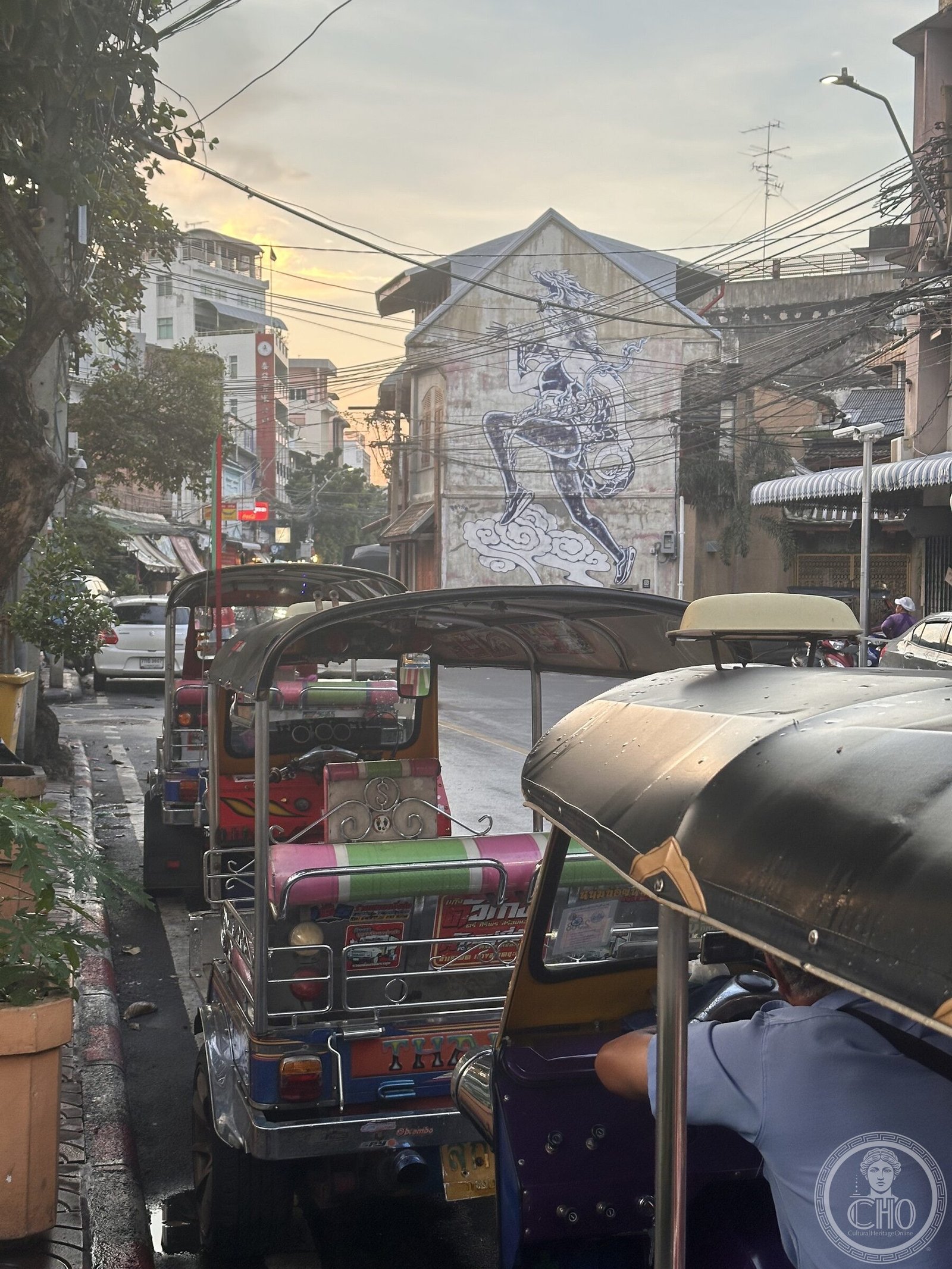
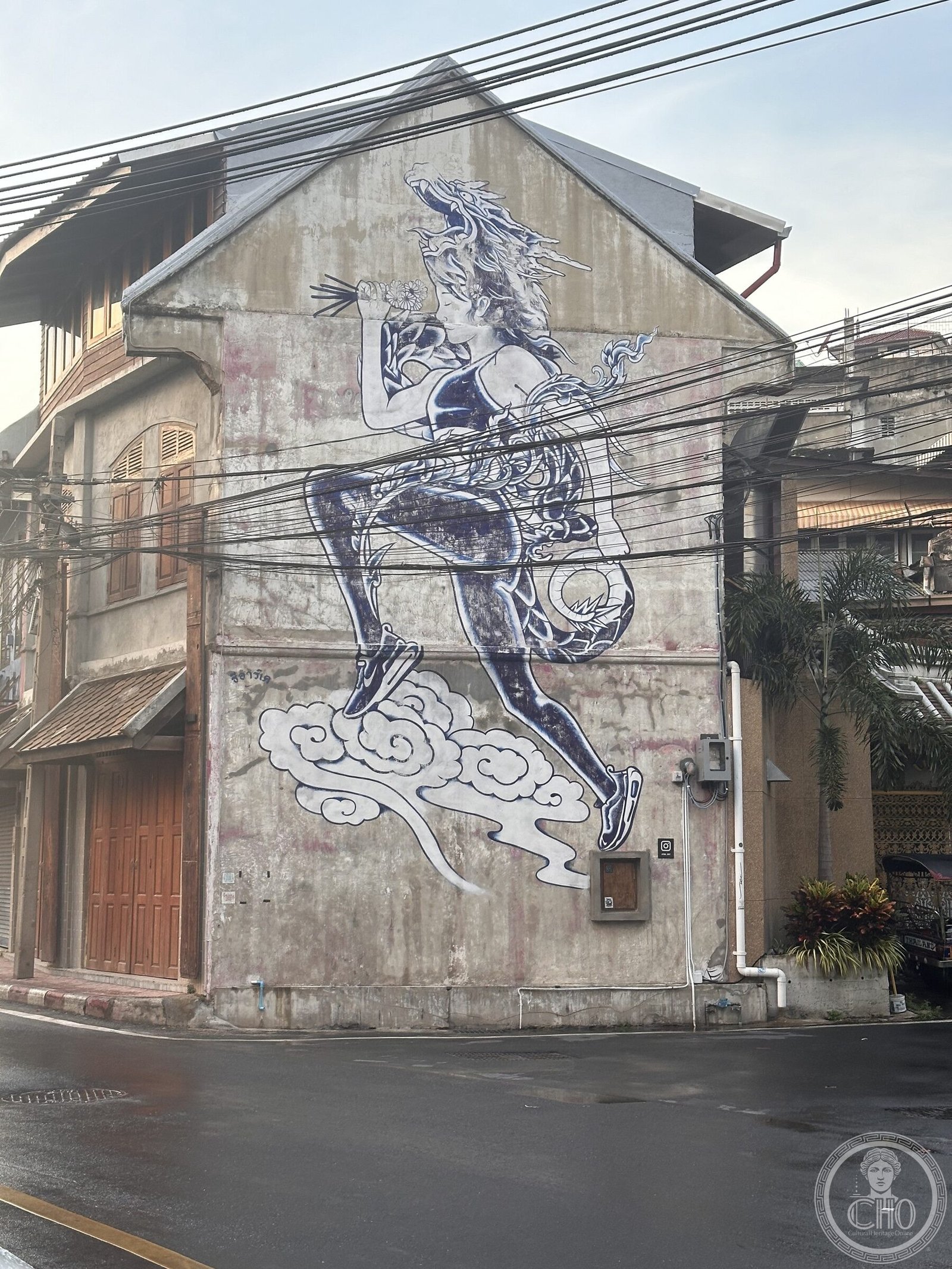
The sois flanking Wat Traimit and the Odeon Circle host Bangkok’s most concentrated outdoor mural collection — large-format paintings on century-old shophouse walls that fuse Thai temple iconography with the visual language of international street art.
At a glance
Bangkok’s urban mural movement gathered momentum in the early 2010s, when cultural groups and the Bangkok Metropolitan Administration began commissioning large-format works in historic neighbourhoods facing development pressure. The area around Wat Traimit — the Temple of the Golden Buddha — became one of the primary venues: the temple’s elevated precinct wall and the blank backs of its surrounding shophouses offered surfaces at a scale that few other Bangkok locations could match. The murals here draw on Rattanakosin iconography, the daily life of Chinese settlers, Buddhist imagery, and contemporary urban themes, producing a visual layer that reads in direct dialogue with the nineteenth-century temple architecture behind them.
Key facts
- Location: Sois around Wat Traimit, Charoen Krung Road, Yaowarat area
- Active from: c. 2013–present (ongoing programme)
- Scale: several multi-storey murals + dozens of smaller works
- Style: Thai figurative + urban realist + international street art
- Context: Old Town Revitalisation Programme, Bangkok Metropolitan Administration
- Best light: 07:00–09:00 (morning, no direct sun on north-facing walls) or overcast
History
The area around Wat Traimit is among the oldest settled parts of Bangkok’s Chinatown: the temple itself stands on a site occupied since before the founding of the Rattanakosin capital in 1782, and the surrounding sois filled with Chinese merchant shophouses during the nineteenth century. The principal attraction of Wat Traimit is its 5.5-tonne solid gold Sukhothai-era Buddha image, whose gold content was discovered in 1955 when the plaster cladding of what had appeared to be an ordinary stucco Buddha cracked during a relocation attempt.
The street art programme was initiated partly in response to the neighbourhood’s designation as a heritage area and partly in response to the demolition of older shophouses along the Charoen Krung Road extension in the late 2000s. The murals occupy the surviving fabric: gable ends, party walls, and the backs of shophouses facing the temple precinct. Several of the large-format works were painted by Thai artists with international reputations in the field; others were community projects involving local Chinatown residents.
The iconography of the murals overlaps deliberately with Wat Traimit’s history: the 1955 discovery of the golden Buddha appears in at least three separate works. Other murals document the Teochew and Hokkien community’s daily life in the early twentieth century: gold traders weighing ingots, riverboat workers loading rice barges, medicine shops dispensing remedies from ceramic jars.
What you see
The largest works appear on the north side of Charoen Krung Road between the Odeon Circle and Hua Lamphong MRT station: multi-storey compositions in ochre, crimson, and gold that adopt the palette of traditional Thai temple murals while rendering present-day scenes and historical vignettes. The choice of earth-red and gold is deliberate — these are also the colours of the Wat Traimit facade, which forms the visual backdrop when you look across the street from the mural walls.
Closer to the temple precinct, more intimate works occupy doorway-sized panels and the corrugated metal covers of electrical boxes. The textures are varied: some murals are painted directly onto the plaster face of pre-war shophouses, their edges following the cracks and ledges of a century-old building; others use the corrugated surface of metal shutters as a graphic element. Early morning light, when the sois are still quiet and the shadows long, brings out detail and colour that midday heat flattens into glare.
Practical information
- Public outdoor spaces — always accessible, no entry fee
- Best light for photography: 07:00–09:00 or on overcast days
- Walking surface: sois are uneven; wear closed-toe shoes
- Combine with: Wat Traimit visit (modest entry fee) + Chinatown morning market
- Estimated time: 1.5 hours for a complete walk
Getting there
MRT Blue Line, Hua Lamphong station, exit 1; walk 5 minutes west along Charoen Krung Road. Chao Phraya express boat to Ratchawong Pier (N5), then 10 minutes walk south-east. From Rattanakosin: tuk-tuk via Charoen Krung Road, 15 minutes. The murals are concentrated in a 400-metre radius around the Odeon Circle; Wat Traimit is at the south-east corner of the area.
Nearby
- Wat Traimit — Temple of the Golden Buddha, on site
- Bangkok Art Deco Chinatown — Yaowarat shophouse district, 5 minutes walk north
- Bangkok General Post Office — Art Deco landmark, 500 metres
- Hua Lamphong Heritage Railway Station — neoclassical terminus, 1910, 800 metres east
Sources
- Bangkok Metropolitan Administration. “Public Art Programme Bangkok Old Town,” 2015.
- Tourism Authority of Thailand. “Explore Bangkok’s Street Art,” 2022.
- Peleggi, Maurizio. “Thailand: The Worldly Kingdom.” Reaktion Books, 2007.
- Charoenwong Kasem Photography Archive, Wat Traimit documentation.
Gallery
Photographs by Luigi De Marchi.
Find it on the map
See this place and what’s around it →📷 Become a Cultural Heritage Online photographer
Share your photos of places: they stay published under your name as the author. The more they're seen, the more you get noticed — and soon a contest will reward the most appreciated photos.
Log in or sign up free to add a photo