
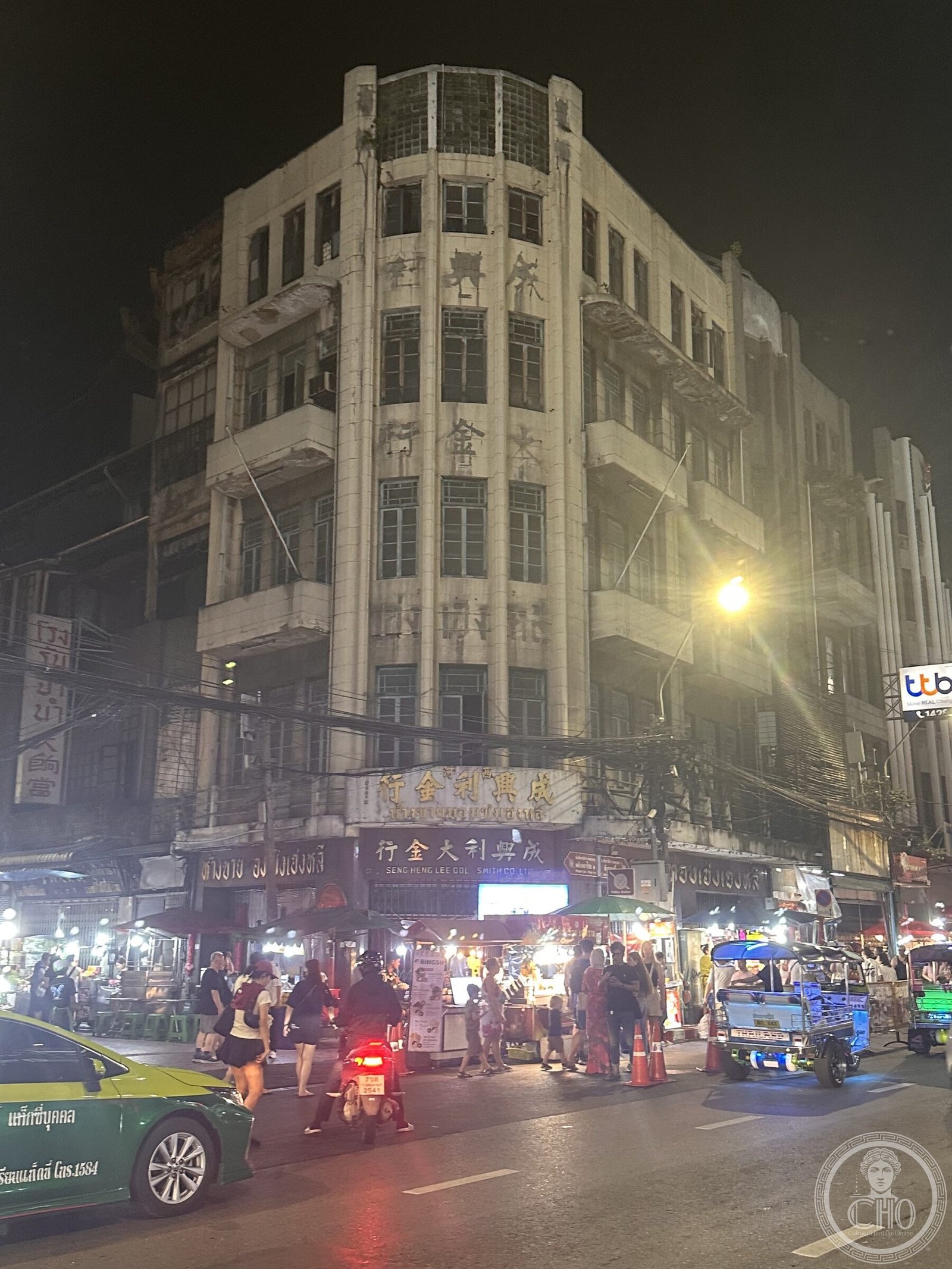
Along Yaowarat Road and its tributary sois, Bangkok’s Chinatown preserves one of Southeast Asia’s most coherent Art Deco streetscapes — a fusion of Chinese shophouse typology and the geometric ornament that swept commercial architecture across Asia in the 1920s and 1930s.
At a glance
The Samphanthawong district — Bangkok’s Chinatown, universally known by its main artery Yaowarat Road — grew from a Chinese merchant settlement established when Rama I relocated the community from the Rattanakosin site in 1782. By the 1920s it had become a dense commercial quarter of three to five-storey shophouses. The Art Deco wave that followed the 1932 constitutional revolution left its mark here in new facades: stepped parapets, geometric tile-work, sun-burst reliefs in plaster, and Chinese character panels framed in Modernist borders, all grafted onto the traditional five-foot-way arcade and narrow plot of the Thai-Chinese shophouse.
Key facts
- Style: Chinese Art Deco / Siam Renaissance, 1920s–1950s
- Location: Yaowarat Road and sois, Samphanthawong district, Bangkok
- Chinese settlement from: 1782, relocated by royal command
- Notable landmarks: Bangkok GPO (1940), Odeon Circle, Yaowarat shophouse rows
- Bangkok GPO: Charoen Krung Road, 1940 — monumental Art Deco government building
- Best time to visit: Early morning (08:00–10:00) before heat and crowds
History
Bangkok’s Chinese community traces its presence in the Yaowarat area to 1782, when King Rama I granted the land along the Chao Phraya to the Chinese merchants who had been displaced from the Rattanakosin site when the new royal city was laid out. By the mid-nineteenth century, Yaowarat Road had become the commercial spine of the district, lined with the traditional Hokkien and Teochew shophouses that the southern Chinese communities had built across Southeast Asia.
The architectural shift toward Art Deco began in earnest after the Siamese Revolution of 1932, which ended absolute monarchy and opened the country more fully to international design currents. Chinese immigrant builders and their patrons, by then prosperous Bangkok merchants, adopted the stepped parapets, terrazzo floors, and geometric ornamental programmes of the international modern style. They applied these elements to the established shophouse format — a two-to-five storey building with a ground-floor arcade open to the pavement — producing a building type unique to Southeast Asia’s Chinese commercial districts.
The Bangkok General Post Office on Charoen Krung Road (1940) represents the institutional register of the same moment: a large government building in buff limestone with a symmetrical Art Deco massing, classical pilasters updated with geometric capitals, and an entrance lobby whose proportions recall the monumental GPO buildings that the British colonial administration built across Asia in the same decade.
What you see
Walking south along Yaowarat Road, the shophouse facades form an almost continuous frieze of Art Deco motifs: zigzag cornices, moulded sun-bursts, Chinese character panels in raised plaster, and the terracotta tiles that Chinese craftsmen imported by the shipload during the 1930s. The Odeon Circle roundabout marks the boundary with the Wat Traimit precinct, where the architecture shifts from commercial to religious. The gold lettering on shopfront fascias — jewellers, gold traders, and herbalists still dominate Yaowarat — glows particularly well at dusk against the greying stone facades.
The Bangkok GPO’s monumental entrance portico still processes hundreds of parcels daily under its original coffered ceiling. The building’s scale — it occupies an entire block facing the river — makes it visible from the Chao Phraya express boats, its limestone bulk in deliberate contrast to the timber shophouses that surround it on the landward side.
Practical information
- Chinatown streets: active 08:00–midnight; busiest 18:00–22:00 (food stalls)
- Bangkok GPO: Mon–Fri 08:00–17:00, Sat 08:00–12:00
- Self-guided walk: 2–3 hours for Yaowarat + GPO + Odeon Circle
- Chinese New Year: the district is magnificently decorated but extremely crowded
- Food: some of Bangkok’s best roast duck, dim sum, and shark-fin soup along Yaowarat
Getting there
MRT (subway) Blue Line, Hua Lamphong station, exit 1; Yaowarat Road is 7 minutes walk west. Chao Phraya express boat to Ratchawong Pier (N5); Yaowarat is 5 minutes walk east. From Rattanakosin: 15 minutes by tuk-tuk via Charoen Krung Road. Taxis are available but traffic along Yaowarat itself is frequently gridlocked in the evening.
Nearby
- Wat Traimit — Temple of the Golden Buddha, 800 metres south-east of Odeon Circle
- Bangkok General Post Office — Art Deco landmark, 400 metres from Yaowarat Road
- Rattanakosin Historic Quarter — royal temples and Grand Palace, 20 minutes by boat
- Hua Lamphong Heritage Railway Station — neo-Italian railway terminus, 1910, 1 km
Sources
- Askew, Marc. “Bangkok: Place, Practice and Representation.” Routledge, 2002.
- Tourism Authority of Thailand. Chinatown Heritage Map, 2019.
- Bangkok Metropolitan Administration. “Yaowarat Streetscape Conservation Plan,” 2010.
- Fine Arts Department of Thailand. “Listed Buildings: Samphanthawong District,” 2015.
Gallery
Photographs by Luigi De Marchi.
Find it on the map
See this place and what’s around it →📷 Become a Cultural Heritage Online photographer
Share your photos of places: they stay published under your name as the author. The more they're seen, the more you get noticed — and soon a contest will reward the most appreciated photos.
Log in or sign up free to add a photo