
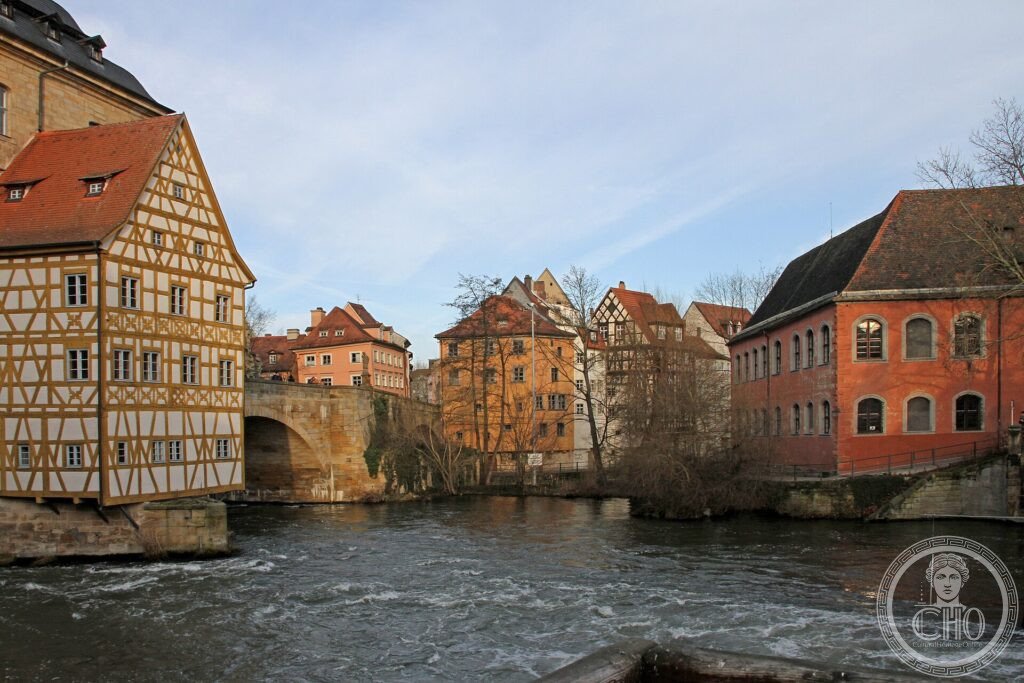
Scampata quasi indenne alle guerre, Bamberg conserva un tessuto urbano che attraversa mille anni: il Duomo imperiale con il celebre Cavaliere di pietra, il municipio vecchio piantato in mezzo al fiume, le case dei pescatori della “Piccola Venezia”. Una città che Heinrich II volle come seconda Roma.
At a glance
Bamberg, in Upper Franconia, is one of the best-preserved historic towns in Germany, spread across seven hills and the valley of the Regnitz. Founded as a bishopric by Emperor Henry II in 1007, it kept its medieval street plan and grew through the Baroque without losing its older fabric. The Imperial Cathedral, the old town hall set on an island in the river, and the riverside fishermen’s houses of “Little Venice” survive intact. The entire old town was inscribed by UNESCO in 1993.
Key facts
- UNESCO: World Heritage since 1993
- Founded as a diocese: 1007, by Emperor Henry II (Heinrich II)
- Bamberg Cathedral: four-towered, rebuilt in the 13th century, late Romanesque–early Gothic
- Bamberg Horseman (Bamberger Reiter): a celebrated equestrian statue of c. 1235, the first monumental rider sculpture since antiquity
- Altes Rathaus: the old town hall, built on an artificial island in the Regnitz
- Preservation: escaped major destruction in the Second World War
History
Bamberg rose to prominence in 1007 when Henry II, later canonised, made it the seat of a new diocese, intending it as a centre of empire and faith. The cathedral he founded was rebuilt after fires in the 13th century in the transitional style between Romanesque and Gothic. The town prospered as an ecclesiastical principality ruled by its prince-bishops.
In the Baroque era the Schönborn bishops reshaped Bamberg with palaces and churches, often by the architect Balthasar Neumann and the Dientzenhofer family, layering grandeur onto the medieval core. Because the town survived the Second World War largely undamaged, this thousand-year accumulation of buildings remains legible street by street.
What you see
On the cathedral hill, the four-towered Dom holds the Bamberg Horseman, the tombs of Henry II and his empress Kunigunde by Tilman Riemenschneider, and a papal grave. Across the way the New Residence and its rose garden look out over the roofs. Down in the valley, the Altes Rathaus straddles the Regnitz on its own island, its walls covered in painted frescoes.
Along the water, the timber-framed former fishermen’s houses of Klein-Venedig lean over the current — the image most visitors carry away.
Practical information
- Cathedral: free to enter; the Diocesan Museum charges admission
- Time needed: a full day to walk the cathedral hill and the riverside town
- Local speciality: Rauchbier, the smoked beer brewed in the town
- Note: the old town is hilly and cobbled; comfortable shoes help
Getting there
Bamberg lies in northern Bavaria on the line between Nuremberg and Würzburg/Leipzig, with frequent direct trains. From the station it is about a 15-minute walk to the old town and the river. GPS: 49.8917° N, 10.8853° E.
Nearby
- Vierzehnheiligen — Balthasar Neumann’s pilgrimage basilica, about 25 km north
- Nuremberg — the great Franconian city, under an hour by train
- Franconian Switzerland — a region of crags, caves and castles east of the town
Sources
- UNESCO World Heritage Centre — “Town of Bamberg” (ref. 624)
- Stadt Bamberg — official city and World Heritage office
- Encyclopaedia Britannica — Bamberg
Find it on the map
See this place and what’s around it →📷 Become a Cultural Heritage Online photographer
Share your photos of places: they stay published under your name as the author. The more they're seen, the more you get noticed — and soon a contest will reward the most appreciated photos.
Log in or sign up free to add a photo