

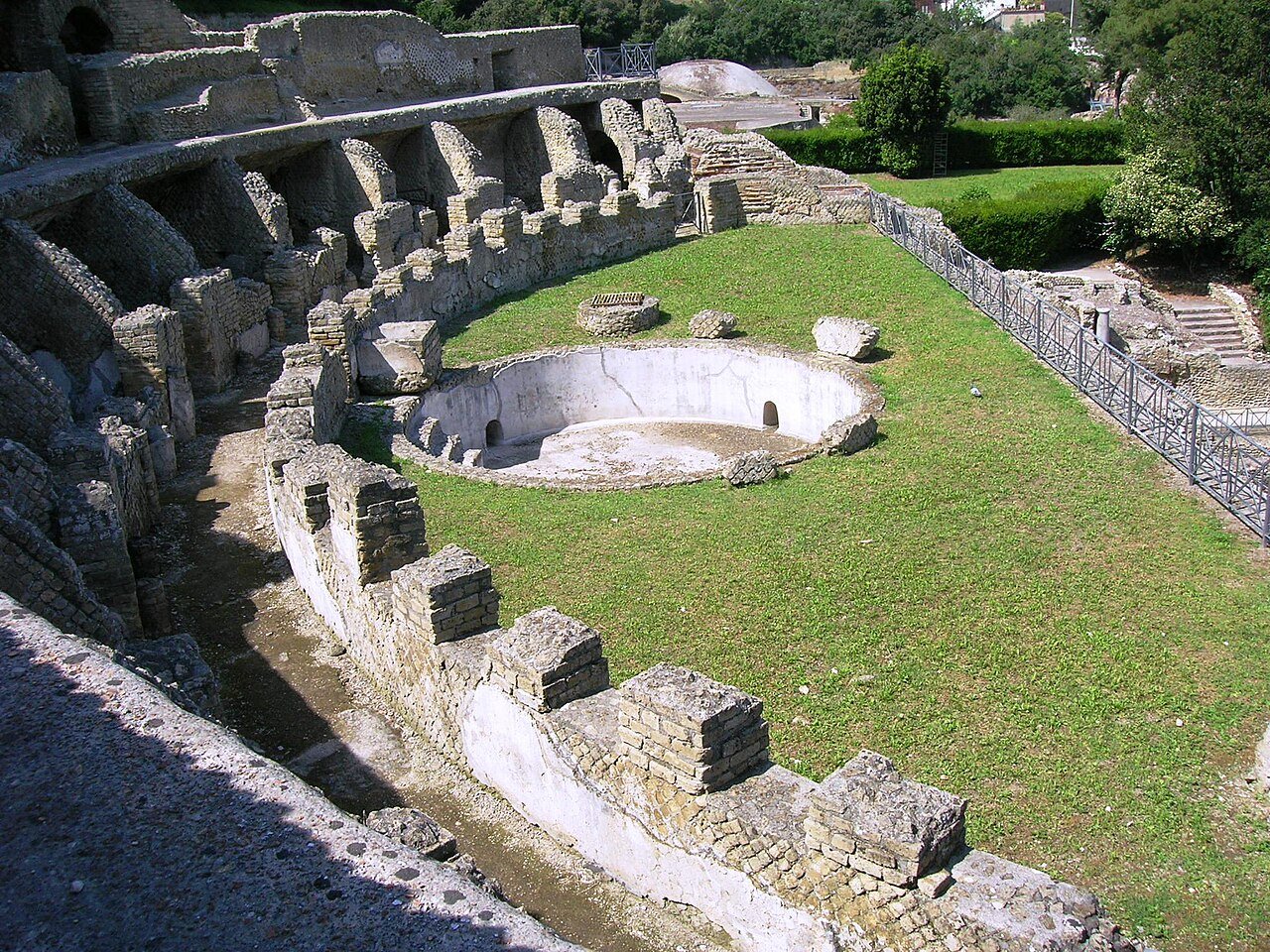
Two to eight metres beneath the surface of the Bay of Pozzuoli lie the ruins of Baiae — the most fashionable resort town of the Roman world, where Caesar, Augustus, Nero, and Hadrian kept villas, submerged by the volcanic ground movement of the Phlegraean Fields over two millennia.
At a glance
Baiae was the most fashionable resort town of the Roman world. At its peak in the 1st to 2nd centuries AD, the coastline of the Bay of Pozzuoli was lined for approximately 3 km with the terraced villa complexes of Rome’s aristocracy, heated by the volcanic hot springs of the Phlegraean Fields caldera. Horace called it the greatest bay in the world. Julius Caesar, Augustus, Nero, and Hadrian all maintained villas here; Cicero and Lucullus had summer homes. The city now lies 2 to 8 metres below the surface of the Bay of Pozzuoli, submerged by the slow volcanic ground movement (bradyseism) of the Phlegraean Fields caldera, which has alternately raised and lowered the local coastline by several metres over the past two thousand years. The underwater archaeological park, established in 2002, makes the submerged ruins accessible to snorkellers, scuba divers, and glass-bottomed boat tours.
Key facts
- Active period: c. 200 BC to 8th century AD
- Submersion cause: Bradyseism (slow volcanic uplift and subsidence) of the Phlegraean Fields caldera
- Current depth: 2 to 8 metres below sea level
- Underwater park established: 2002
- Location: Northwestern shore of the Bay of Naples, Bacoli municipality, Campania
- Distance from Naples: Approximately 20 km west
- Onshore museum: National Archaeological Museum of the Phlegrean Fields (Castello di Baia)
History
From the late Roman Republic through the Imperial period, Baiae was the resort destination of Rome’s elite. The thermal springs of the Phlegraean Fields had been exploited since at least the 2nd century BC, and by the 1st century BC the coastline had become the most concentrated display of luxurious private architecture in the ancient world. The villas were remarkable: multi-storey maritime residences with heated bathing pools cooled by seawater, underground heated chambers, fish ponds stocked with moray eels and sea bream, and sea-facing porticoes. Horace wrote: nullus in orbe sinus Baiis praelucet amoenis (no bay in the world shines more brightly than lovely Baiae). Julius Caesar maintained his principal villa here; Caligula had engineers build a floating bridge of boats across the bay to fulfil a prophecy that he would no more become emperor than ride across it on horseback.
The same volcanic activity that made Baiae desirable ultimately destroyed it. The Phlegraean Fields caldera is a supervolcanic system covering approximately 100 square kilometres that periodically rises and falls as magma pressures change underground. Between the 4th and 8th centuries AD, the ground beneath the northern Bay of Naples subsided by several metres, gradually submerging the coastal villas. By the 8th century AD the waterfront districts were entirely underwater. Systematic underwater archaeological investigation began in the 1950s; the Parco Sommerso di Baia was formally established as a protected marine archaeological area in 2002.
What you see
The visible underwater remains include marble mosaic floors still in situ on the seabed, the bases and drums of villa portico columns, fish-pond walls, water pipes, fragments of painted stucco, and the colossal torso of a statue of Ulysses. The submerged ruins are distributed across approximately 1.76 square kilometres at depths between 2 and 15 metres, accessible to snorkellers in shallower sections and to scuba divers throughout. Glass-bottomed boat tours from Baia harbour provide views of the mosaic floors without diving equipment.
On shore, the Castello di Baia houses the Museo Archeologico dei Campi Flegrei, displaying finds including cast reproductions of statuary left in situ, inscriptions, bronze fittings, and models of the villa complexes. The so-called Temple of Mercury — a domed structure visible above the waterline — is actually an ancient Roman thermal bath; its intact concrete dome is one of the oldest surviving domed structures in the world, predating the Pantheon.
Practical information
- Underwater park: Glass-bottomed boat tours year-round from Baia harbour; guided snorkelling and scuba diving by appointment with licensed operators
- Onshore museum: Museo Archeologico dei Campi Flegrei, Castello di Baia — open Tuesday to Sunday
- Best season: May to October for diving and snorkelling; glass-bottomed boats run year-round
- Equipment: Dive operators provide full equipment hire; mask and fins sufficient for snorkelling sections
Getting there
Baiae is in the municipality of Bacoli, approximately 20 km west of Naples. By public transport: Cumana railway from Naples Montesanto station to Fusaro or Lucrino (40 to 50 minutes), then local bus or taxi to Baia harbour. By car: A56 motorway toward Pozzuoli then SP1 via Bacoli; parking available near the harbour. The nearest airport is Naples Capodichino (NAP), approximately 35 km east.
Nearby
- Pozzuoli: Ancient Puteoli, the main commercial port of Republican Rome; the Serapeum macellum has columns showing clear evidence of bradyseism-driven inundation
- Cumae: The oldest Greek colony on the Italian mainland (c. 740 BC), site of the Cumaean Sibyl’s cave and sanctuary of Apollo
- Lago d’Averno: The volcanic crater lake the Romans identified as the entrance to the Underworld, where Aeneas descends in Virgil’s Aeneid
- Herculaneum: The AD 79 eruption site, approximately 25 km southeast
Sources
- Parco Sommerso di Baia. baiasommersa.it
- Museo Archeologico dei Campi Flegrei. campiflegrei.beniculturali.it
- Wikipedia contributors. Baiae. en.wikipedia.org/wiki/Baiae
- D’Arms, John H. Romans on the Bay of Naples. Harvard UP, 1970.
Find it on the map
See this place and what’s around it →📷 Become a Cultural Heritage Online photographer
Share your photos of places: they stay published under your name as the author. The more they're seen, the more you get noticed — and soon a contest will reward the most appreciated photos.
Log in or sign up free to add a photo