
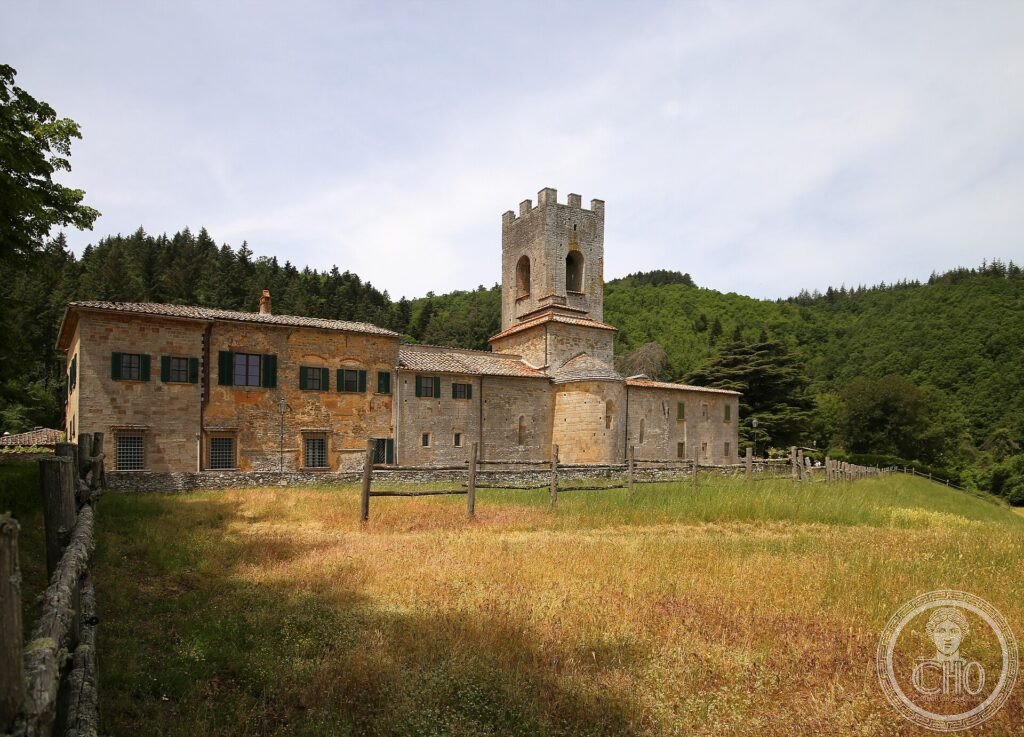
La Badia a Coltibuono — 'badia' per l'abbazia vallombrosana, 'coltibuono' per il “buon coltivo” che i monaci ricavarono dal bosco — è uno dei luoghi più emblematici del Chianti: un'abbazia romanica del XI secolo che produce vino da quasi mille anni e dove i Stucchi Prinetti custodiscono la tradizione con lo stesso scrupolo dei monaci benedettini che li precedettero.
At a glance
Badia a Coltibuono is located at 620 m altitude in the forested hills of the Chianti Classico zone, 4 km above Gaiole in Chianti (Siena), entirely surrounded by oak and chestnut woodland that the Vallombrosan monks cleared between the 11th and 13th centuries to create vineyards, olive groves, and farmland. The name means “good cultivation” (buon coltibuono), referring to the monks' agricultural work. The founding document is a gift of land to the Vallombrosan order recorded in 1049; the current buildings (Romanesque tower, church, cloister, chapter house, refectory, dormitory) date from the 11th–12th centuries, with later modifications. The monastery was suppressed in 1810 under Napoleon; in 1846 it was purchased by the Florentine banker Michele Giuntini, whose descendants the Stucchi Prinetti family manage it today as a wine estate (Chianti Classico, Vin Santo, olive oil) with a restaurant and agriturismo. The church is still used for weddings and concerts; tours of the wine cellars and the Romanesque buildings are available.
Key facts
- Founded: 1049 (founding document); Vallombrosan order (reform Benedictine order founded by Giovanni Gualberto in 1036 at Vallombrosa); active until 1810 (Napoleonic suppression)
- Architecture: Romanesque tower (11th–12th c.); cloister with round arches on simple columns (12th c.); church of San Lorenzo (12th c., with frescoes); chapter house; refectory; all in Chianti sandstone (alberese)
- Wine: Badia a Coltibuono is one of the historic Chianti Classico estates; vineyards on the estate include Sangiovese and other Chianti Classico varieties on the estate historic vineyards; cellar tours and tastings available
- Lorenza de' Medici: the estate became internationally known through the cooking school and books of Lorenza de' Medici (wife of Piero Stucchi Prinetti), who promoted Tuscan cuisine internationally in the 1980s–2000s
- Restaurant: Ristorante Badia a Coltibuono (in the monastery buildings); seasonal Chianti cuisine; reservations essential
History
The Vallombrosan order, founded by Giovanni Gualberto near Florence in 1036, was one of the reform monastic movements that swept 11th-century Italy. Gualberto, a Florentine nobleman who had witnessed a murder in the streets of Florence and tried (and failed) to avenge it, withdrew to the monastery of San Miniato al Monte, then to Camaldoli, and finally to the beech forests of Vallombrosa where he established a community based on strict observance and manual labour. The Vallombrosans spread quickly through Tuscany, Emilia-Romagna, and Lombardy; the foundation at Coltibuono in 1049 was part of this expansion into the Chianti hills. The monks cleared the surrounding forest, drained the marshes, planted vineyards and orchards, and built the Romanesque complex that still defines the estate's architectural character.
The monastery flourished through the 12th–13th centuries, accumulating landholdings across the Chianti zone. It was periodically in conflict with the nearby Ricasoli and Firidolfi families, the Chianti's dominant feudal clans, but generally maintained its position as the largest landholder in the immediate area. After the Napoleonic suppression in 1810, the buildings passed through several hands before being purchased by Michele Giuntini in 1846; the Stucchi Prinetti family (Giuntini's descendants) have managed the estate ever since.
What you see
The approach through the chestnut and oak forest to Badia a Coltibuono is one of the most quietly atmospheric in the Chianti: the road climbs from Gaiole through woodland that still has the character the monks maintained. The complex appears suddenly at a curve — the Romanesque tower dominant, the church facade behind, the farm buildings and cellars extending on the right. The church of San Lorenzo is Romanesque, with a single nave, painted barrel vault (18th century, with earlier fresco fragments), and carved stone altar. The cloister, entered from the church's north side, has simple round arches on short columns; the chapter house opens off the east walk. The wine cellars, in the monastery's lower level, contain thousands of bottles aging in the dark beneath the medieval walls.
Practical information
- Restaurant: Ristorante Badia a Coltibuono; lunch and dinner; seasonal Tuscan menu; reservations strongly advised; badiacoltibuono.com
- Winery tours: available with advance booking; cellar visit + tasting of Chianti Classico and Vin Santo
- Agriturismo: rooms available in the monastery buildings; pool; olive oil and wine shop
- Opening hours: estate open daily; restaurant closed Monday; winery shop open daily 09:00–18:00
Getting there
By car from Gaiole in Chianti (4 km uphill): local road signed to Badia a Coltibuono; steep but paved. By car from Siena (20 km north): SS408 to Gaiole, then up. GPS: 43.4778° N, 7.6669° E.
Nearby
- Gaiole in Chianti — 4 km below; medieval borgo; Chianti Classico wine producers; L'Eroica vintage cycling event (October)
- Brolio Castle — 8 km south; home of the Barone Ricasoli family; credited with defining the modern Chianti Classico formula; open daily
- Siena — 20 km south; UNESCO historic centre; Piazza del Campo and Palazzo Pubblico; Palio (July and August)
Sources
- Wikipedia — “Badia a Coltibuono” (en.wikipedia.org/wiki/Badia_a_Coltibuono)
- Badia a Coltibuono official website — badiacoltibuono.com
- Caby, C., De l'eremitisme rural au monachisme urbain, Roma 1999 (Vallombrosan order history)
Find it on the map
See this place and what’s around it →📷 Become a Cultural Heritage Online photographer
Share your photos of places: they stay published under your name as the author. The more they're seen, the more you get noticed — and soon a contest will reward the most appreciated photos.
Log in or sign up free to add a photoIs this page about you?
This page is read by travellers and heritage enthusiasts who find it on Google. Tell us how you are connected to this place and we will take it from there.