
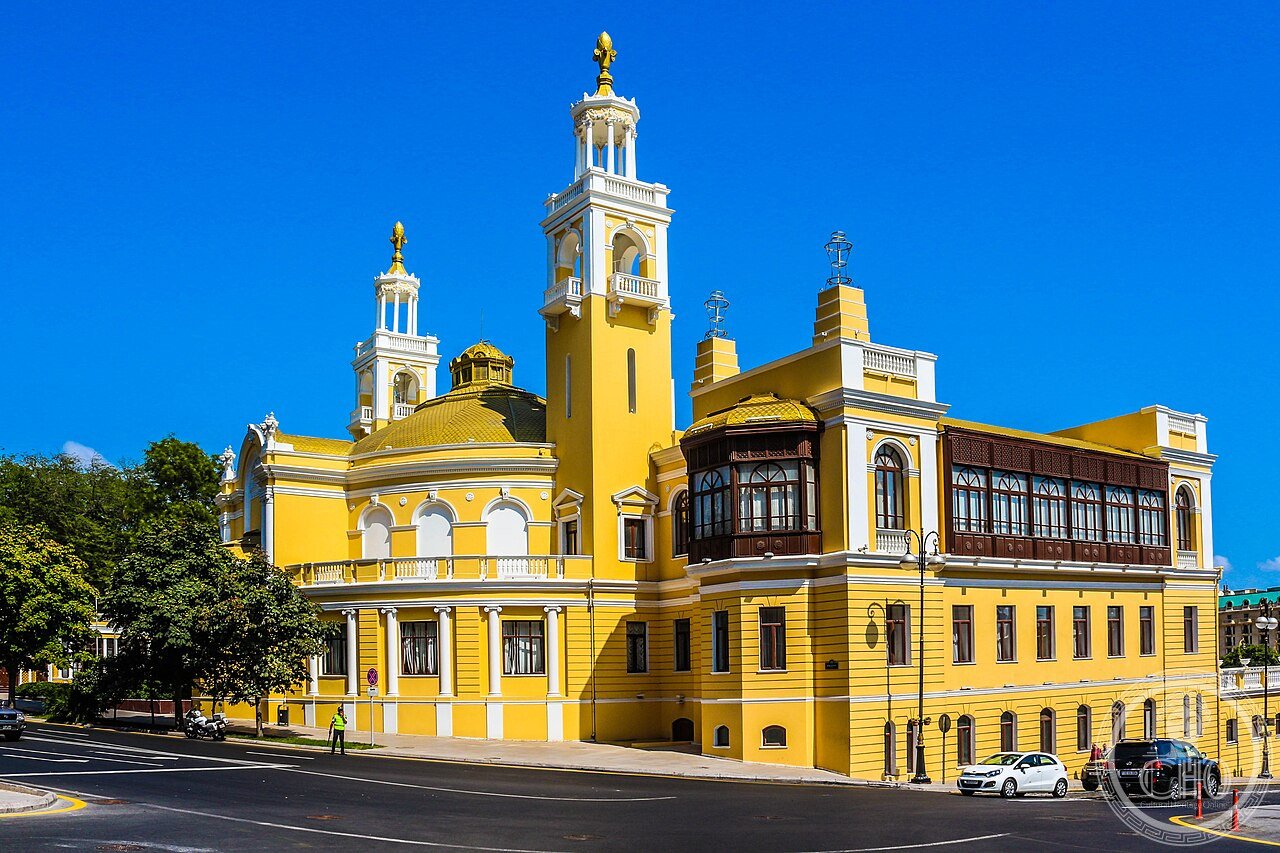
A grand French Renaissance concert hall built in 1912 at the height of Baku’s oil-boom era, designed by Polish architect Jozef Plosko for the city’s merchant-oil aristocracy.
At a glance
- Type
- Concert Hall
- Period
- 1912
- Style
- French Renaissance Revival
- Location
- Baku Boulevard, Baku, Azerbaijan
- Coordinates
- 40.3756, 49.8372
- Architect
- Jozef Plosko
Overview
The Azerbaijan State Philharmonic Hall in Baku is a grand French Renaissance concert hall built in 1912 during the Azerbaijani oil boom, when the city’s merchant-oil aristocracy competed to build palaces and civic monuments to rival Paris and Vienna. Designed by Polish architect Jozef Plosko, the building stands at the edge of Baku’s historic center overlooking the Caspian Sea from the city’s famous Boulevard. Its elaborately ornamented facade, colonnaded entrance, and finely preserved acoustic interior make it one of the most beautiful buildings in the South Caucasus. Today it serves as the home of the Azerbaijan State Philharmonic Orchestra, hosting classical concerts, opera performances, and international festivals.
History
Baku at the turn of the twentieth century was one of the wealthiest cities in the Russian Empire, its fortunes built on the oil fields of Absheron Peninsula that supplied half the world’s petroleum. The new oil aristocracy – families like the Taghiyevs, Nagiyevs, and Asadullayevs – invested their fortunes in civic buildings meant to signal Baku’s place among the great European cities. The building that would become the Philharmonic Hall was commissioned in 1910 as the Winter Club, a private social venue for Baku’s elite, and completed in 1912. After the Soviet takeover of Azerbaijan in 1920, the building was nationalized and converted into the primary concert venue for the new Azerbaijani Soviet Republic. It became the stage for premiering works by Uzeyir Hajibeyov (composer of the first opera in the Muslim world), Fikret Amirov, and Gara Garayev – the founding figures of Azerbaijani classical music. The hall was officially named the State Philharmonic Hall and remains the most prestigious concert venue in the country.
Architecture and Design
Jozef Plosko drew on French Renaissance and Beaux-Arts precedents for the design, giving the building a grandeur appropriate to its social ambitions. The main facade features a central colonnaded entrance flanked by paired pilasters, elaborate stucco ornamentation on every surface, and wrought-iron lanterns at the entrance portal. The roofline is animated by balustrades, urns, and sculptural details in the Parisian manner. The interior concert hall preserves its original acoustic geometry – a deep horseshoe arrangement with tiered balconies, ornate plasterwork ceilings, and a generous stage. The building sits within Baku’s UNESCO-listed Icherisheher (Old City) buffer zone and faces the Caspian seafront promenade, framing views toward the water from its colonnaded terrace.
Cultural significance
The Philharmonic Hall is the symbolic center of Azerbaijani classical musical culture. It hosted the premieres of Uzeyir Hajibeyov’s Leyli and Majnun in 1908 (considered the first opera composed in the Muslim world) and has been the primary venue for every major Azerbaijani musical premiere since. The building also represents the unique hybrid culture of Baku’s oil-boom era – a Muslim-majority society that built European-style civic institutions, employed European architects, and produced a generation of composers who fused Azerbaijani mugham modal tradition with Western symphonic forms. The hall’s survival through the Soviet period largely intact makes it an unusually authentic example of pre-revolutionary Caucasian civic architecture.
Visiting today
The Philharmonic Hall is an active concert venue and the exterior can be viewed freely at any time from the Boulevard promenade. Concert tickets are available through the Azerbaijan State Philharmonic Orchestra website and at the box office on the Boulevard. The main concert season runs from September through May. The building is located in Baku’s Sabail District at the northern end of the Caspian seafront promenade, a short walk from the Old City walls and the National Art Museum.
Getting there
The Philharmonic Hall is easily reached from central Baku. The nearest Baku Metro station is Icheri Sheher (Old City), approximately 10 minutes on foot along the Boulevard promenade. Bus lines 5, 6, and 88 stop nearby on Neftchilar Avenue. Taxis and ride-share services (Bolt, Uber) are widely available throughout central Baku. From Heydar Aliyev International Airport, the journey by taxi or airport bus takes approximately 30 minutes.
Sources and resources
Find it on the map
See this place and what’s around it →📷 Become a Cultural Heritage Online photographer
Share your photos of places: they stay published under your name as the author. The more they're seen, the more you get noticed — and soon a contest will reward the most appreciated photos.
Log in or sign up free to add a photoDo you manage this place?
This page is read by travellers and heritage enthusiasts who find it on Google. Keep it accurate — and make it work for you. Free for non-profit heritage institutions.