
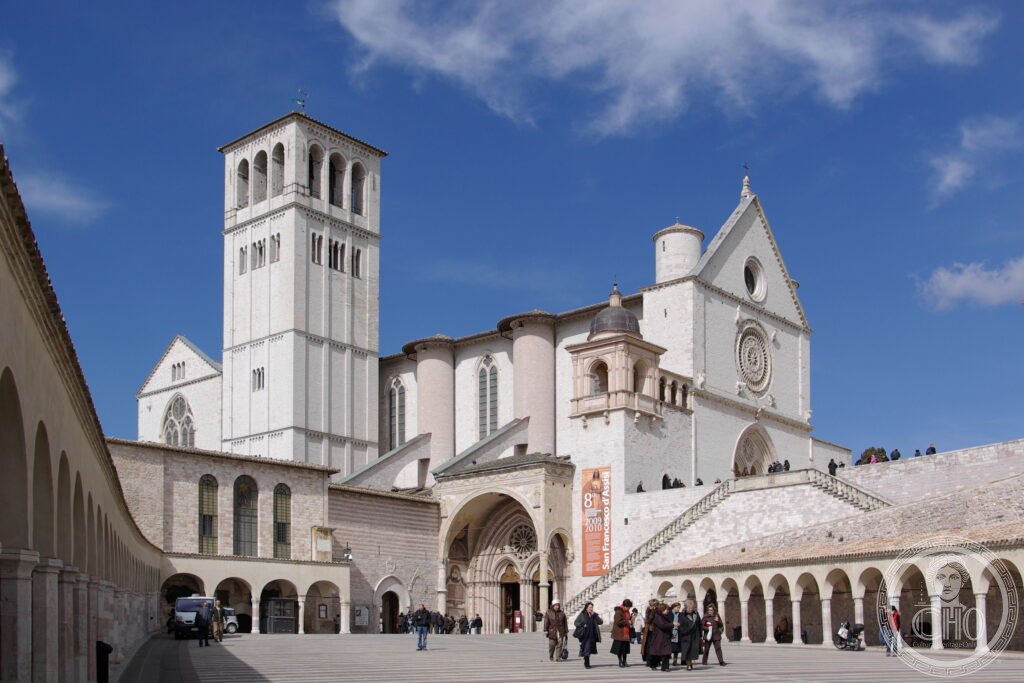
Assisi, Basilica di San Francesco

Assisi Basilica San Francesco Giotto frescoes 1228 upper lower church Francis stigmata Umbria pilgrimage UNESCO 2000
Basilica of Saint Francis of Assisi (Basilica di San Francesco d’Assisi), Assisi, Province of Perugia, Umbria, Italy. The west facade of the Upper Basilica (built 1228–1253 CE; consecrated 1253 CE; the rose window: the only surviving Cosmati-work stone rose window in central Italian church architecture; the Cosmati workshop that cut the rose window inserted geometric patterns in colored stone (porphyry and cipollino marble) into the white limestone matrix, a technique derived from the Roman opus sectile floor tradition applied to a window — unprecedented in 1230s Italian architecture). The Lower Basilica (the lower church; built from 1228 CE; the vaulted nave below the Upper Basilica) contains the tomb of Saint Francis (1182–1226 CE). The Basilica is the primary monument of the UNESCO serial inscription “Assisi, the Basilica of San Francesco and Other Franciscan Sites” (reference 990, inscribed 2000). Photo via Wikimedia Commons.
Assisi, Province of Perugia, Umbria, Italy · Built 1228–1253; Cimabue (c.1280), Giotto (c.1295–1300), Simone Martini (c.1322–1326); Pope Gregory IX commissioned 1228 CE; UNESCO WHS 2000 (ref 990)

Assisi, Basilica di San Francesco

The Basilica of Saint Francis of Assisi (UNESCO 2000) is the mother church of the Franciscan order, built over the tomb of Francis (1182–1226 CE) from 1228 onward, whose Upper Basilica Giotto fresco cycle depicting the Life of Saint Francis (c.1295–1300 CE) is the single most consequential cycle in the history of Italian painting — the first extended narrative cycle in Italian art to use naturalistic space, individualized gesture, and pictorial illusion as systematic tools, initiating the tradition that runs through Masaccio, Leonardo, and Michelangelo.

At a glance

Assisi Basilica (the most precisely AssisiBasilicaSanFrancesco serial Assisi Umbria Italy 43.0744 N 12.6035 E UNESCO WHS 2000 reference 990 serial 7 sites: the 7 inscribed sites are: the Basilica di San Francesco (the primary monument), the Sacro Convento (the friary adjacent to the basilica), the Rocca Maggiore (the medieval castle above the town), the Eremo delle Carceri (the hermitage in the forests above the Basilica), the Basilica di Santa Chiara (the church of Saint Clare), the Cathedral of San Rufino, and the Sanctuary of Rivotorto (the site of the original Franciscan community); the physical structure of the Basilica: the Basilica is in fact two churches stacked vertically (the Lower Basilica (chiesa inferiore): the older structure (begun 1228 CE); built into the hillside; the tomb of Saint Francis is in a crypt beneath the Lower Basilica floor (the tomb was rediscovered and opened in 1818 CE; the sarcophagus is visible in the crypt through iron screens); the vaults of the Lower Basilica are decorated with frescoes by Cimabue (c.1280 CE) and Simone Martini (c.1322–1326 CE; the Life of Saint Martin of Tours cycle is the most complete early 14th-century fresco cycle in Italy); the Upper Basilica (chiesa superiore): built above the Lower Basilica; the Gothic structure (the first fully Gothic church in central Italy; the ribbed vaults, the pointed arches, the flying buttresses are all Northern French Gothic features imported into Italy by the Master Builder Filippo da Campello; the Italian Gothic tradition that follows — Siena Cathedral, Santa Croce Florence, Santa Maria Novella Florence — all derive from the Assisi model); the Giotto frescoes in the Upper Basilica (c.1295–1300 CE; the 28 scenes of the Life of Saint Francis in the nave (the entire nave wall surface below the clerestory windows); the most studied single fresco cycle in Italian art history; the most-replicated fresco programme in 20th-century art history).

Key facts

  • Giotto’s Life of Saint Francis cycle (c.1295–1300) and why it changed the direction of Italian painting for the next 200 years: the 28 scenes (the scenes are arranged in two registers on the south, north, and west walls of the nave; the sequence runs clockwise from the south wall right to the north wall left; each scene is approximately 2.7m × 2.3m; the scenes are separated by painted stone-colored bands imitating architectural frames): the specific innovations in Giotto’s Assisi cycle (compared to the preceding Byzantine tradition (Duccio di Buoninsegna, Cimabue) and the concurrent Sienese tradition): (1) architectural space (for the first time in Italian painting, buildings in the background scenes are shown in three-quarter perspective, creating the illusion of a space that the figures inhabit rather than a surface they are pinned against; Scene 6 (Presepio di Greccio) shows an entire church interior in perspective, with the congregation visible inside — the first interior perspective in Western art); (2) physical weight (the figures in Giotto’s Assisi have mass — they stand on their feet (their feet are shown on the ground plane, not floating above it); they cast shadows; their drapery falls from their bodies under gravity; this is the first consistent application of depicted physical weight in the Italian painting tradition); (3) individual gesture (the bystanders in each scene have individual reactions to the central event: in Scene 14 (the Miracle of the Spring) a thirsty pilgrim drinks from the miraculous spring with a gesture of physical relief that has no precedent in Byzantine icon painting; the figures do things with their bodies that reflect what their minds are doing — the first consistent psychological characterization in Italian painting); (4) the specific scenes known by date: Scene 6 (Presepio di Greccio, the Christmas crib at Greccio; c.1296–1297 CE); Scene 13 (Nativity at Greccio; c.1296); Scenes 19-28 (the post-stigmata scenes and death and canonization; c.1298–1300 CE)
  • GPS: 43.0744° N, 12.6035° E

History

From Francis of Assisi (1182–1226 CE) to the 1228 commission to the 1997 earthquake to 2000 UNESCO (the most precisely AssisiBasilicaSanFrancesco serial 1182 CE birth of Francis: Francis di Pietro di Bernardone (1181/1182–1226 CE; born in Assisi in the merchant family of Pietro di Bernardone; the name “Francesco” (the French one) was given to him by his father who traded with France; the conversion (c.1204 CE): Francis’ specific experience of conversion (the voices he heard in the ruined church of San Damiano; the lepers he chose to embrace; the 1209 CE papal confirmation of the Franciscan rule by Innocent III (the most important ecclesiastical decision of the 13th century: Innocent III had previously refused to confirm the Waldensian movement, which had similar poverty ideals but was moving toward heresy; the Franciscan confirmation integrated the poverty movement into the mainstream Church and channeled the reformist energy into a new mendicant order rather than into schism)); the stigmata (September 1224 CE; on La Verna mountain (85 km north of Assisi): Francis received the stigmata (the physical wounds corresponding to the wounds of Christ: hands, feet, side); the first documented stigmatization in Christian history; the Franciscan tradition considers this the central event of Francis’s life (the imitation of Christ taken to its physical completion)); the 1228 commission (Pope Gregory IX arrived in Assisi two days after the canonization of Francis (16 July 1228 CE) and laid the foundation stone of the Basilica on the same day; the commission was specifically designed to create a monument that would establish Assisi as the primary Franciscan pilgrimage centre in competition with Rome and Santiago de Compostela); Cimabue (c.1280 CE): the Madonna in Majesty (Maestà) in the apse of the Lower Basilica; the most important pre-Giotto painting in Assisi; Cimabue’s figures already show proto-naturalistic tendencies within the Byzantine tradition; the 1997 earthquake: an earthquake (magnitude 6.1) struck Assisi on 26 September 1997 CE; the vault of the Upper Basilica nave (specifically the vault above the entrance where the Cimabue Evangelists frescoes were located) collapsed; the falling vault destroyed two archaeologists who were documenting the damage from the first tremor; the lost frescoes (the Cimabue vault frescoes, c.1280 CE) are partially reconstructed from the 80,000 fragments recovered; 2000 CE UNESCO inscription reference 990.

What you see

The Lower Basilica tomb, the Cimabue apse, the Upper Basilica Giotto cycle, and the Sacro Convento (the most precisely AssisiBasilicaSanFrancesco single visit (minimum 3 hours; ideally a full day): dress code: legs and shoulders must be covered; no shorts; visitors are provided with plastic wraps at the entrance if needed; admission: free to both churches; the crypt (the tomb of Francis) requires a specific ticket from the sacristy (the ticket is free; the crypt is accessed via a separate staircase from the Lower Basilica; the most important single space in the Basilica: the pink Assisi stone sarcophagus (1818 CE discovery; the sarcophagus is the plain stone box with no decoration — the Franciscan poverty ideal maintained to the end)); photography: permitted in the Lower Basilica but NOT in the Upper Basilica (the no-photography rule was introduced in 2004 CE after the commercial exploitation of Giotto images caused a legal dispute between the Basilica administration and a publisher); the visit sequence: 1) the Piazza San Francesco (the large square in front of the Basilica; the lower piazza is surrounded by the Sacro Convento arches; the specific view: the two-level west facade (Lower Basilica portal at street level; Upper Basilica portal above) framed by the massive Franciscan friary (the Sacro Convento; the largest Franciscan friary in Italy; still inhabited by approximately 60 Franciscan friars)); 2) the Lower Basilica (enter from the south portal on the Piazza Inferiore; the Martini cycle (St Martin of Tours; the south transept; Simone Martini 1322–1326 CE — the best single work of the Sienese International Gothic style); the Cimabue apse Madonna); 3) the crypt (the tomb of Francis; 10 min; the silent space is the most affecting in the entire complex); 4) the Upper Basilica (enter from the west portal above; start at the west wall (the Last Judgment, the workshop of Cimabue, c.1280 CE — note the self-portrait of Cimabue in the crowd); walk clockwise along the south wall (scenes 1–14); cross to the north wall (scenes 15–28); the single most important scene: Scene 3 (Francis renouncing his father’s possessions; the father is restrained by a neighbor as Francis strips off his clothes; the bishop covers Francis with his cape — the moment of conversion rendered as a Renaissance tableau 100 years before the Renaissance)).

Practical information

  • Getting to Assisi from Rome or Florence and combining with the Umbrian landscape circuit (Orvieto, Spoleto, Spello): transport from Rome: Trenitalia from Roma Termini to Assisi (2h15min; €14; change at Foligno (20 min wait) for the local train to Assisi (the Assisi station is in Santa Maria degli Angeli, 5 km from the historic center of Assisi; bus connection to the historic center every 15 min; €1.30; or taxi €8)); from Florence: Trenitalia from Firenze SMN to Perugia (2h; €12) + regional train Perugia→Assisi (30 min; €3.50); the Umbrian circuit (4 days): Day 1 Orvieto (130 km south of Florence; the Cathedral (Duomo di Orvieto; 1290–1464 CE; the facade by Lorenzo Maitani — the most elaborate Italian Gothic cathedral facade (4 marble pilaster reliefs: Creation, Tree of Jesse, New Testament, Last Judgment); the Capella di San Brizio interior (Luca Signorelli 1499–1504 CE frescoes — the specific influence on Michelangelo’s Sistine Chapel))); Day 2 Assisi; Day 3 Spello (15 km south of Assisi; the Cappella Baglioni in the church of Santa Maria Maggiore with Pinturicchio frescoes (1500–1501 CE)); Day 4 Spoleto (35 km south; the Cascata delle Marmore + the Rocca Albornoziana + the Duomo with Filippo Lippi frescoes (1467–1469 CE; completed after Lippi’s death by his son Filippino Lippi))

Getting there

Trenitalia from Rome (2h15, €14, change at Foligno) or Florence→Perugia→Assisi (2h30 total). Station at Santa Maria degli Angeli, 5 km from center (bus every 15 min, €1.30). Free entry to both churches. GPS: 43.0744, 12.6035.

Nearby

  • Eremo delle Carceri — 4 km east (same UNESCO serial 2000; the hermitage in the Subasio forest where Francis prayed; 2.5 km walk from Assisi along a forest path (the Sentiero Francescano della Pace; no cars); the interior grottoes where Francis and his early companions slept are accessible; free admission)
  • Perugia — 25 km west (the Galleria Nazionale dell’Umbria (the most important painting collection in Umbria; Perugino, Piero della Francesca, Fra Angelico, Nicola Pisano); the Fontana Maggiore (1278 CE; Nicola and Giovanni Pisano) in the Piazza IV Novembre)

Sources

  • Wikipedia, Basilica of Saint Francis of Assisi; Giotto; Cimabue; Francis of Assisi; Simone Martini, accessed June 2026
  • UNESCO, Assisi, the Basilica of San Francesco and Other Franciscan Sites, WHS reference 990, inscribed 2000
  • Bellosi, Luciano. Cimabue. Milan: Electa, 1998

Hero image: Basilica di San Francesco, Assisi, Umbria, Italy, Wikimedia Commons. Editorial text © Cultural Heritage Online, 2026.

📷 Diventa un fotografo di Cultural Heritage Online

Condividi le tue foto dei luoghi: restano pubblicate con la tua firma come autore. Più vengono viste, più ti fai conoscere — e presto un concorso premierà le foto più apprezzate.

Accedi o registrati gratis per aggiungere una foto
📋 Copy & share on social
Scroll to Top