
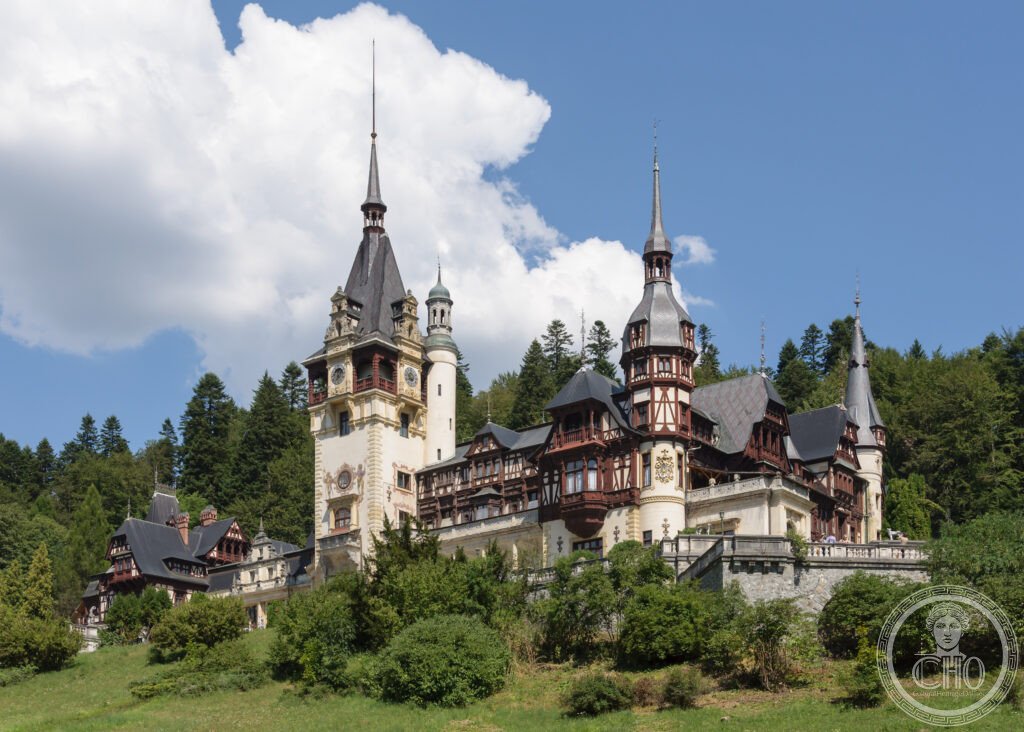
Voluto da Carlo I come residenza estiva della nuova dinastia romena, il castello di Peleș è un capolavoro del Neo-Rinascimento tedesco arroccato nei boschi dei Carpazi. Fu uno dei primi castelli d’Europa con elettricità propria, riscaldamento centrale e ascensore: una dichiarazione di modernità travestita da fiaba.
At a glance
Peleș Castle sits in the Carpathian foothills near Sinaia, about 120 km north of Bucharest. Built between 1873 and 1914 as the summer residence of King Carol I of Romania, it is widely regarded as one of the most beautiful castles in Europe and the masterpiece of Romanian royal architecture. Designed in a German Neo-Renaissance idiom, with timbered gables, turrets and richly carved interiors, it was also a showcase of cutting-edge technology: it was among the first castles in Europe to have its own electrical power plant, central heating, and an elevator. Today it is a museum holding one of the finest collections of decorative art, arms and armour in south-eastern Europe.
Key facts
- Built: 1873–1883 (first phase), with expansions until 1914
- Commissioned by: King Carol I of Romania, founder of the modern Romanian monarchy
- Architects: Johannes Schultz, then Karel Liman; interiors by Jean Lecomte du Noüy and others
- Style: predominantly German Neo-Renaissance, with Baroque, Rococo and Moorish rooms
- Technology: own hydroelectric plant; central heating; central vacuum; elevator — exceptionally advanced for its time
- Collections: over 4,000 European and Oriental weapons; paintings, ceramics, gold and silver, Murano glass
History
When Carol I of the House of Hohenzollern-Sigmaringen became ruler of the Romanian principalities in 1866, he sought a summer residence that would express both the legitimacy and the modernity of the new state. He chose a wooded site near the Sinaia monastery in the Carpathians. Construction began in 1873 and the castle was inaugurated in 1883, though work on the interiors and additions continued for decades, finishing only in 1914, the year of Carol’s death.
Peleș served as the royal summer residence until the abolition of the monarchy in 1947. Under the Communist regime it was closed to the public for long periods and used as a state reception venue. After 1989 it was restored and reopened as a museum, and in 2007 it was formally returned to the former royal family, which now operates it as a heritage site.
What you see
The exterior is a romantic composition of half-timbered gables, slender towers and terraced gardens with marble statuary, set against a backdrop of forested mountains. Inside, the rooms unfold as a sequence of stylistic worlds: the Honour Hall with its carved walnut panelling and retractable glass ceiling; the Armoury with thousands of weapons; the Florentine, Moorish, Turkish and Imperial rooms; a private theatre; and a library with a concealed door. The craftsmanship — woodcarving, stained glass, leatherwork, Murano chandeliers — is of the highest European standard of the late 19th century.
Practical information
- Getting there: from Bucharest by train to Sinaia (about 2 hours), then a 20-minute uphill walk or taxi
- Opening: closed on certain weekdays (often Monday and Tuesday); check current schedule before visiting
- Tickets: guided tours of the ground floor; an additional ticket for the upper floors
- Time needed: 1.5–2 hours for the castle; combine with Pelișor and Sinaia Monastery nearby
Getting there
Peleș Castle is in Sinaia, in the Prahova Valley, on the main rail and road route between Bucharest and Brașov. Trains run frequently from Bucharest (about 2 hours). From Sinaia station the castle is a 20–30 minute walk uphill through the park, past the Sinaia Monastery. GPS: 45.3597° N, 25.5425° E.
Nearby
- Pelișor Castle — the smaller Art Nouveau royal residence, a few minutes’ walk away
- Sinaia Monastery — the 17th-century monastery that gave the town its name
- Cantacuzino Castle, Bușteni — Neo-Romanian castle, about 10 km north
Sources
- Muzeul Național Peleș — official museum documentation (peles.ro)
- Romanian Royal Family — historical and biographical materials (romaniaregala.ro)
- Encyclopaedia Britannica — Carol I of Romania; Sinaia
- Institutul Național al Patrimoniului — Romanian heritage register
Find it on the map
See this place and what’s around it →📷 Become a Cultural Heritage Online photographer
Share your photos of places: they stay published under your name as the author. The more they're seen, the more you get noticed — and soon a contest will reward the most appreciated photos.
Log in or sign up free to add a photoIs this page about you?
This page is read by travellers and heritage enthusiasts who find it on Google. Tell us how you are connected to this place and we will take it from there.