

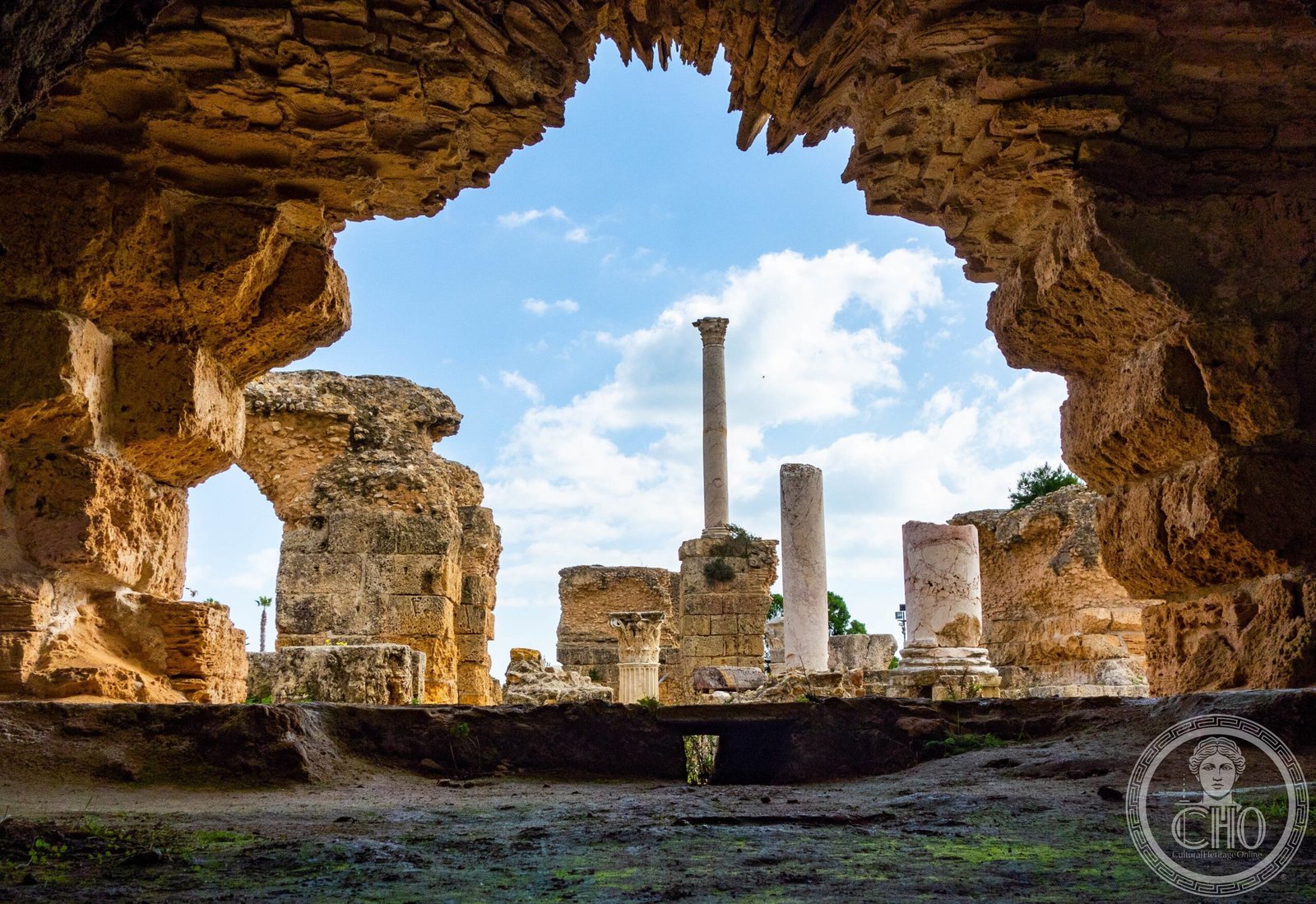
Scattered across modern Carthage, the remains of this once-powerful Punic city reveal monumental streets, vast spaces, and the architectural ambitions of antiquity—now protected as a UNESCO World Heritage Site.
At a glance
The archaeological site of Carthage occupies the hill of Byrsa and surrounding areas of the modern city, offering fragmentary but eloquent testimony to Punic urban power. Excavation and conservation efforts, launched internationally between 1972 and 1992, transformed the site from threatened obscurity into a protected cultural monument.
History
Byrsa hill served as the center of the ancient Punic city of Carthage, once a dominant Mediterranean power. In the 13th century, the site acquired Christian significance when King Louis IX of France died there during the Eighth Crusade. A cathedral and the Acropolium were later erected, the latter built at the end of the 19th century on the presumed location of the saint-king’s tomb.
As modern Carthage expanded, archaeologists feared irreversible destruction of the remains. Their advocacy prompted UNESCO to launch a major international campaign (1972–1992) culminating in the site’s World Heritage designation in 1979.
What you see
Foundations and column fragments constitute the primary visible evidence today. The grid of streets, though mostly vanished, can still be discerned through their scale and organization. The Acropolium’s massive silhouette dominates the Byrsa ridge, while near the cathedral stands an empty cenotaph commemorating Saint Louis, whose remains were repatriated to France.
The extreme dispersion of remains challenges visitors, though some architectural clusters can be identified. Immense dimensions and panoramic vistas hint at the city’s former magnificence.
Cultural significance
Carthage represents a crucial node in Mediterranean history—a Punic commercial and military superpower, later a Christian pilgrimage destination. The site embodies the layering of civilizations and the perpetual tension between preservation and urban development in the modern world.
Key facts
- Country: Tunisia
- Coordinates: 36.91°N, 10.28°E
- UNESCO World Heritage Site since 1979
- Major conservation campaign: 1972–1992
Practical information & getting there
The site is integrated into the residential city of Carthage, north of Tunis. Remains are dispersed across several neighborhoods; some clusters are more accessible than others. Plan extended time to appreciate the scale and layout. Current conditions reflect both the challenges of archaeological preservation and the ongoing negotiation between heritage protection and urban life.
Sources & resources
Find it on the map
See this place and what’s around it →📷 Become a Cultural Heritage Online photographer
Share your photos of places: they stay published under your name as the author. The more they're seen, the more you get noticed — and soon a contest will reward the most appreciated photos.
Log in or sign up free to add a photo