
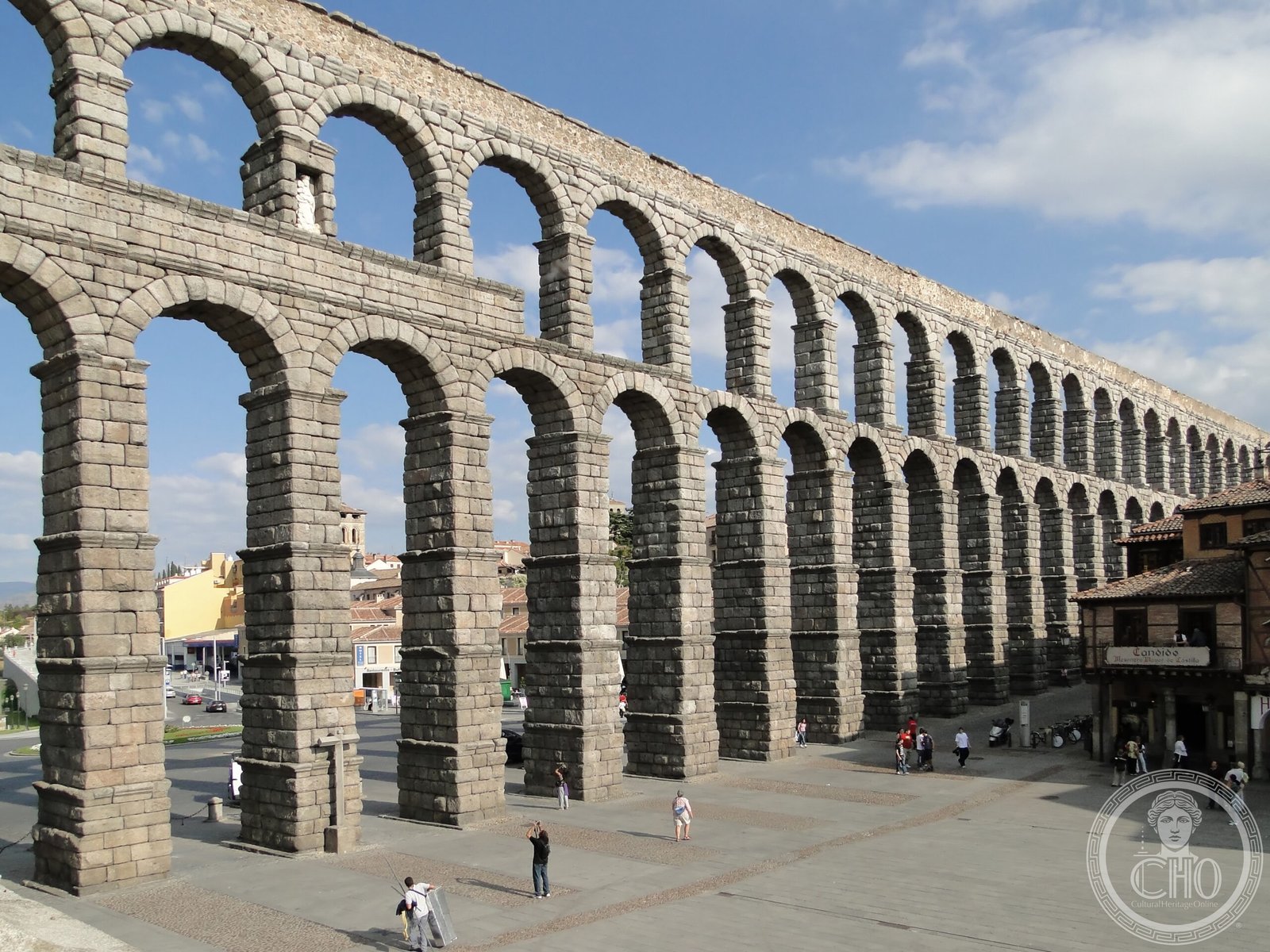
A masterpiece of Roman engineering, this elevated water-bridge channels water 17 kilometres across the Castilian landscape with 167 arches of astonishing precision—a structure that has served Segovia for nearly two millennia.
At a glance
The Aqueduct of Segovia carried mountain spring water to the city’s fountains, public baths and private houses from its completion in the first century AD until 1973. Its 167-arch elevated section survives as one of Europe’s best-preserved Roman aqueduct bridges, built without mortar and still standing substantially intact.
History
Constructed around the first century AD, the aqueduct was engineered to solve Segovia’s water scarcity by tapping springs in mountains 11 miles away. Roman builders achieved this feat using only stone, gravity and mathematical precision. The structure remained in continuous use for nearly 2,000 years, a testament to both Roman ambition and durability, before being decommissioned in 1973.
What you see
The aqueduct’s most striking feature is its double-tiered arcade of 167 arches, each carved from granite blocks fitted without binding mortar. The lower arcade reaches approximately 29 metres at its highest point; a narrower upper channel runs atop, a design that balanced hydraulic pressure with structural economy. The exposed stonework shows minimal deterioration across two millennia.
Cultural significance
The aqueduct has become Segovia’s defining landmark—so central to civic identity that it appears on the city’s coat of arms. Its recognition as UNESCO World Heritage status in 1985, alongside Segovia’s Old Town, reflects its value both as an engineering marvel and as evidence of Roman influence on the Iberian Peninsula.
Key facts
- Country: Spain
- City: Segovia
- Period: 1st century AD
- Number of arches: 167
- Water distance: 17 kilometres (11 miles)
- Coordinates: 40.9479, -4.1178
- UNESCO World Heritage Site: 1985
Practical information & getting there
The aqueduct runs through central Segovia and is freely accessible to view from ground level along its entire course. The most photographed section is the two-tiered arcade north of the Plaza de Azoguejo. Segovia is located approximately 55 kilometres northwest of Madrid and is easily reached by train or bus from the capital.
Sources & resources
Find it on the map
See this place and what’s around it →📷 Become a Cultural Heritage Online photographer
Share your photos of places: they stay published under your name as the author. The more they're seen, the more you get noticed — and soon a contest will reward the most appreciated photos.
Log in or sign up free to add a photo