
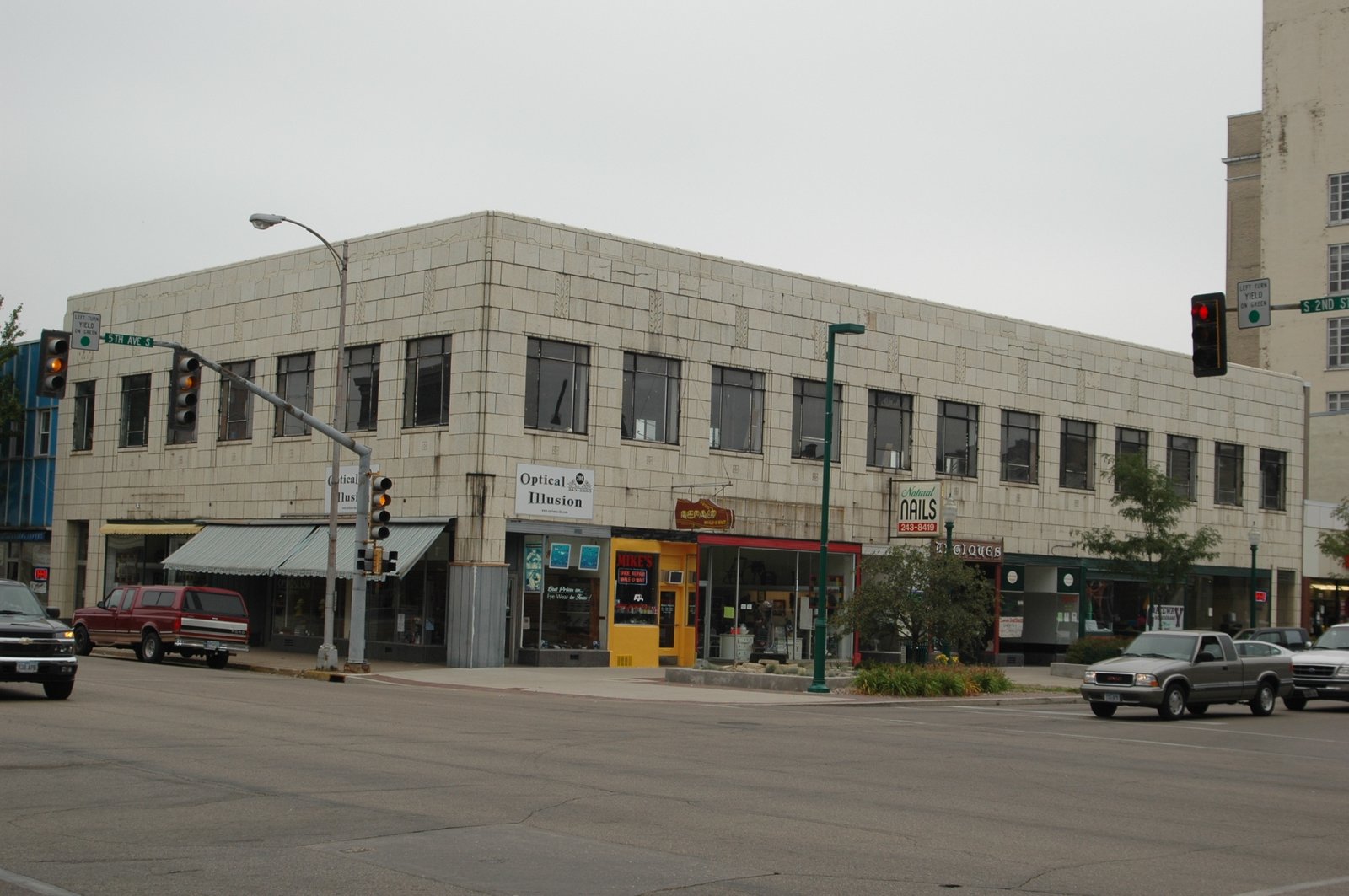
A cream-colored terra cotta jewel in downtown Clinton, Iowa — a 1931 commercial building where Chicago school windows and Art Deco cladding distill the decade’s design confidence into a small Iowa city.
At a glance
The Ankeny Building in downtown Clinton, Iowa, is a compact Art Deco commercial structure that packs a surprising formal precision into a modest footprint. Designed in 1931 by Chicago architect Harold Holmes and built by Daniel Haring, the building features cream-colored terra cotta panels on its exterior — a material popular with Art Deco designers for its ability to hold sharp geometric ornamental detail. The building was listed on the National Register of Historic Places on March 2, 2006.
Key facts
- Built: 1931
- Architect: Harold Holmes (Chicago)
- Builder: Daniel Haring
- Style: Art Deco
- Exterior: Cream-colored terra cotta panels
- Windows: Chicago school steel and glass, second floor
- NRHP listed: March 2, 2006 (refnum 06000105)
- Coordinates: 41.8428°N, 90.1883°W
History
Clinton, Iowa, built its fortune on lumber in the nineteenth century, and by the early twentieth had diversified into manufacturing and commerce. The Ankeny Building dates from the building boom of the late 1920s and early 1930s, when American downtowns were still investing in quality commercial architecture even as the Great Depression began to constrict credit. Chicago architect Harold Holmes brought a professional finish to the commission that a smaller Iowa city might not have expected: the building’s terra cotta cladding and steel window systems reflect the design standards of a major metropolitan practice applied to a river city courthouse town.
The building takes its name from the Ankeny family, who were significant figures in Iowa politics and commerce in the nineteenth and early twentieth centuries. It was listed on the National Register of Historic Places in 2006 as part of the Clinton, Iowa Multiple Property Submission — a recognition that situated it within the broader context of historic downtown commercial architecture in the region.
What you see
The exterior is sheathed in cream-colored terra cotta — a material that Art Deco designers embraced for its ability to hold intricate molded ornament and its reflective surface quality in daylight. The corner view reveals the building’s principal virtue: a tight integration of the Chicago school window system (horizontal steel-framed glazing with a central fixed light and flanking operable sashes) with the Art Deco panel geometry of the facade. Holmes used the window rhythm to organize the cladding into a coherent surface rather than applying ornament as afterthought.
The building reads as a piece of civic self-respect in a town that took its commercial character seriously. At a time when many midsize Iowa cities were building in cheaper brick with minimal detail, the Ankeny Building’s terra cotta announces ambition.
Practical information
- Access: Commercial building in downtown Clinton — exterior freely viewable
- Location: Downtown Clinton, Iowa, on the Mississippi River
- Season: Year-round for exterior viewing
- Time needed: 15 minutes for exterior study
Getting there
Clinton is located on the Mississippi River in eastern Iowa, approximately 20 miles south of the Quad Cities (Davenport/Rock Island) and accessible via U.S. Route 30. The nearest major airport is Quad Cities International Airport, approximately 30 miles north.
Nearby
- Mississippi River views — Clinton’s historic downtown runs along the river; Eagle Point Park offers panoramic views
- Clinton County Courthouse (1903) — Beaux-Arts courthouse on the same commercial strip
- Des Moines Building (1930) — a 14-story Art Deco/Art Moderne tower in Iowa’s capital, 150 miles west (see CHO database)
Sources
- Wikipedia, “Ankeny Building”
- National Register of Historic Places, refnum 06000105, listed March 2, 2006
- Clinton, Iowa Multiple Property Submission
- Michael J. Kearney, photographer (CC BY-SA 2.5), Wikimedia Commons
Find it on the map
See this place and what’s around it →Record researched and written by Luigi De Marchi for Cultural Heritage Online, 2026.
📷 Become a Cultural Heritage Online photographer
Share your photos of places: they stay published under your name as the author. The more they're seen, the more you get noticed — and soon a contest will reward the most appreciated photos.
Log in or sign up free to add a photoIs this page about you?
This page is read by travellers and heritage enthusiasts who find it on Google. Tell us how you are connected to this place and we will take it from there.