

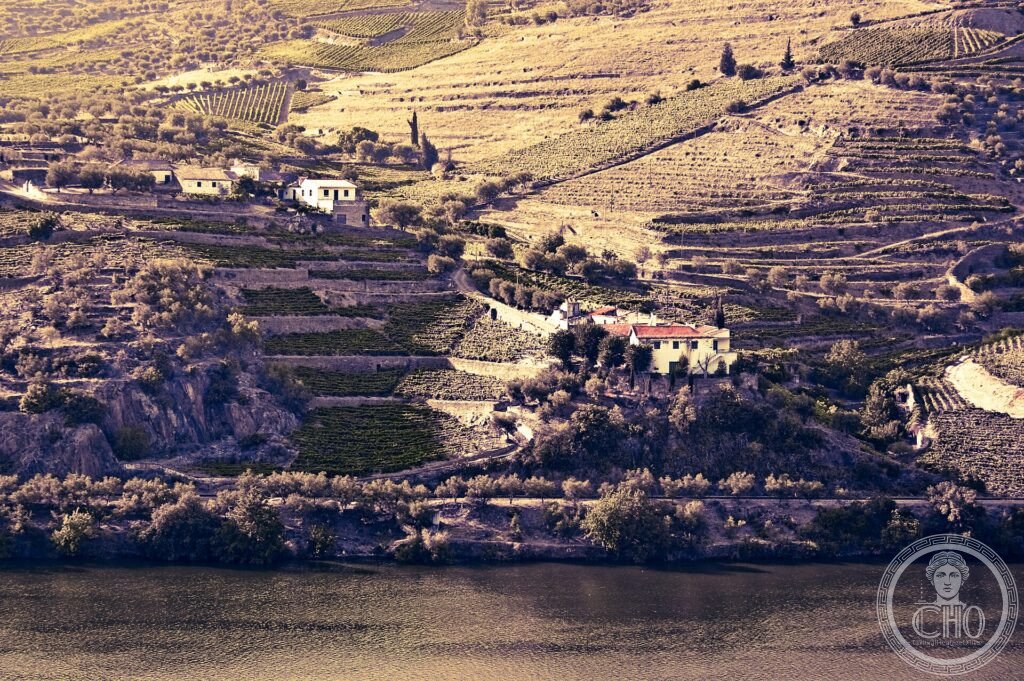
For more than two centuries, human hands have carved the steep slopes of the Douro valley into endless vineyard terraces. Port wine is born here, and here in 1756 the world’s first demarcated wine region was established: a landscape entirely built, where nature and labour blur into one another.
At a glance
The Alto Douro is one of the oldest wine regions in the world and the source of port wine. For more than two thousand years vineyards have climbed the steep schist slopes of the Douro valley, shaped by hand into terraces held by dry-stone walls. In 1756 it became the first formally demarcated and regulated wine region in the world. The result is a dramatic cultural landscape, where the work of generations has remade an entire valley. It was inscribed by UNESCO in 2001.
Key facts
- UNESCO: World Heritage since 2001 (Alto Douro Wine Region)
- First demarcated region: defined and regulated in 1756 under the Marquis of Pombal
- Port wine: the fortified wine matured downstream in Vila Nova de Gaia
- Terraces: vineyards held on schist slopes by dry-stone walls (socalcos)
- Quintas: the wine estates that dot the valley
- The river: the Douro, once carrying wine boats, now cruise vessels
History
Wine has been made in the Douro since antiquity, but the modern landscape took shape from the 17th century, when demand for port wine in England drove the terracing of ever-steeper slopes. To protect the wine’s quality and curb fraud, in 1756 the statesman the Marquis of Pombal created the Companhia Geral and demarcated the production zone with stone markers — the first such regulation anywhere.
Generations of labour built the socalcos, the narrow terraces that follow the contours of the hills. The phylloxera blight of the 19th century scarred the valley, and rebuilding changed the terrace patterns. Today the quintas continue to produce port and increasingly fine table wines, while river cruises have opened the valley to visitors.
What you see
The valley is a vast amphitheatre of vines: terrace upon terrace of green following every fold of the hills down to the dark river. White-walled quintas sit among the vineyards, and at harvest the slopes fill with pickers. The patterns of old hand-built terraces and newer planted slopes record centuries of changing technique.
Viewpoints such as São Leonardo de Galafura and the bends near Pinhão reveal the scale of the landscape; the railway and river thread along the valley floor.
Practical information
- Best seen: by river cruise, the scenic Douro railway, or driving the valley roads
- Quintas: many estates offer tastings and stays
- Time needed: a full day, longer to tour estates
- Harvest: September brings the vintage and the busiest season
Getting there
The Alto Douro lies upstream from Porto in northern Portugal. The Douro railway from Porto runs along the river to Pinhão and Pocinho; roads and river cruises also serve the valley. GPS (Pinhão area): 41.16° N, 7.55° W.
Nearby
- Porto — the city at the river mouth, also UNESCO-listed
- Pinhão — the wine village with an azulejo-tiled station
- Côa Valley — Palaeolithic rock art further up the river
Sources
- UNESCO World Heritage Centre — “Alto Douro Wine Region” (ref. 1046)
- Instituto dos Vinhos do Douro e do Porto — official wine authority
- Encyclopaedia Britannica — Douro River; port wine
Find it on the map
See this place and what’s around it →📷 Become a Cultural Heritage Online photographer
Share your photos of places: they stay published under your name as the author. The more they're seen, the more you get noticed — and soon a contest will reward the most appreciated photos.
Log in or sign up free to add a photo