
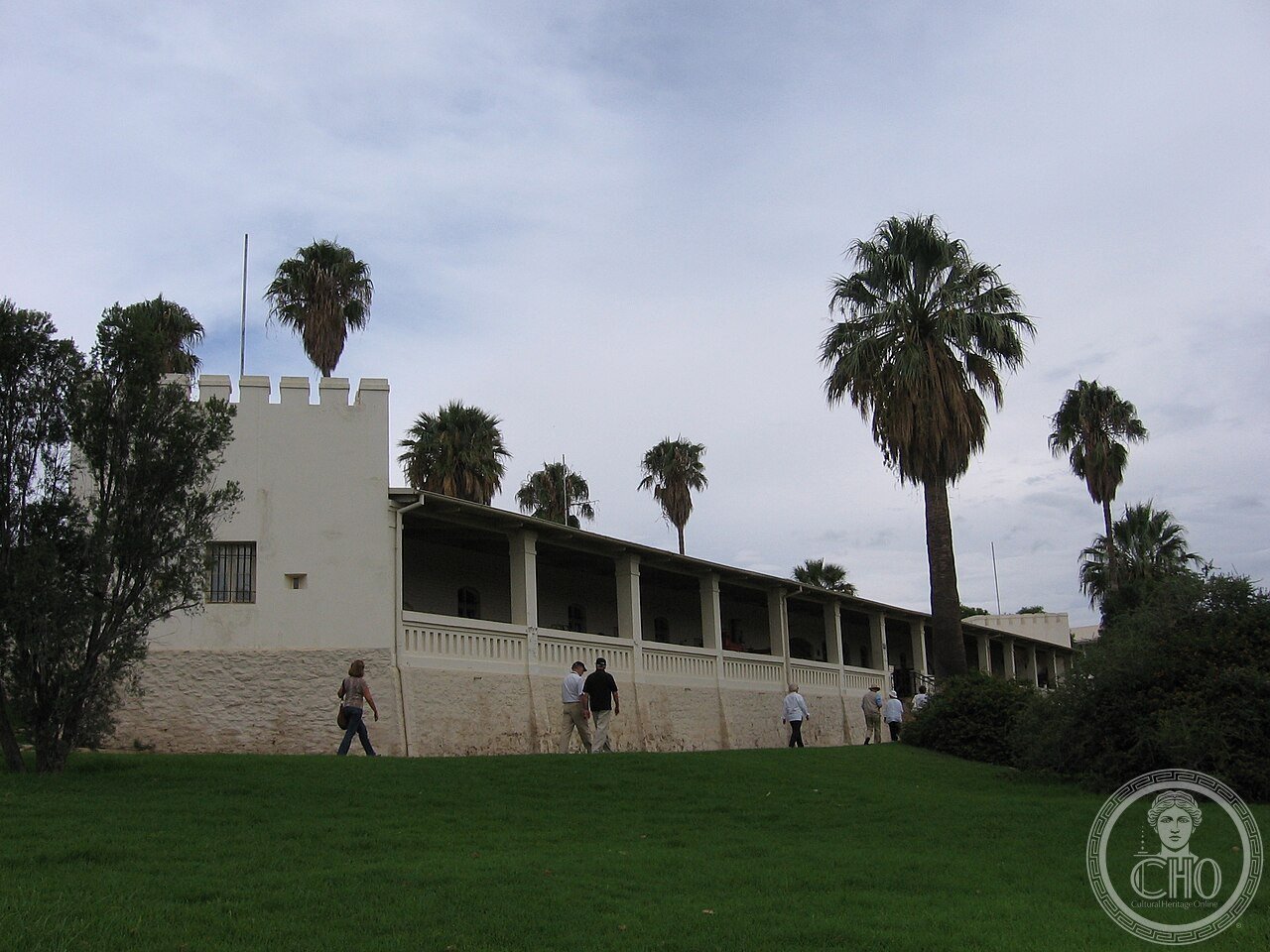
The oldest surviving building in Namibia, built in 1890 as a German colonial fortress and now housing the Independence Memorial Museum.
At a glance
- Type
- Military fort / museum
- Period
- 1890
- Style
- German Colonial Military
- Location
- Windhoek, Namibia
- Coordinates
- -22.5705, 17.0849
- Architect
- Captain Curt von Francois (German Schutztruppe)
Overview
The Alte Feste, or Old Fort, in Windhoek is the oldest surviving building in Namibia and the principal monument of the German colonial era in South West Africa. Built in 1890 by the German Schutztruppe under Captain Curt von Francois, it was constructed as a military stronghold to secure the newly established colonial capital. The thick-walled stone structure, built from local schist and quartzite, features crenellated towers and loophole embrasures typical of German colonial defensive architecture in Africa. After Namibian independence in 1990, the fort was converted into the Independence Memorial Museum, documenting the liberation struggle against German and then South African rule.
History
The fort played a central role in the Battle of Windhoek (1904) during the Herero and Nama genocide, when German forces used it as a command post during a systematic extermination campaign that killed an estimated 80 percent of the Herero and 50 percent of the Nama people. This was one of the first genocides of the 20th century and was formally recognised as such by Germany in 2021. The building later served German colonial administration until the South African mandate period following World War I, and then as a government archive under South African rule. A large bronze equestrian statue outside the fort commemorates the Herero resistance to German colonial aggression.
Architecture and Design
The Alte Feste was built using locally quarried schist and quartzite, materials that give the structure its distinctive grey-brown appearance. The defensive design features crenellated parapets, corner towers, and narrow loophole embrasures for rifle fire. The thick walls were engineered to withstand assault and provide shade in the African heat. The overall layout follows a compact courtyard plan typical of small German colonial forts built across South West Africa in the 1890s. Unlike later colonial administrative buildings in Windhoek that adopted more ornate German Renaissance styles, the Alte Feste is purely utilitarian in character, a product of military necessity rather than imperial display.
Cultural significance
The Alte Feste carries enormous weight in Namibian national memory. For the Herero and Nama peoples, it is inseparable from the genocide perpetrated by German colonial forces; for the broader nation, it marks the origin point of a colonial history that shaped modern Namibia profoundly. The building now serves as the National Museum of Namibia, housing the Independence Memorial Museum, which charts the path from German conquest through South African apartheid rule to liberation in 1990. Its continued presence as a museum rather than a site of erasure reflects Namibia’s approach to difficult heritage: bearing witness rather than forgetting.
Visiting today
The Alte Feste houses the Independence Memorial Museum and is open to visitors Tuesday through Sunday. The museum collection covers colonial history, the genocide, the liberation struggle, and post-independence nation-building. The adjacent museum garden contains the equestrian statue commemorating Herero resistance. Entry fees are modest. The site is located in central Windhoek on Robert Mugabe Avenue, a short walk from Parliament Gardens and the Lutheran Christuskirche, another prominent German colonial landmark.
Getting there
The Alte Feste is located in central Windhoek on Robert Mugabe Avenue, within walking distance of the city center hotels and the main commercial district. Windhoek is served by Hosea Kutako International Airport approximately 40 kilometres east of the city. Taxis and shuttle services connect the airport to the city center. Within Windhoek, walking is feasible in the compact city center; taxis are the main form of local transport. There is no commuter rail service in Windhoek.
Sources and resources
Find it on the map
See this place and what’s around it →Record researched and written by Luigi De Marchi for Cultural Heritage Online, 2026.
📷 Become a Cultural Heritage Online photographer
Share your photos of places: they stay published under your name as the author. The more they're seen, the more you get noticed — and soon a contest will reward the most appreciated photos.
Log in or sign up free to add a photoIs this page about you?
This page is read by travellers and heritage enthusiasts who find it on Google. Tell us how you are connected to this place and we will take it from there.