
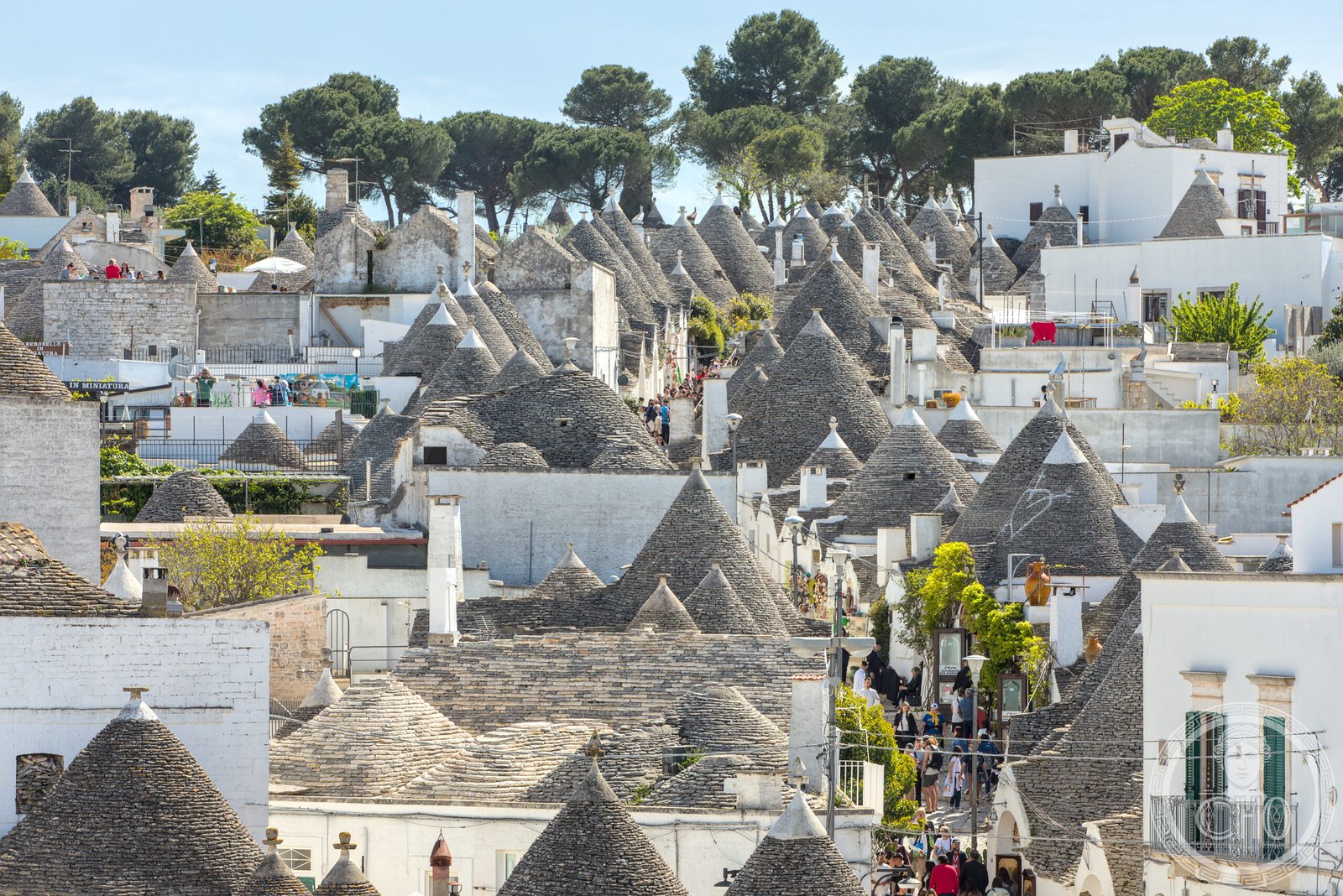
A town of whitewashed cone-roofed houses called trulli, Alberobello preserves an extraordinary medieval building tradition still inhabited and adapted for modern living.
At a glance
Alberobello, known as the “Capital of the Trullo,” is famous for its distinctive trulli—ancient dry-stone dwellings with conical limestone roofs. The entire old town was inscribed as a UNESCO World Heritage Site in 1996. Located in the Valle d’Itria and the Murgia dei Trulli plateau, it remains one of the most intact examples of vernacular architecture in southern Italy.
History
According to historical studies, the trulli of Alberobello date to the mid-14th century, when damaged buildings were demolished and rebuilt rather than repaired. In the 15th century, the Counts of Conversano allegedly imposed dry-stone construction on peasants to circumvent a Neapolitan royal edict that taxed new urban settlements. These buildings were designed to appear precarious and temporary—and therefore non-taxable—yet their engineering proved remarkably durable.
What you see
Trulli are built on circular or oval plans, with thick lime masonry set directly onto natural rock foundations. Rooms radiate from a central compartment in modular units. Walls are thick and windows scarce, creating excellent thermal regulation—warm in winter, cool in summer. The roof’s pseudo-dome consists of concentric horizontal limestone slabs called “chianche” (inner) and “chiancarelle” (outer). Keystones are often decorated with esoteric or spiritual motifs, while a projecting ledge channels rainwater into underground cisterns. The Trullo Sovrano, the largest trullo in the country, now houses a museum spread across two floors and hosts concerts, theatrical performances, and cultural events in summer.
Cultural significance
The trulli represent a unique survival of ancient construction techniques still in everyday use. Their ingenious design—load-bearing without mortar or internal supports—demonstrates sophisticated understanding of statics and climate control. Recent restoration of trulli and nearby masserie (traditional farmhouses) has combined preservation with hospitality, allowing visitors and residents to experience these structures while retaining their original character. Local artisans continue traditional textile work, and regional sweets like pettole and cartellate remain part of the food culture.
Key facts
- Address: Piazza del Popolo, 33, 70011 Alberobello
- Coordinates: 40.7832078, 17.2368001
- Population: 10,718
- UNESCO World Heritage Site: 1996
- Official website: https://www.comunealberobello.gov.it/index.php?lang=it
- Phone: 080 432 1200
Practical information
Many trulli have been renovated and converted into guesthouses, restaurants, and shops. Summer visitors can attend cultural events, theatrical performances, and concerts. Artisan boutiques sell traditional linen textiles and local food specialties. Opening hours for individual trulli and attractions vary; check the official municipal website for current details.
Getting there
Alberobello is located in the metropolitan city of Bari, Puglia, within the Valle d’Itria region. The town centre is accessible by car, bus, and regional rail services connecting to Bari and other major towns in Puglia.
Sources & resources
Find it on the map
See this place and what’s around it →📷 Become a Cultural Heritage Online photographer
Share your photos of places: they stay published under your name as the author. The more they're seen, the more you get noticed — and soon a contest will reward the most appreciated photos.
Log in or sign up free to add a photo