
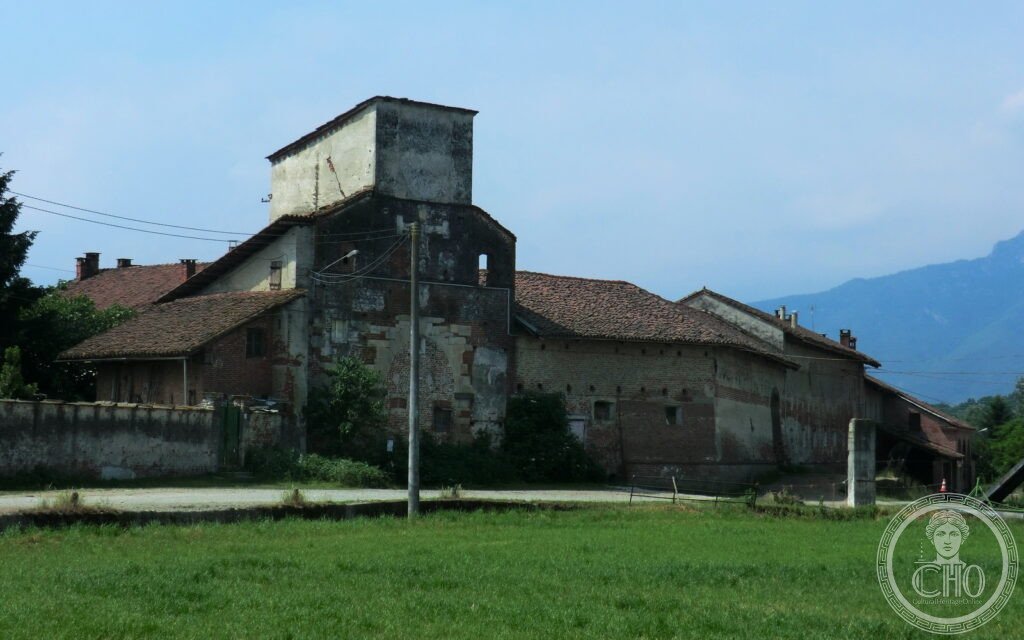
A Cistercian abbey founded in 1135 in the Po valley south of Saluzzo, whose almost complete monastic complex — church, cloister, chapter house, dormitory, and granary — survives in its medieval configuration, making it one of the best-preserved Cistercian ensembles in northern Italy.
At a glance
The Abbazia di Santa Maria di Staffarda stands in the floodplain of the Po river south of Saluzzo, at the foot of the Cottian Alps near Cuneo. Founded in 1135 by the Marquis of Saluzzo with the involvement of the Cistercian order, it followed the standard Cistercian formula of remote, productive agricultural land, strict architectural austerity, and independence from episcopal control. The abbey complex that survives today includes the church (XII–XIII century, with later Gothic additions in the apse and cloister), the cloister with its distinctive brick arches, the chapter house, the refectory, the lay brothers’ range, and the granary — one of the few cases in Italy where an almost complete Cistercian monasterium survives above ground.
The Marquises of Saluzzo used the abbey as a burial site throughout the thirteenth and fourteenth centuries; several of their tombs are preserved in the church. The abbey was assigned to the Ordine Mauriziano of Turin in 1750 and later used in part as an agricultural estate; passed to the Ordine Mauriziano of Turin in 1750 (papal bull of Benedict XIV) and is today owned and managed by the Fondazione Ordine Mauriziano, which also holds Stupinigi and Sant’Antonio di Ranverso.
Key facts
- Foundation: 1135, by Manfredo I del Vasto, Marquis of Saluzzo
- Order: Cistercian (daughter house of Casanova Abbey); affiliated to Cîteaux
- Church: XII–XIII century, Romanesque-Cistercian with Gothic apse added c. 1370
- Stewardship: Fondazione Ordine Mauriziano (since 1750)
- Location: Staffarda di Revello (CN), Piemonte
- GPS: 44.7014, 7.4350 — Google Maps
History
The Cistercian order, founded at Cîteaux (Burgundy) in 1098 as a reform movement within Benedictine monasticism, spread rapidly across Europe in the twelfth century under the intellectual leadership of Bernard of Clairvaux (1090–1153). The Cistercian programme combined agricultural productivity (each abbey was a large farming operation, often pioneer-clearing woodland or draining marshes) with an architectural aesthetic of extreme austerity: no sculpture, no coloured glass, no polychrome decoration, proportions governed by mathematical ratios derived from the square and double square.
Staffarda’s foundation followed this pattern: the abbey was planted in the low-lying flood land of the Po tributary (the “staffarda” was a swampy, rush-covered area), presumably to drain and cultivate it. The economic success of the operation is visible in the large granary — the grange — which remains one of the finest surviving examples of medieval agricultural infrastructure in Italy. The abbey’s church, built in stages from the 1130s to the late thirteenth century, follows the Cistercian model closely: a nave of undecorated round-arched bays, plain capitals, and no figurative carving anywhere except the tomb slabs of the Marquises of Saluzzo.
The Battle of Staffarda (1690), fought in the fields around the abbey between the French army of Catinat and the Savoyard-Imperial forces of the Prince of Savoy (later the Duke of Savoy Victor Amadeus II), was among the most significant engagements of the Nine Years’ War in northern Italy. The abbey itself was occupied and partly damaged by French troops.
What you see
The approach to the abbey is across flat rice and maize fields with the Alps behind — a spatial framing that matches Bernard of Clairvaux’s precept that Cistercian monasteries should have “a flat land and a distant mountain view.” The church facade, in pale local stone, has a doorway carved with a minimum of ornament — a pattern of geometric interlace in the archivolt, nothing else. The interior is a long nave of eleven bays, the arches round and undecorated, the light entering only from small round windows and the clerestory. The Marquises’ tombs along the south wall are the only sculptural programme in the church; they are carved in a local Romanesque-to-Gothic transition style, dating from the thirteenth and fourteenth centuries.
The cloister, rebuilt in brick in the late Gothic period, is the most visually distinctive element: round arches on thin columns in the older bays, pointed arches in the later, with a pattern of terracotta tracery in the upper openings. The chapter house, where the community met daily, retains its original vault.
Gallery
Practical information
- Opening: Tuesday–Sunday; hours vary seasonally. Check ordinemauriziano.it for current schedule.
- Admission: Ticketed; check current rates.
- Duration: 1–1.5 hours for a thorough visit.
- Nearby market: The small medieval borgo of Revello (5 km) has a farmers’ market on Friday mornings — good combination with the abbey.
- Events: Gregorian chant concerts in the church in summer — check the programme.
Getting there
Staffarda is 40 km south of Turin on the SS589 via Saluzzo, or 30 km north-east of Cuneo on the SP589. By car: from Turin 45 minutes; from Cuneo 35 minutes. By train: to Saluzzo (Trenitalia, change at Carmagnola from Turin); then taxi or local bus 10 km to Staffarda. No direct bus from Cuneo. From Turin airport (TRN): 60 km, 50 minutes by car. The abbey is easily combined with a day in the historic centre of Saluzzo (10 km north), which has its own castle, frescoed churches, and the Castello della Manta (another FAI property, 7 km).
Nearby
- Saluzzo — 10 km north; the most complete medieval town centre in Piemonte, with the Castiglia fortress and frescoed palazzi
- Castello della Manta (FAI) — 7 km; late Gothic fresco cycle of the Nine Heroes and Nine Heroines (c. 1420) in the baronial hall
- Cuneo — 30 km south; market town with porticoed main square; base for excursions to the Langhe and Roero wine country
Sources
- Fondazione Ordine Mauriziano: ordinemauriziano.it
- Wikipedia IT: Abbazia di Staffarda
- Fresia, Armando: L’abbazia cistercense di Staffarda, Cuneo, 1984
Find it on the map
See this place and what’s around it →📷 Become a Cultural Heritage Online photographer
Share your photos of places: they stay published under your name as the author. The more they're seen, the more you get noticed — and soon a contest will reward the most appreciated photos.
Log in or sign up free to add a photoDo you manage this place?
This page is read by travellers and heritage enthusiasts who find it on Google. Keep it accurate — and make it work for you. Free for non-profit heritage institutions.