
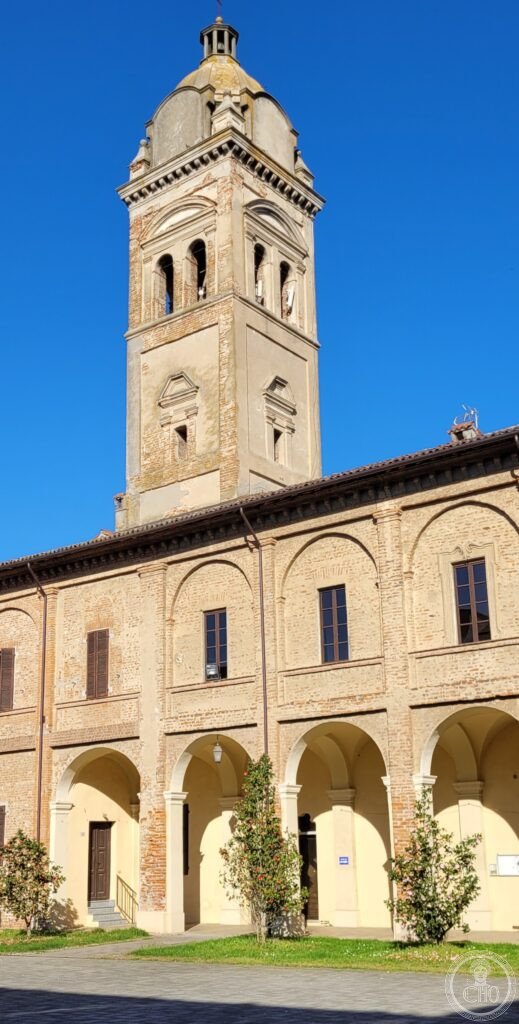
Dal treno per Mortara la Lomellina è tutta risaie e cielo basso; poi, a Breme, sotto il pavimento di una chiesa scomparsa, si apre una cripta del Mille a tre navatelle, con una colonna di marmo venato e muri a corsi alternati di mattoni e ciottoli di fiume. È quanto resta di una delle abbazie più potenti dell’Italia settentrionale, fondata dai monaci di Novalesa in fuga dai Saraceni.
At a glance
The Abbazia di San Pietro stands at the edge of Breme, a small village in the Lomellina rice plain of the province of Pavia. What survives — a stone crypt, an early baptistery, a monumental monastic kitchen, an Olivetan cloister — is the remnant of one of medieval northern Italy’s most powerful abbeys. The community itself was a transplant. In the early 10th century the Benedictine monks of Novalesa, in the Val di Susa, fled the Saracen raids carrying their treasure and their library, and refounded their house here on land granted by the Marquis of Ivrea. Regione Lombardia ranks it among the most influential abbeys in Europe between the 10th and 13th centuries.
Key facts
- Refounded: at Breme in the early 10th century (904–906 in the sources) by Donniverto, last abbot of Novalesa; the house was the direct heir of the Novalesa Abbey, founded in 726
- Order: Benedictine; a “free” abbey subject only to Pope and Emperor, confirmed by Otto III’s diploma of 998 and by papal bulls of Benedict VIII (1014) and Eugene III (1151)
- Crypt: the oldest in the Lomellina, 10th–11th century; about 11 × 6 m, three small naves on four cylindrical stone columns (one of veined white marble) and four later brick pillars
- Later history: handed to the Olivetans in 1542–43; suppressed by the House of Savoy in the 1780s; the abbey church was demolished in the early 19th century, in the Napoleonic period
- Chronicon Novaliciense: a major 11th-century monastic chronicle was written here by an anonymous Breme monk, narrating the history of Novalesa and Breme
History
Novalesa, founded in 726 on the road over the Alps, was one of the great Frankish-era monasteries. When Saracen raiding reached the Susa valley in the early 10th century, its monks abandoned the site, carried the monastic treasure and codices first to Turin and then down into the Lomellina, where the Marquis of Ivrea gave them land at Breme. Donniverto, the last abbot of Novalesa, became the first abbot of Breme and rebuilt the house in the image of the one he had left.
Within a few generations Breme was among the most powerful abbeys north of the Apennines, holding churches, castles and estates across Italy and into France. Its dependence shifted with the politics of the age — to the lords of Susa, to imperial appointees, to the church of Pavia in 1093, to the Marquesses of Montferrat — before it regained independence in 1210. One of its abbots, Adraldus, a friend of the reformer Peter Damian, went on to become bishop of Chartres (1070–1075). In a reversal of fortune, the once-abandoned Novalesa was eventually rebuilt as a priory dependent on Breme. Decline set in during the late Middle Ages; the Olivetans took over the house in 1542–43 and built the porticoed cloister, but the abbey was suppressed under the House of Savoy in the 1780s and its church pulled down soon after.
What you see
The heart of the site is the crypt, beneath the presbytery of the lost abbey church and the oldest in the Lomellina. Roughly 11 metres long, it is divided into three small naves by four cylindrical stone columns — one in fine veined white marble, possibly reused Roman material from nearby Lomello — with four brick pillars added later. The walls alternate courses of brick and river pebbles, a banded technique scholars also read on the adjacent baptistery. The crypt once ran several bays longer; shortened and used as a cellar, it is now entered by a 17th-century stair cut through the masonry.
Around it the complex preserves an Early Christian baptistery of the 8th century, the 16th-century Olivetan cloister, and a monumental medieval kitchen with built-in ovens and an underground ice store — shown to visitors as an “underground museum.” The abbey church itself, documented as a three-nave building with an apse, survives only in its footprint and in fragments of wall embedded in later masonry.
Practical information
- Visiting: the crypt and the medieval kitchens are shown on guided visits organised by the Comune di Breme and the FAI; check the Comune di Breme website for current opening times
- On the route: Breme is a stop on the “Itinerario Romanico in Lomellina” linking Breme, Lomello and Velezzo
- Time needed: about 45 minutes for the crypt, baptistery and kitchens
Getting there
Breme lies in the western Lomellina, about 30 km west of Pavia, near the confluence of the Po and Sesia. By car it is reached via Sartirana and Mortara; the nearest railway station is Mortara, on the Milan–Alessandria line. GPS: 45.1267° N, 8.6212° E.
Nearby
- Lomello — on the same Romanesque itinerary; the basilica of Santa Maria Maggiore and its early baptistery of San Giovanni ad Fontes
- Sartirana Lomellina — medieval castle and rice-country landscape
- Mortara — market town of the Lomellina and main rail hub
Sources
- Comune di Breme — “L’abbazia di San Pietro” and “Il Chronicon Novalicense” (comune.breme.pv.it)
- Regione Lombardia — tourism portal, “Breme” (in-lombardia.it)
- Treccani — Enciclopedia dell’Arte Medievale, “Novalesa, Abbazia di”
- New Catholic Encyclopedia — “San Pietro in Breme, Abbey of”
Find it on the map
See this place and what’s around it →📷 Become a Cultural Heritage Online photographer
Share your photos of places: they stay published under your name as the author. The more they're seen, the more you get noticed — and soon a contest will reward the most appreciated photos.
Log in or sign up free to add a photoDo you manage this place?
This page is read by travellers and heritage enthusiasts who find it on Google. Keep it accurate — and make it work for you. Free for non-profit heritage institutions.