

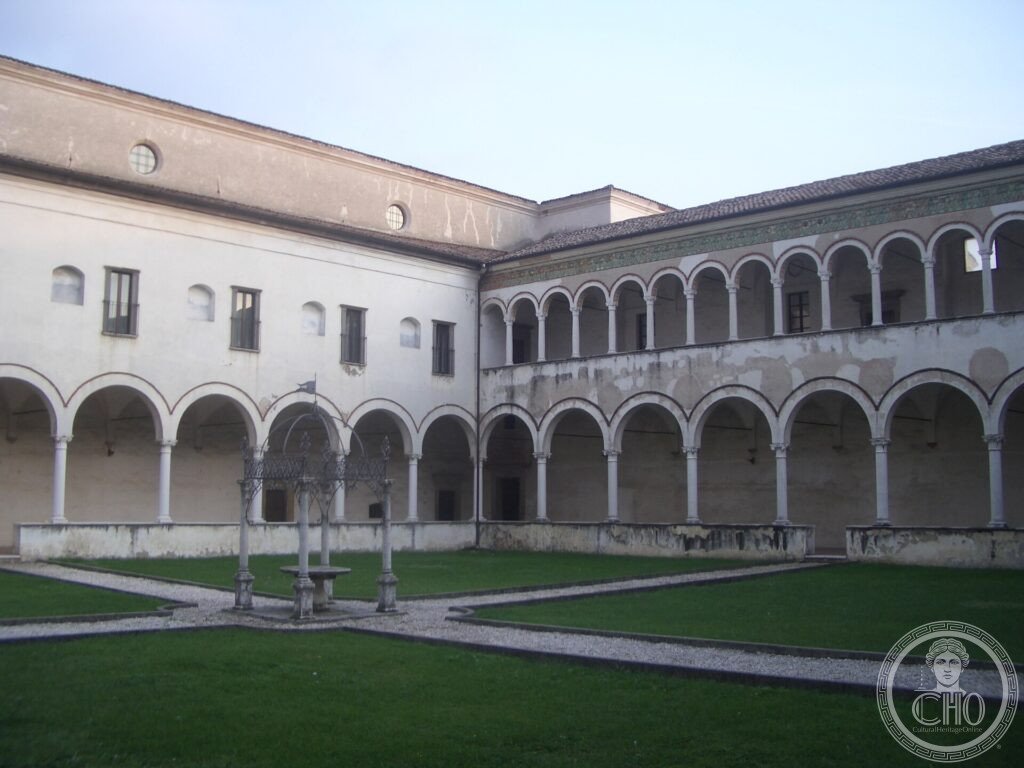
Three cloisters, each larger than the last, each from a different age: the first Romanesque, the second late Gothic, the third sixteenth-century with loggias painted in trompe-l’œil by Girolamo Romanino. Then the church, with the altarpieces by Moretto da Brescia. Then the monastic oil mill that still presses the olives of the Brescian hills. Rodengo-Saiano is the most intact abbey of the Lombard pre-Alpine foothills.
At a glance
The Olivetan Benedictine Abbey of Rodengo-Saiano stands at 200 m on the western slopes of the Monte Orfano hill, 15 km east of Brescia, in the foothills of the Franciacorta wine zone. The foundation history is disputed but the site is documented from the 10th–11th century; it was held by Cluniac monks before passing to the Olivetan Benedictines in 1446. The Olivetans (Ordo Sancti Benedicti Congregationis Montis Oliveti), a reform Benedictine congregation founded near Siena in 1319, built the complex into its current form through the 15th–16th centuries. Three successive cloisters give the complex its distinctive character: the Romanesque-Gothic small cloister (13th–14th c.), the later-Gothic medium cloister (15th c.), and the large Renaissance cloister (early 16th c.) with its double loggia painted by Girolamo Romanino in the early 16th century. The church contains three altarpieces by Alessandro Bonvicino (il Moretto da Brescia, 1498–1554), the leading Brescian painter of the High Renaissance. An active community of Olivetan monks maintains the complex and operates the monastic olive-oil mill (frantoio), open for visits.
Key facts
- Founded: documented from 10th–11th c.; Cluniac before 1446; Olivetan Benedictine from 1446 (Olivetans = reform Benedictine congregation, founded 1319 at Monte Oliveto Maggiore near Siena)
- Three cloisters: Chiostro Piccolo (small, 13th–14th c., Gothic arches); Chiostro Medio (medium, 15th c., late-Gothic); Chiostro Grande (large, early 16th c., Renaissance double loggia with frescoes by Girolamo Romanino, c. 1520)
- Girolamo Romanino (c. 1484–after 1559): leading Brescian painter; his trompe-l'oeil frescoes in the large cloister (landscapes seen through arched openings, mocked-up architectural elements) are an early example of illusionistic architectural painting in northern Italy
- Il Moretto (Alessandro Bonvicino, 1498–1554): three altarpieces in the church: the Madonna with Saints, the Coronation of the Virgin, and the Descent from the Cross; characteristic of his warm palette and devotional intimacy
- Frantoio monacale: the monastery's working olive-oil mill (operated seasonally in November); oil from Monte Orfano olives sold in the abbey shop
- Today: active Olivetan community; open to visitors daily; guided tours; refectory (with Romanino frescoes) by appointment
History
The earliest documentary reference to a religious house at Rodengo is from the 10th century; the site is traditionally associated with a Cluniac priory, though the evidence is not conclusive. What is certain is that in 1446 the community joined the Olivetan Benedictine congregation, which had been founded in 1319 by Bernardo Tolomei, a Sienese nobleman who withdrew to Monte Oliveto Maggiore in the crete senesi and established a reformed Benedictine community. The Olivetans' particular characteristic was a combination of strict observance with a strong humanistic culture: they produced manuscripts, cultivated music, and decorated their monasteries with ambitious fresco programmes. The 15th and 16th centuries saw the Rodengo building campaign that created the complex as it stands today: first the medium cloister (15th c.), then the great cloister with Romanino's frescoes (early 16th c.), then the decoration of the church with Moretto's altarpieces.
The Napoleonic suppression of 1797 briefly dissolved the community; the monks returned in the 1840s and have maintained the complex since. The 20th century saw careful restoration of the Romanino frescoes, which had suffered from humidity in the cloister walls, and the stabilization of the church's structural fabric.
What you see
The abbey is approached through a forecourt with the church on the right. The church facade is Renaissance in character; the interior has a single nave with side chapels. The three Moretto altarpieces are in different positions (high altar, left transept, right transept); all three show his characteristic warm palette (ochre-gold, deep red) and the contemplative stillness of his figures. From the church, a doorway leads into the first (small) cloister: Gothic arches on octagonal columns, late-medieval in feel. The second (medium) cloister is through another doorway: also Gothic, slightly larger, with a well at the centre. The large cloister, the grandest space, has a double loggia of Renaissance arches on the ground floor and Romanino's painted arches on the upper floor; the landscape views visible through the painted architectural openings are a sophisticated visual joke that still works. The refectory, off the south walk of the large cloister, has a painted ceiling and more Romanino work; it requires advance arrangement to visit.
Practical information
- Opening hours: Mon–Sat 08:30–12:00 and 14:30–17:30; Sun 09:00–12:00; closed religious feast days
- Guided tours: available for groups by appointment; individual visits free and unguided except church
- Abbey shop: olive oil (November harvest), honey, herbal products
- Time needed: 45 minutes to 1 hour
Getting there
By car from Brescia (15 km east): SS510 toward Iseo, then signs to Rodengo-Saiano and the abbey (on Via Orzinuovi). By bus: lines Brescia–Rodengo stop near the abbey. GPS: 45.5667° N, 10.1167° E.
Nearby
- Franciacorta — surrounding wine zone; Franciacorta DOCG (Italian Champagne-method sparkling wine); numerous wineries open for tasting
- Lago d'Iseo — 20 km north-east; scenic alpine lake; Monte Isola (car-free island); floating piers installation site (Christo, 2016)
- Brescia — 15 km west; UNESCO historic centre; Roman Capitolium and amphitheatre; Pinacoteca Tosio Martinengo (Moretto, Romanino, Raphael)
Sources
- Wikipedia — “Rodengo Abbey” (en.wikipedia.org/wiki/Rodengo_Abbey)
- Abbazia di Rodengo Saiano — abbaziarodengo.it (official website)
- Begni Redona, P.V., Alessandro Bonvicino: il Moretto da Brescia, Brescia 1988
Find it on the map
See this place and what’s around it →
📷 Become a Cultural Heritage Online photographer
Share your photos of places: they stay published under your name as the author. The more they're seen, the more you get noticed — and soon a contest will reward the most appreciated photos.
Log in or sign up free to add a photoIs this page about you?
This page is read by travellers and heritage enthusiasts who find it on Google. Tell us how you are connected to this place and we will take it from there.