
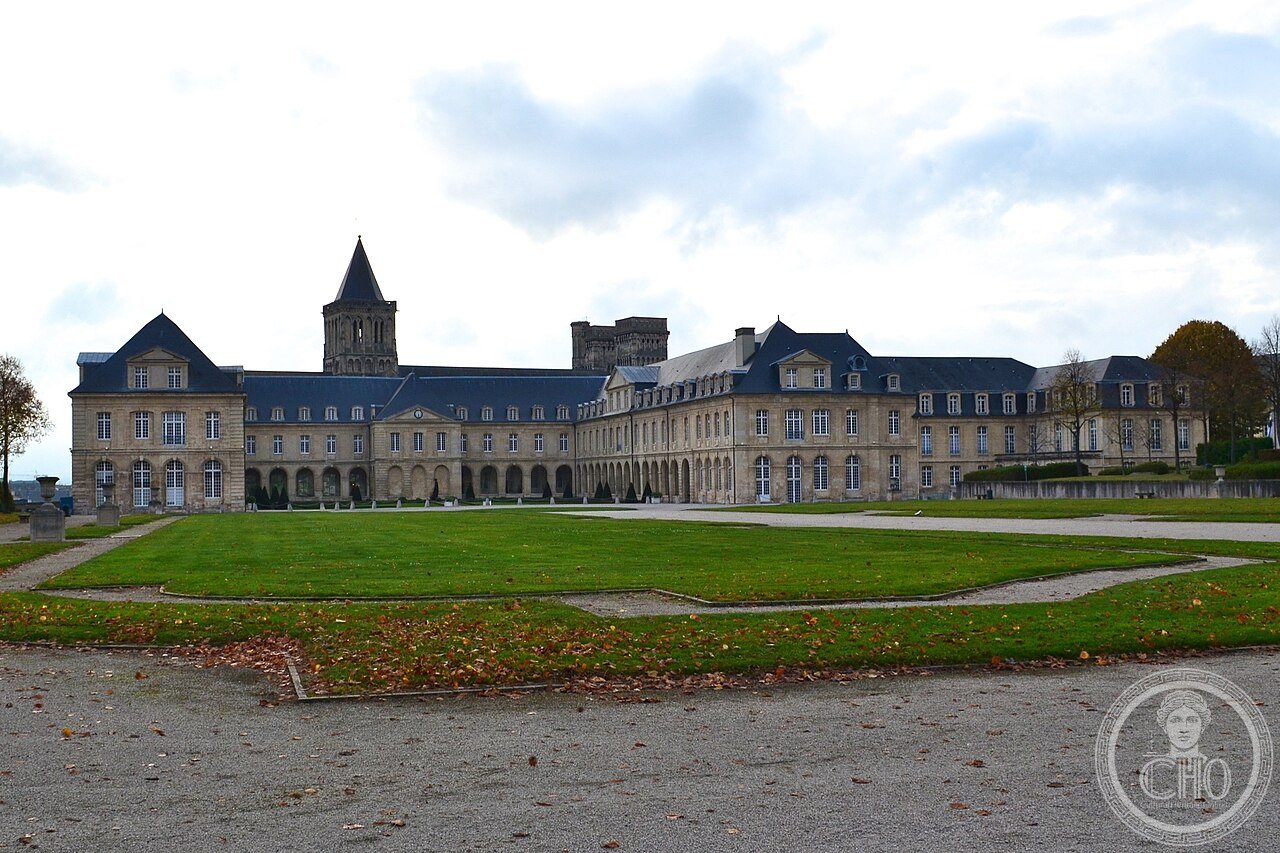
Like her husband William with his Abbaye aux Hommes, Matilda of Flanders founded this abbey for women as a penance for the marriage forbidden by Pope Leo IX. Consecrated in 1066 — the very year of the Norman conquest of England — the abbey still holds, beneath a slab of black Tournai marble, the tomb of Matilda: unlike her husband’s, never desecrated.
About Abbaye aux Dames, Caen
The Abbey of Sainte-Trinité, known as the Abbaye aux Dames (Women’s Abbey), was founded as a Benedictine nunnery around 1060 by William the Conqueror and his wife Matilda of Flanders, its establishment paired directly with William’s own Abbaye aux Hommes as part of the couple’s shared act of penance for their marriage, which Pope Leo IX had prohibited on grounds of consanguinity. Construction began in 1062, starting from the rear of the building, and continued until the complex was fully completed in 1130; the church itself, built between 1060 and 1080, was consecrated on 18 June 1066 — the very year of the Norman Conquest of England — and stands today as a fine example of Norman Romanesque architecture. Matilda died in 1083 and was buried in the choir beneath a slab of black Tournai marble inscribed with an epitaph praising her piety and noble lineage; the choir’s very layout is centred on her burial site. Unlike William’s own tomb at the Abbaye aux Hommes, which suffered repeated desecration during the Wars of Religion in 1562 and the French Revolution in 1793, Matilda’s tomb and its original black marble slab have survived largely intact, giving the Abbaye aux Dames a rare, genuinely continuous physical connection to one of Norman history’s most significant royal figures. The abbey complex today serves as the seat of the Regional Council of Normandy.
Key facts
- Foundation: c. 1060, by William the Conqueror and Matilda of Flanders, as shared penance for their prohibited marriage
- Construction: begun 1062; church built 1060-1080; complex completed 1130
- Consecration: 18 June 1066, the same year as the Norman Conquest of England
- Matilda’s death and burial: 1083, beneath a black Tournai marble slab in the choir
- Tomb survival: unlike William’s own tomb, Matilda’s has remained largely intact and undisturbed
- Modern use: seat of the Regional Council of Normandy
History
The paired foundation of the Abbaye aux Dames alongside William’s own Abbaye aux Hommes reflects the deliberately doubled, symmetrical character of the couple’s shared penitential response to Pope Leo IX’s marriage prohibition — a joint gesture in which both William and Matilda personally sponsored parallel monastic foundations, each eventually serving as their own individual burial site, giving the reconciliation with Rome a matched institutional weight reflecting both spouses’ equal culpability in the original canonical transgression. The church’s 1066 consecration, falling in the very same year as William’s conquest of England, situates the Abbaye aux Dames within the same pivotal historical moment that transformed the Norman duchy into a cross-Channel kingdom, even though the abbey’s own religious significance remained entirely separate from the military campaign unfolding simultaneously.
The striking contrast between Matilda’s largely undisturbed tomb and William’s own repeatedly desecrated burial — opened and scattered by Huguenot iconoclasts in 1562, then destroyed entirely by Revolutionaries in 1793 — offers a genuinely instructive case study in how nominally similar medieval royal tombs, founded by the same couple in parallel institutions, could suffer entirely different historical fates depending on subsequent religious and political currents specific to each site. Matilda’s survival intact makes the Abbaye aux Dames the more historically continuous of the two Caen royal foundations in terms of its founder’s actual physical presence.
What you see
Matilda of Flanders’s tomb, beneath its original black Tournai marble slab in the choir, is the abbey’s essential single destination, offering visitors a rare, genuinely undisturbed connection to an 11th-century Norman royal burial. The Romanesque church itself, dating substantially to the 1060-1080 building campaign, gives visitors direct access to fine Norman architecture contemporary with the Conquest itself. The abbey’s continuing institutional life as the seat of the Regional Council of Normandy situates the historic complex within an active contemporary civic role.
Practical information
- Opening hours: generally open daily, check current hours before visiting; free admission to the church
- Address: Avenue Georges Clemenceau, 14000 Caen, France
Getting there
Caen has direct rail connections from Paris (approximately 2 hours). The Abbaye aux Dames stands in central Caen, on the opposite side of the city from the Abbaye aux Hommes. GPS: 49.1876° N, -0.3490° E.
Nearby
- Abbaye aux Hommes — the corresponding Men’s Abbey, holding William the Conqueror’s own (largely destroyed) tomb
- Château de Caen — William the Conqueror’s castle, in the city centre
- D-Day beaches — the Normandy landing beaches, within reach of Caen
Sources
- Wikipedia — “Abbey of Sainte-Trinité, Caen” (en.wikipedia.org)
- History Hit — “Abbaye aux Dames” (historyhit.com)
- Caen la mer Tourisme — “Abbaye Aux Dames à CAEN” (caenlamer-tourisme.com)
Find it on the map
See this place and what’s around it →📷 Become a Cultural Heritage Online photographer
Share your photos of places: they stay published under your name as the author. The more they're seen, the more you get noticed — and soon a contest will reward the most appreciated photos.
Log in or sign up free to add a photo