
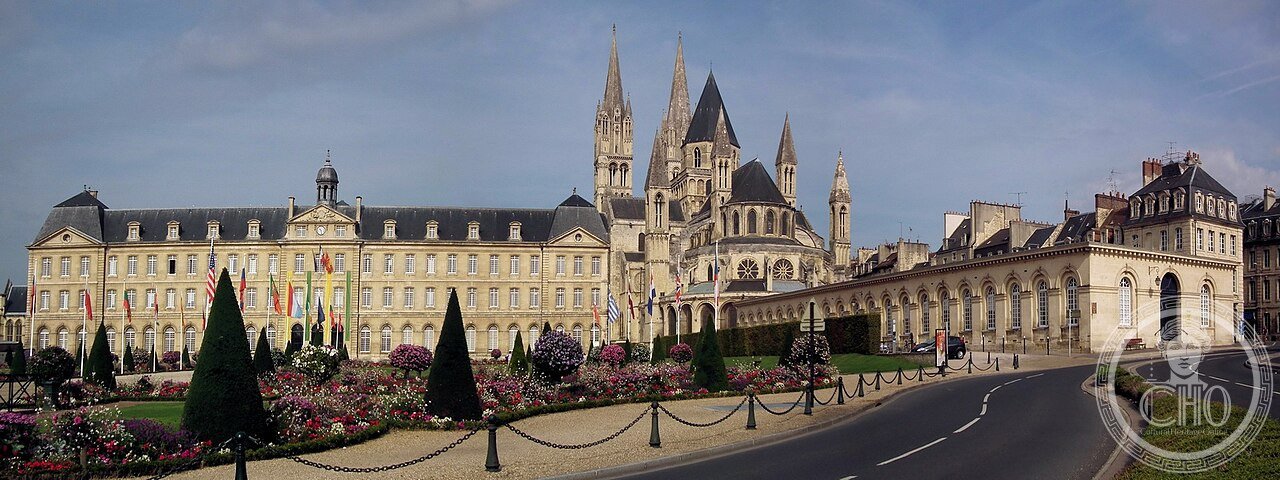
William the Conqueror founded the abbey as a penance, after Pope Leo IX had forbidden his marriage to his cousin Matilda of Flanders. Buried here in 1087, his body was too large for the tomb: when the attendants forced it in, it burst, filling the church with a revolting smell. The tomb was desecrated twice, first by Huguenot iconoclasts in 1562, then by revolutionaries in 1793, who scattered his bones in the street.
About Abbaye aux Hommes, Caen
The Abbey of Saint-Étienne, known as the Abbaye aux Hommes (Men’s Abbey), a former Benedictine monastery in Caen, Normandy, was founded in 1063 by William the Conqueror, with construction beginning in 1066. William established the abbey specifically as an act of penance and reconciliation with the Pope: he had fallen out with Pope Leo IX after marrying his cousin Matilda of Flanders around 1049, despite the pope’s explicit prohibition of the union. Lanfranc of Pavia, Prior of Bec Abbey — who had himself initially expressed concerns about the marriage — acted on William’s behalf to secure Leo’s eventual forgiveness, with the founding of paired Caen abbeys (this Men’s Abbey and the corresponding Women’s Abbey, Abbaye aux Dames) forming part of the reconciliation. The monastery’s consecration finally took place in 1077, cementing William’s legacy as both conqueror and significant patron of Church and art. Following his 1087 death in Rouen, William’s body was sent to Caen for burial at Saint-Étienne according to his own wishes, but the interment was marked by genuine indignity: the corpse, having swollen, proved too large for the prepared tomb, and when attendants forced it into the space, the body burst, spreading a disgusting odour throughout the church. William’s tomb subsequently suffered a troubled history of repeated disturbance: in 1562, during the French Wars of Religion, Huguenot iconoclasts opened the grave again, destroying the original black marble tombstone (similar to Matilda’s own at the Abbaye aux Dames) and scattering William’s bones, of which only a single thigh bone survived. Revolutionaries exhumed the burial once more in 1793, this time destroying William’s monument entirely and casting his remaining bone into the street.
Key facts
- Foundation: 1063, by William the Conqueror; construction begun 1066
- Founding motive: penance for his uncanonical marriage to Matilda of Flanders, arranged via Lanfranc of Bec
- Consecration: 1077
- William’s burial: 1087, following his death in Rouen; the corpse burst during interment due to a too-small tomb
- 1562: tomb opened and desecrated by Huguenot iconoclasts during the Wars of Religion; bones scattered, only a thigh bone recovered
- 1793: tomb exhumed and monument destroyed by Revolutionaries; remaining bone thrown into the street
History
William’s founding of the Abbaye aux Hommes as papal penance situates the monastery within a broader medieval pattern of powerful rulers using major ecclesiastical foundations to resolve genuine canon-law conflicts with the papacy — his and Matilda’s marriage, forbidden by Pope Leo IX likely on grounds of consanguinity, required exactly this kind of substantial, visible institutional reconciliation gesture to secure eventual papal acceptance, with Lanfranc’s diplomatic intervention proving essential to brokering the resolution. The paired foundation of both a Men’s and Women’s Abbey in Caen gave the reconciliation a symbolically balanced, doubled institutional weight appropriate to the seriousness of the original marital transgression.
William’s own burial disaster and the tomb’s subsequent double desecration — first by Reformation-era Huguenot iconoclasts, then by Revolutionary-era secularists nearly two and a half centuries later — makes his final resting place one of the most genuinely disturbed royal burials in European history, the loss of all but a single thigh bone reducing history’s most consequential Norman conqueror to an almost entirely erased physical presence within his own carefully chosen burial church. This repeated violation reflects the broader pattern of medieval royal and ecclesiastical tombs suffering targeted destruction during both the Wars of Religion’s iconoclastic violence and the French Revolution’s systematic assault on symbols of the old monarchical and religious order.
What you see
William the Conqueror’s tomb, its site marked despite the physical remains’ near-total historical loss, remains the abbey’s essential single destination for visitors tracing the Conqueror’s documented biography. The Romanesque abbey church, substantially dating to the 1063-1077 building campaign, offers a significant example of Norman Romanesque architecture directly associated with William’s own patronage. The abbey’s later conversion into a lycée (secondary school), still in partial use today, gives the site a continuing institutional life beyond its medieval monastic origins.
Practical information
- Opening hours: generally open daily, check current hours before visiting; guided tours available
- Address: Esplanade Jean-Marie Louvel, 14000 Caen, France
Getting there
Caen has direct rail connections from Paris (approximately 2 hours). The Abbaye aux Hommes stands in central Caen, a short walk from the city’s historic centre. GPS: 49.1811° N, -0.3729° E.
Nearby
- Abbaye aux Dames — the corresponding Women’s Abbey, holding Matilda of Flanders’s own tomb, elsewhere in Caen
- Château de Caen — William the Conqueror’s own castle, in the city centre
- D-Day beaches — the Normandy landing beaches, within reach of Caen
Sources
- Wikipedia — “Abbey of Saint-Étienne, Caen” (en.wikipedia.org)
- Caen la mer Tourisme — “In the footsteps of William the Conqueror at the Abbaye aux Hommes” (caenlamer-tourisme.com)
- History Hit — “Abbaye aux Hommes” (historyhit.com)
Find it on the map
See this place and what’s around it →📷 Become a Cultural Heritage Online photographer
Share your photos of places: they stay published under your name as the author. The more they're seen, the more you get noticed — and soon a contest will reward the most appreciated photos.
Log in or sign up free to add a photo