Aachen Cathedral

Aachen Cathedral Charlemagne Palatine Chapel Germany first UNESCO site Carolingian octagon
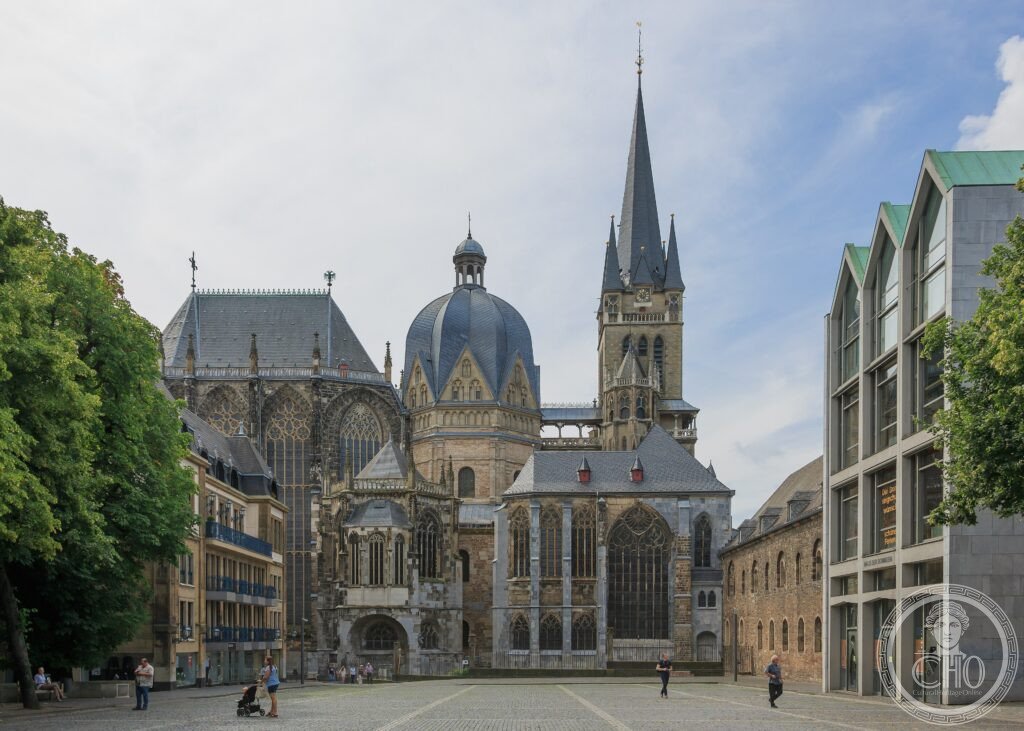
The Palatine Chapel of Aachen Cathedral (consecrated 805 CE; architect Odo of Metz; the octagonal dome 31.5m high; the bronze gates (original Carolingian period; 800 CE); the double-shell octagonal rotunda at the core of the cathedral (the Carolingian Palace Chapel of Charlemagne (742-814 CE), Emperor of the West (800 CE); the model for all subsequent centrally-planned sacred architecture in Western Europe)), Aachen (Aix-la-Chapelle), North Rhine-Westphalia, Germany. UNESCO World Heritage Site 1978 (the first site inscribed on the UNESCO list). Photo via Wikimedia Commons.
Aachen, North Rhine-Westphalia, Germany · Charlemagne’s Palatine Chapel 800 CE; first UNESCO World Heritage Site (1978); 30 Holy Roman Emperors crowned here; Charlemagne’s throne still in place

Aachen Cathedral

The cradle of European civilization and the first building ever inscribed on the UNESCO World Heritage List — Aachen Cathedral (Germany; UNESCO WHS 1978, site number 1) was built by Charlemagne as his Palatine Chapel (consecrated 805 CE), served as the coronation church for 30 Holy Roman Emperors, and contains the marble throne on which Charlemagne sat, still in its original position on the upper gallery of the octagonal rotunda.

At a glance

Aachen Cathedral (the most precisely AachenGermany single Aachen Aix-la-Chapelle North Rhine-Westphalia Germany 65 km west Cologne near Belgian Dutch border Carolingian Palatine Chapel consecrated 805 CE Charlemagne personal chapel royal palace complex Charlemagne built monumental chapel to demonstrate cultural equal of Byzantine emperors and ancient Rome Odo of Metz architect name recorded from document only architect name from Carolingian period known Odo built double-shell octagonal rotunda 16 sided outer wall 8 sided inner rotunda 31.5m dome height inspired by San Vitale Ravenna Byzantine 6th century CE Justinian mosaic decorations Byzantine craftsmen Justinian Ravenna Charlemagne copied San Vitale deliberately Rome classical inheritance claim bronze doors original Carolingian 800 CE wolf’s head door handles authentic 800 CE bronze 30 Holy Roman Emperors coronation 936 CE Otto I first coronation after Charlemagne died 813 CE 1531 CE last Ferdinand I coronation in Aachen 36 coronations total 30 German kings 6 queens Charlemagne throne marble Roman marble slabs assembled Carolingian throne pilgrim site 2 million visitors year UNESCO 1978 first inscription number 1 UNESCO heritage in any UNESCO world heritage site)).

Key facts

  • Why Aachen Cathedral was the first UNESCO World Heritage Site (the politics of heritage inscription in 1978): the UNESCO World Heritage Convention was adopted in 1972; the first formal World Heritage Committee meeting was held in September 1978; 12 sites were inscribed in the first round: Aachen Cathedral (Germany), L’Anse aux Meadows (Canada), the Galápagos Islands (Ecuador), Kraków (Poland), Ngorongoro Conservation Area (Tanzania), Quito (Ecuador), Simien Mountains National Park (Ethiopia), the Nahanni National Park Reserve (Canada), Yellowstone (USA), the Grand Canyon (USA), Rock Islands (Palau, then US Trust Territory), and Mount Kilimanjaro (Tanzania); Aachen Cathedral was given the UNESCO list number 1 (reflecting the alphabetical listing by country — Germany = Deutschland); being “number 1” was therefore alphabetical, not a ranking of importance; nonetheless, Aachen Cathedral is the de facto symbol of the World Heritage Programme: it appears on UNESCO publications and is the building most associated internationally with the WHC itself
  • GPS: 50.7747° N, 6.0836° E

History

From Roman baths to Carolingian palace to coronation church to pilgrimage centre (the most precisely AachenGermany single Roman period Aquae Granni Roman name Aachen thermal spring spa Roman baths 1st 4th century CE Romans settled Aachen for thermal springs 760 CE Charlemagne inherited throne from Pepin the Short 768 CE Charlemagne began using Aachen as preferred palace residence 794 CE Charlemagne established Aachen as permanent capital Carolingian Empire Frankfurt 794 synod moved to Aachen 800 CE Christmas Day 800 CE Pope Leo III crowned Charlemagne Emperor of the Romans in Rome first Holy Roman Emperor concept first use Augustus 800 CE 792 805 CE Palatine Chapel construction Odo of Metz architect consecrated 805 CE Charlemagne present consecration 814 CE Charlemagne died Aachen buried chapel 840 CE Louis the Pious succeeded died 843 CE Treaty of Verdun divided Carolingian Empire 3 parts East Francia West Francia Middle Francia 881 CE Charles the Fat briefly reunited empire 936 CE Otto I coronation Aachen first King Germany after Charlemagne 30 subsequent coronations 1165 CE Frederick Barbarossa Holy Roman Emperor canonized Charlemagne Sainthood political move 1000 CE Ottonian Westwork tower added 1355 1414 CE Gothic choir added extended east end to accommodate pilgrimages 1349 1414 CE Gothic choir construction 1656 CE town fire damaged 1978 CE first UNESCO inscription UNESCO heritage: the relics of Charlemagne and the Aachen pilgrimage (how a Carolingian emperor became a medieval saint): Pope Leo III excommunicated a political rival in 799 CE; Charlemagne rescued the Pope and restored him to Rome; in return, the Pope crowned Charlemagne Emperor on Christmas Day 800 CE; after Charlemagne’s death in 814 CE, his body was interred in the Palatine Chapel (the precise original burial location is debated — certainly in the chapel); in 1165 CE, Holy Roman Emperor Frederick Barbarossa (who needed to counter the political influence of the Pope) arranged the formal canonization of Charlemagne as Saint Charlemagne (Carolus Magnus); this created the Aachen pilgrimage route — pilgrims came to venerate the relics of Charlemagne (his skull, forearm bone, and other remains) and the four Great Relics (the robe of the Virgin Mary, the swaddling clothes of Jesus, the loincloth of Christ, and the cloth on which John the Baptist’s head rested after beheading); the Great Relics are displayed every 7 years (next display 2028 CE))) — the most precisely AachenGermany single Roman thermal baths Aquae Granni 794 CE permanent capital 800 CE Christmas Day Pope Leo III Emperor of Romans 792 805 CE Palatine Chapel Odo Metz 814 CE Charlemagne died buried 1165 CE Barbarossa canonized political 1000 CE Ottonian tower 1355 1414 CE Gothic choir 1978 CE first UNESCO list number 1 alphabetical Deutschland Great Relics robe Virgin swaddling clothes loincloth Baptist cloth displayed 7 years next 2028 UNESCO heritage in any UNESCO world heritage site)).

What you see

The Carolingian octagon, Charlemagne’s throne, and the cathedral treasury (the most precisely AachenGermany single Carolingian Palatine Chapel core original Charlemagne 792 805 CE double-shell octagon 16 outer sides 8 inner sides 31.5m dome mosaic interior Carolingian mosaic lost restored 19th century CE gold mosaic ceiling recreated original Carolingian design gold background Christ enthroned 24 elders original medieval columns ancient Roman columns from Ravenna and Rome brought north by Charlemagne bronze doors wolf head door handles original 800 CE Carolingian bronze actual 1200-year-old original metalwork still in daily use Charlemagne marble throne upper gallery 6 marble slabs assembled from Roman spolia plain no ornamentation throne of German kings 800 CE 1531 CE Karlsschrein Charlemagne reliquary 1215 CE Frederick II golden reliquary chest containing Charlemagne remains finest Mosan goldsmith work Cathedral Treasury Domschatzkammer finest collection Carolingian and medieval goldsmith work in world Lothair Cross 1000 CE Ottonian Otto III gold filigree cross Bust Reliquary Charlemagne 1350 CE gold bust containing Charlemagne skull top of head Gothic choir 1355 1414 CE seven large windows stained glass enormous 1414 CE stained glass among largest medieval gothic windows Germany Hungarian Chapel 1367 CE private chapel additional extensions several other chapels added Ottonian Hohenstaufen periods UNESCO heritage: the Carolingian columns of Aachen (the physical evidence of Charlemagne’s imperial ambitions): Charlemagne transported approximately 50 marble columns from Rome and Ravenna to Aachen for the Palatine Chapel; the columns (the green porphyry columns from Ravenna, probably from the Exarchate of Ravenna; the white marble columns from Rome) represent the physical materials of the old Roman Empire literally carried north and installed in the new Carolingian capital; the Byzantine Emperor Irene (the Eastern Roman Empress) was asked for permission to remove the columns from Ravenna — the fact that the Byzantine Emperor needed to approve the removal confirms that Charlemagne negotiated with Constantinople for imperial legitimacy; the columns are still in the interior of the Aachen Cathedral, in their original Carolingian positions — making them the most tangible physical link between the Roman Empire and the Carolingian dynasty)) — the most precisely AachenGermany single octagon 16 outer 8 inner 31.5m dome Carolingian gold mosaic Christ enthroned 24 elders recreated 19th century original design bronze doors wolf heads original 800 CE Carolingian 1200 years daily use marble throne plain Roman spolia 6 slabs upper gallery 800 1531 CE Karlsschrein 1215 CE Frederick II finest Mosan gold reliquary Domschatzkammer finest Carolingian medieval goldsmith world Lothair Cross 1000 CE Ottonian Otto III gold filigree Bust 1350 CE Charlemagne skull Gothic choir 1355 1414 CE 50 columns from Rome Ravenna Byzantine Irene permission UNESCO heritage in any UNESCO world heritage site)).

Practical information

  • Getting there: from Cologne: ICE train (35-40 min; €15-35; frequent departures from Cologne Hauptbahnhof); or RE regional train (1h15m; €12; every 30 min); by car from Cologne (70 km; 1h on A4 Autobahn); from Brussels: Thalys/Eurostar to Aachen (1h; €30-60); from Amsterdam: IC train to Aachen (2h30m via Eindhoven; €25-50); the Cathedral (free entry to the main nave; the Carolingian octagon and choir are free and always open during visiting hours; 7 AM-7 PM Mon-Fri, Sat-Sun 7 AM-6 PM; cathedral tours: €4 per person; begin every 30 min at the main entrance); Charlemagne’s throne (accessible only on guided tour of the upper gallery; tours 2-3 times/day; book in advance at the cathedral information centre); the Cathedral Treasury Domschatzkammer (€5; open Mon 10 AM-1 PM, Tue-Sun 10 AM-6 PM; one of the greatest treasury collections in Europe; the Lothair Cross and the Carolingian bronzes alone justify the visit); best time (Aachen is accessible year-round; Christmas markets (Weihnachtsmarkt) around the cathedral are among the finest in Germany (November-December))

Getting there

From Cologne: ICE 35-40 min (€15-35) or RE 1h15m (€12). From Brussels: Thalys 1h. Cathedral free; throne tour €4 (book ahead). Treasury €5 (essential). Best: year-round; Christmas market December exceptional. GPS: 50.7747, 6.0836.

Nearby

  • Cologne — 70 km east (the Cologne Cathedral (Kölner Dom; UNESCO WHS 1996; the longest-constructed Gothic cathedral in the world (1248-1880 CE, 632 years); 157m height; the Reliquary of the Three Magi (the largest golden reliquary in the world; the Three Wise Men of the Nativity story are supposedly entombed inside); the most visited monument in Germany (6 million visitors/year))
  • Maastricht — 30 km north (Netherlands; the Basilica of Our Lady (11th century CE; the finest Romanesque church in the Netherlands; the Black Madonna); the Basilica of Saint Servatius (4th century CE founding; the oldest church building in the Benelux); the Maastricht underground (Roman and medieval tunnels (Sint Pietersberg); the casemates (18th century military tunnel system)); the city where the Maastricht Treaty establishing the European Union was signed (1992 CE)))

Sources

  • Wikipedia, Aachen Cathedral; Charlemagne; Palatine Chapel, Aachen; Odo of Metz, accessed June 2026
  • UNESCO, Aachen Cathedral, WHS reference 3, inscribed 1978 (site number 1 alphabetically)

Hero image: Aachen Cathedral, North Rhine-Westphalia, Germany, Wikimedia Commons. Editorial text © Cultural Heritage Online, 2026.

📷 Diventa un fotografo di Cultural Heritage Online

Condividi le tue foto dei luoghi: restano pubblicate con la tua firma come autore. Più vengono viste, più ti fai conoscere — e presto un concorso premierà le foto più apprezzate.

Accedi o registrati gratis per aggiungere una foto
📋 Copy & share on social
Scroll to Top