
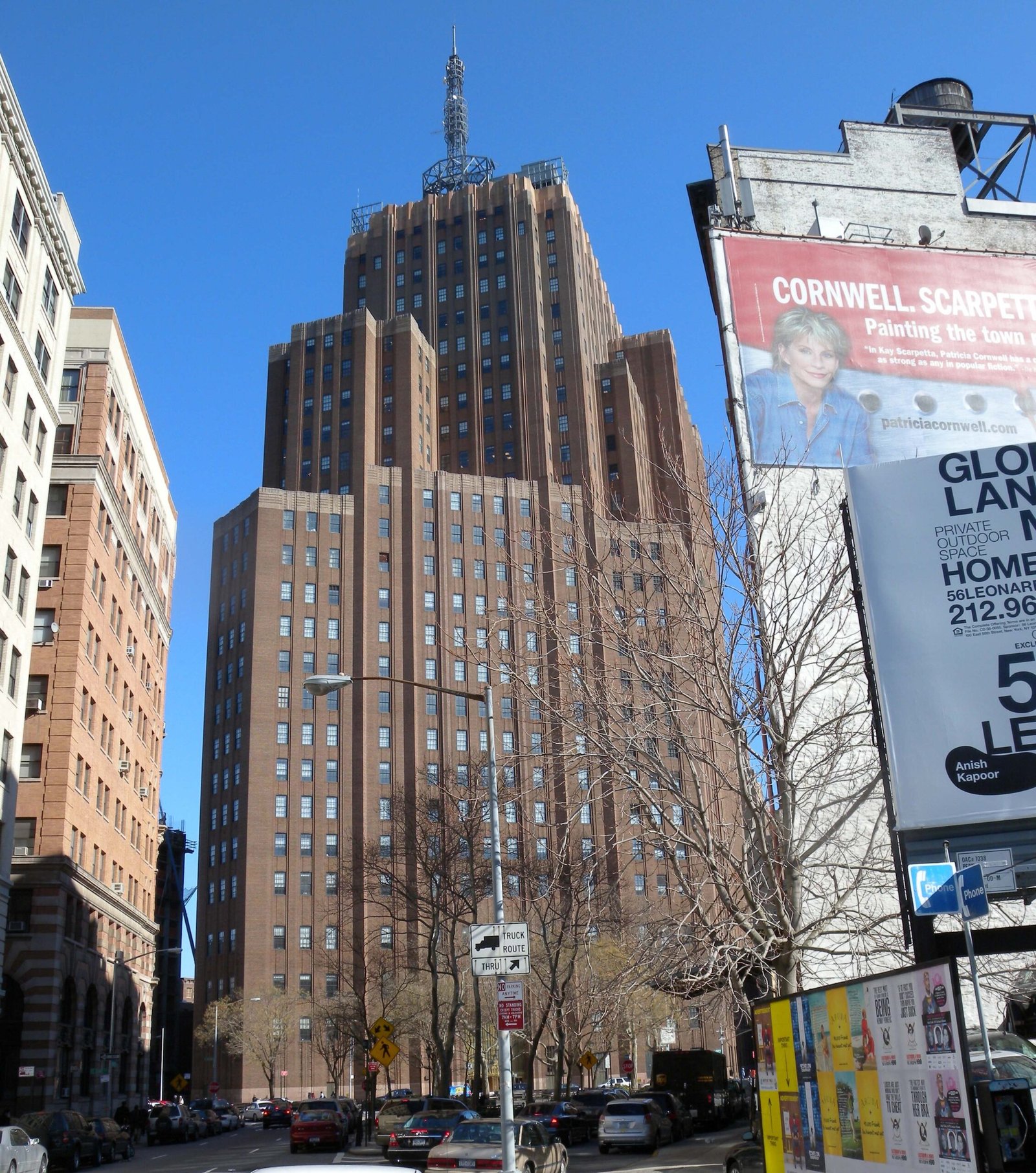
A 27-story Art Deco telecommunications tower completed in 1932, designed by Ralph Thomas Walker. Upon completion, it was the world’s largest building dedicated exclusively to long-distance calling.
At a glance
This 549-foot brick tower dominates a full block in Tribeca, bounded by Walker, Lispenard, Church Street, and Avenue of the Americas. Originally built for AT&T, it remains operational as a data and communications center, though no longer AT&T-owned. Its exterior and landmark lobby were designated official New York City landmarks in 1991.
History
The site’s development spanned two decades. The original Walker–Lispenard Building (24 Walker Street) was designed between 1911 and 1914 by Cyrus L. W. Eidlitz and McKenzie, Voorhees & Gmelin. It was expanded by seven stories in the late 1910s. The final and most ambitious campaign—undertaken between 1929 and 1932—created the current structure. This last major skyscraper by Walker in Lower Manhattan represented the pinnacle of Art Deco telecommunications design.
What you see
The building’s design emphasizes technological modernity through complex massing and numerous setbacks. Its brick façade displays varied hues and is crowned by decorative parapets. Ornamental detailing conveys both progressiveness and cutting-edge design—visual qualities that mirror its engineering purpose. The main lobby contains murals celebrating the building’s role as a communications hub, reflecting mid-century optimism about telecommunications technology.
Cultural significance
32 Avenue of the Americas exemplifies how Art Deco style elevated functional infrastructure into architectural statement. As the world’s largest dedicated long-distance calling facility upon completion, it represented American technological leadership and the infrastructure revolution of the early 20th century. The building’s landmark status recognizes its historical importance to both telecommunications and New York City’s architectural heritage.
Key facts
- Country: United States
- City: Manhattan, New York
- Completed: 1932
- Height: 549 feet (167 meters)
- Stories: 27
- Architect: Ralph Thomas Walker (final campaign); Cyrus L. W. Eidlitz and McKenzie, Voorhees & Gmelin (original phase)
- Coordinates: 40.7200°N, 74.0047°W
- Landmark designation: 1991
Practical information & getting there
The building is located in the Tribeca neighborhood of Lower Manhattan, occupying the full block bounded by Walker Street, Lispenard Street, Church Street, and Avenue of the Americas (Sixth Avenue). This area is well served by public transit and lies within Manhattan’s historic downtown district. The exterior and lobby remain visible and accessible to visitors exploring the neighborhood’s architectural heritage.
Sources & resources
Find it on the map
See this place and what’s around it →📷 Become a Cultural Heritage Online photographer
Share your photos of places: they stay published under your name as the author. The more they're seen, the more you get noticed — and soon a contest will reward the most appreciated photos.
Log in or sign up free to add a photoIs this page about you?
This page is read by travellers and heritage enthusiasts who find it on Google. Tell us how you are connected to this place and we will take it from there.