

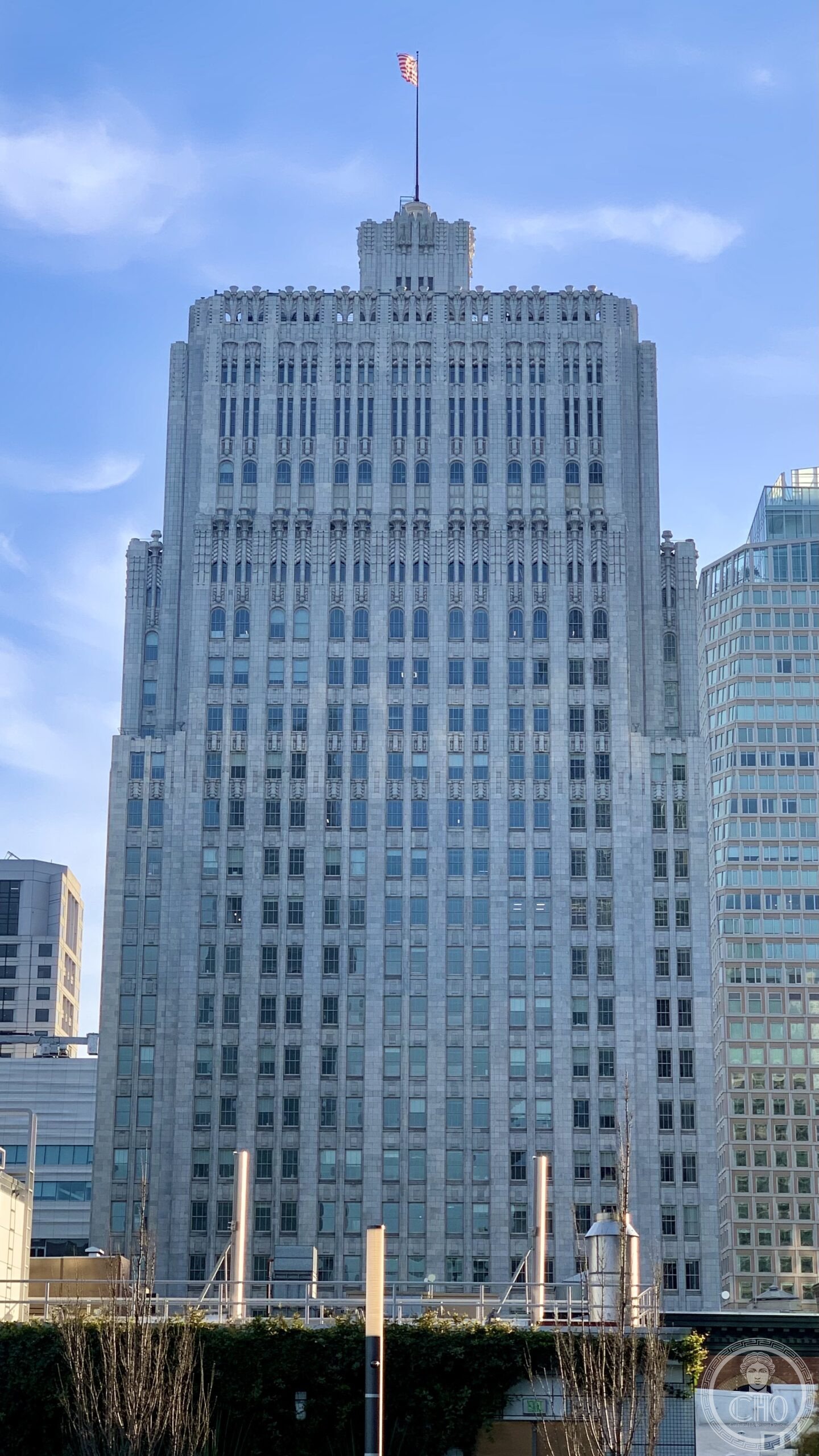

Completed in 1925 for the Pacific Telephone and Telegraph Company, the 26-story tower at 140 New Montgomery Street is the most formally resolved Gothic Art Deco skyscraper in San Francisco — its limestone facade rising from a two-story commercial base through a sequence of carefully modulated setbacks to a crown of Gothic pinnacles and tracery, designed by Timothy Pflueger and James Miller of the firm Miller & Pflueger at the height of their architectural influence on the city.
At a glance
Standing 26 stories on a street that Timothy Pflueger helped to define, 140 New Montgomery was among the most prominent commercial towers in San Francisco when it was completed in 1925. The facade in Indiana limestone combines Gothic tracery and pointed arches with the setback massing demanded by the city’s 1921 height ordinance, creating a tower that reads simultaneously as medieval and Modern. The building served as the headquarters of Pacific Telephone and Telegraph until the company’s eventual consolidation into AT&T; it subsequently became the headquarters of Yelp, Inc., and is listed on the National Register of Historic Places and designated a San Francisco Landmark. Its position between Market Street and the Financial District makes it one of the most visible examples of Gothic commercial architecture on the West Coast.
Key facts
- Completed: 1925
- Architects: Miller & Pflueger (Timothy Pflueger and James Miller)
- Style: Gothic Art Deco
- Address: 140 New Montgomery St, San Francisco, CA 94105
- Height: 26 stories
- NRHP: Listed; San Francisco Landmark
- Notable: Tallest building in San Francisco at completion; limestone Gothic facade with setback crown; AT&T / Yelp HQ
History
Timothy Pflueger was the defining architect of San Francisco’s Art Deco decade. Born in San Francisco in 1892, he joined James Miller’s firm as a young draftsman and became a partner; together, as Miller & Pflueger, they produced a sequence of buildings that gave the city its Art Deco character: the 450 Sutter Street dental building with its Mayan-influenced interior, the Pacific Coast Stock Exchange at 301 Pine Street, the Castro Theatre, and, beginning in 1922, the Pacific Telephone Building at 140 New Montgomery. The telephone company’s brief was straightforward: a tall, prominent headquarters that would announce the company’s prestige and its technological modernity to the growing city. Pflueger’s response was to synthesise the Gothic vocabulary of the Tribune Tower competition — then dominating architectural discussion in the United States — with the setback massing requirements of San Francisco’s 1921 building ordinance.
The result was a building that reads differently from different vantages. From the intersection of New Montgomery and Mission, where the street narrows to a canyon, the tower’s full height is compressed and the Gothic crown appears directly above the entrance portal. From the elevated Salesforce Park to the north, now possible from the Transbay Transit Center, the building’s relationship to the surrounding Financial District towers — taller but mostly post-war glass and steel — makes its limestone mass and Gothic silhouette stand out as the anchor of the earlier generation of commercial San Francisco.
Pacific Telephone and Telegraph occupied the building until the consolidations that created AT&T Pacific Bell. The building subsequently passed through several corporate tenants before Yelp, Inc. made it their headquarters. The landmark designation has protected both the exterior and key interior elements, including the lobby with its original bronze hardware and period ornament. The building remains in active commercial use.
What you see
The New Montgomery Street facade is the building’s set-piece: a 26-story composition in Indiana limestone that rises from a two-story commercial base — with carved Gothic surrounds at the entrance and arched windows in the upper base zone — through a shaft of vertical piers to the setback zone at approximately the 18th floor, where a programme of tracery panels and carved ornament marks the transition to the upper tower. The crown, with its Gothic pinnacles and pointed arch windows, is Pflueger’s most ambitious formal gesture: at this height the ornament is visible from several blocks away, and the silhouette of the tower against the sky is one of the most distinctive in the city.
The lobby, entered from New Montgomery Street, is the best-preserved of the public spaces: the bronze entrance doors, the marble wall surfaces, and the vaulted ceiling with its original bronze lighting fixtures survive in excellent condition. The spatial character of the lobby — tall, narrow, transitional — is characteristic of Pflueger’s approach to public space in commercial buildings: the architecture announces the institution without overwhelming the individual. From Salesforce Park above the Transbay Transit Center, to the north, the building’s relationship to the surrounding district becomes legible as a diagram of the city’s architectural history: limestone and terra cotta on one side, glass curtain wall on the other.
Practical information
- Lobby access: Weekdays during business hours; free entry
- Best view: New Montgomery Street looking north from Howard; or from Salesforce Park rooftop garden
- Time needed: 20–30 minutes lobby + exterior
- GPS: 37.7876° N, 122.3996° W
- Nearest transit: BART Montgomery St station (3 minutes walk)
Getting there
140 New Montgomery Street is in the South of Market district, immediately south of Market Street and east of the Union Square retail area. BART serves Montgomery St station (Market and Montgomery) 3 minutes north on foot; Muni Metro serves the same station. San Francisco International Airport (SFO) is approximately 14 miles (23 km) south; BART from SFO to Montgomery St takes approximately 35 minutes.
Nearby
- Salesforce Transit Center / Salesforce Park — roof garden above the new transit hub with panoramic views including the 140 New Montgomery silhouette, 5 minutes north-east
- 450 Sutter Street (1929) — Timothy Pflueger’s Mayan-influenced Art Deco dental building, already in the CHO collection, 8 minutes north-west
- San Francisco Museum of Modern Art (SFMOMA) — Mario Botta 1995 + Snohetta 2016 extension; world-class modern and contemporary collection; 3 minutes west on Howard Street
Sources
- National Register of Historic Places, Pacific Telephone Building nomination — nps.gov
- San Francisco Planning Department, Landmark designation records — sf.gov
- Gebhard, David, and Deborah Nevins. 200 Years of American Architectural Drawing. Whitney Library of Design, 1977.
- Wikidata, 140 New Montgomery / Pacific Telephone Building — wikidata.org
- California Office of Historic Preservation, building record — ohp.parks.ca.gov
Find it on the map
See this place and what’s around it →📷 Become a Cultural Heritage Online photographer
Share your photos of places: they stay published under your name as the author. The more they're seen, the more you get noticed — and soon a contest will reward the most appreciated photos.
Log in or sign up free to add a photoIs this page about you?
This page is read by travellers and heritage enthusiasts who find it on Google. Tell us how you are connected to this place and we will take it from there.