

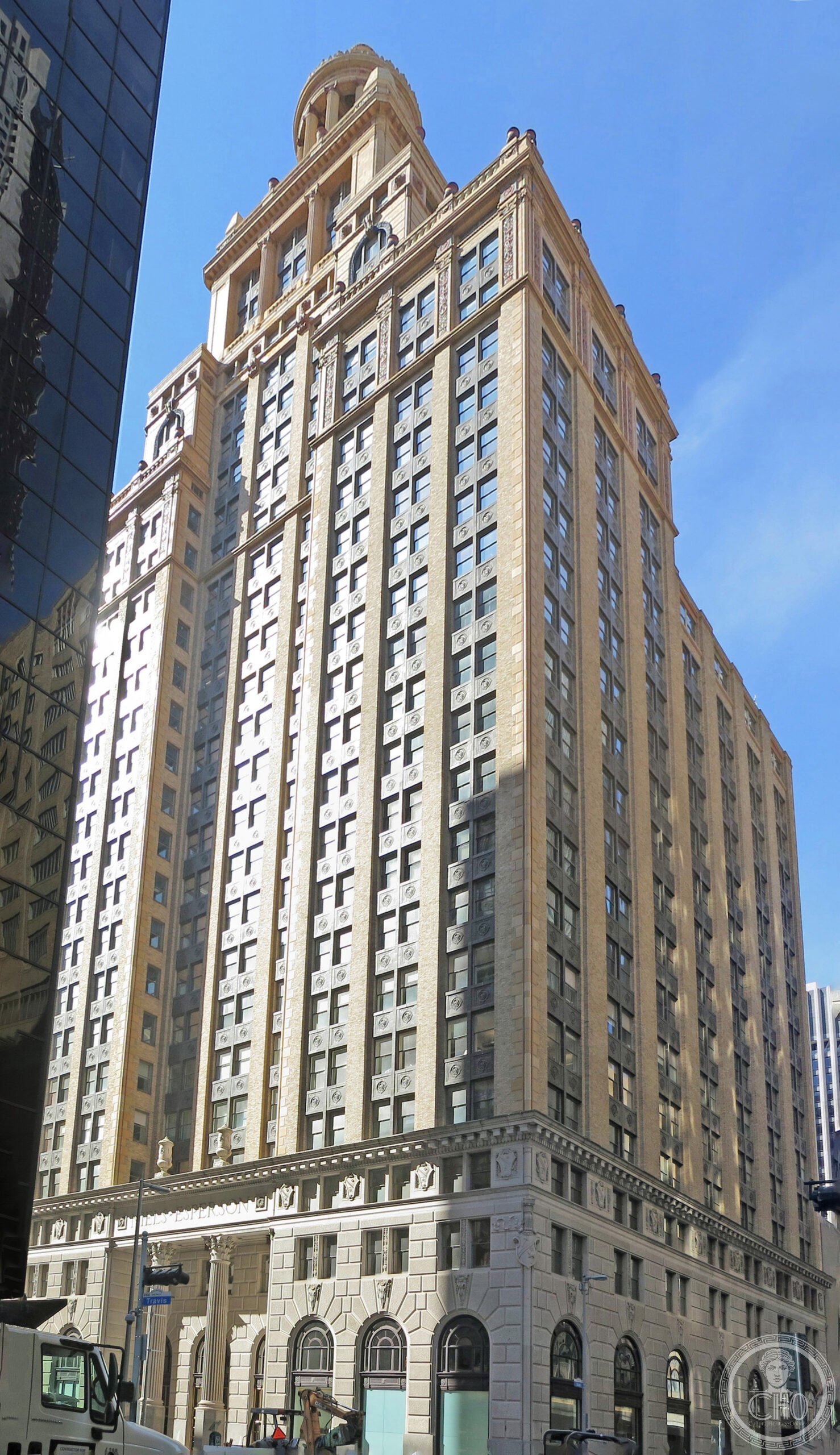

Completed in 1927 at 808 Travis Street in downtown Houston, the Niels Esperson Building is the most distinctive skyscraper in the Texas bayou city’s early commercial skyline — a 32-story tower designed by John Eberson whose upper shaft and crowned cupola blend Italian Renaissance ornament with Art Deco massing, built by Mellie Esperson as a monument to her late husband Niels and long regarded as among the most beautiful commercial buildings in Texas.
At a glance
The Niels Esperson Building at 808 Travis Street was commissioned by Mellie Esperson to honour the memory of her husband, oil magnate Niels Esperson, who had died before his ambitions for a downtown Houston skyscraper could be realised. Designed by John Eberson — best known for his “atmospheric” cinema interiors but equally accomplished in commercial towers — the building rises 32 stories in a composition that draws on Italian Renaissance palace architecture for its ornamental vocabulary while employing the setback and verticality of the American skyscraper tradition. The adjacent Mellie Esperson Building (1941) at the same address is a later companion tower. Together, the Esperson Buildings form one of the signature ensembles of Houston’s pre-war downtown. The Niels Esperson Building is listed on the National Register of Historic Places.
Key facts
- Completed: 1927
- Architect: John Eberson (attributed)
- Style: Italian Renaissance / Art Deco
- Address: 808 Travis St, Houston, TX 77002
- Height: 32 stories
- NRHP: Listed; Texas Historic Landmark
- Notable: Built by Mellie Esperson as memorial to her husband Niels; cupola crown; companion to Mellie Esperson Building (1941)
History
Niels Esperson arrived in Texas in the late 19th century and became one of the state’s most successful oil operators, building his fortune from the discoveries of the early Texas oil boom. His ambition, before his death in 1922, was to build a skyscraper in downtown Houston that would announce the city’s commercial importance and serve as a monument to the industry that had transformed it. It fell to his widow, Mellie Esperson, to realise that ambition. She commissioned John Eberson — the architect of dozens of atmospheric movie palaces across the United States, whose theatrical approach to ornament translated naturally to a prestige tower commission — to design the building that would carry her husband’s name.
Eberson’s design drew on the Italian Renaissance tradition, particularly the Venetian palace, for its ornamental vocabulary: the upper floors are clad in a programme of arched windows, carved cornices, and pilasters that transform the setback skyscraper form into something that reads, from the street, more like a campanile or a palazzo than a conventional office tower. The crown — a cupola set atop the setback zone of the upper shaft — is the building’s most distinctive feature at a distance. The overall effect is of a European landmark transposed to the Texas bayou city, which is precisely what Mellie Esperson intended.
The Niels Esperson Building was completed in 1927 and served as one of the premier office addresses in Houston for decades. The companion Mellie Esperson Building, designed by Kenneth Franzheim and completed in 1941, extended the complex to the south. The Esperson Buildings were listed on the National Register of Historic Places in recognition of their architectural significance within the context of Texas and the American South-West. The buildings continue in commercial use and remain one of the most-photographed architectural ensembles in downtown Houston.
What you see
The Travis Street facade of the Niels Esperson Building is the building’s most formal presentation: a composition in cream-coloured terracotta that rises from a two-story commercial base through a central shaft of vertical piers to the setback zone, where the Renaissance ornamental programme intensifies into a sequence of arched loggias, carved figurative panels, and elaborate cornices. The cupola above, set on an octagonal drum with arched openings, is the building’s crown and its most visible element at a distance — visible from the freeway approaches to downtown and from the elevated viaducts that surround the central business district.
At street level, the building’s entrance on Travis Street is framed by a two-story arcade with carved Renaissance ornament and bronze hardware. The lobby beyond is one of the best-preserved pre-war commercial interiors in Houston, with original marble floors, ornate bronze elevator surrounds, and painted ceiling panels. The relationship between the Niels Esperson (1927) and the later Mellie Esperson (1941) is best understood from the intersection of Travis and Rusk, where the massing of both towers is visible together.
Practical information
- Lobby access: Open weekdays during business hours; free entry
- Best view: Travis Street looking north from Rusk; or from Main Street looking west
- Time needed: 20–30 minutes lobby + exterior
- GPS: 29.7560° N, 95.3693° W
- Nearest transit: METRORail Main Street Square station (4 minutes walk)
Getting there
The Niels Esperson Building is at 808 Travis Street in downtown Houston, two blocks from Main Street. The METRORail Red Line serves Main Street Square station (Main and Commerce) 4 minutes east on foot. George Bush Intercontinental Airport (IAH) is approximately 23 miles (37 km) north; the METRO Express Bus 102 connects the airport to downtown in approximately 50–70 minutes.
Nearby
- Gulf Building (1929) — Gothic Art Deco tower at 712 Main Street, 3 minutes south; Alfred C. Finn architect; the other great pre-war Houston skyscraper
- Market Square Park — downtown Houston’s original civic centre; Travis and Congress, 2 minutes north
- Minute Maid Park — home of the Houston Astros, with its retractable roof and Crawford St facade; 10 minutes east on foot
Sources
- National Register of Historic Places, Esperson Buildings nomination — nps.gov
- Texas Historical Commission, Esperson Buildings marker — thc.texas.gov
- Houston Preservation Alliance, Esperson Buildings entry — houstonpreservation.org
- Gray, Lisa. “The skyscrapers that built Houston.” Houston Chronicle, 2014 (architecture series).
- Wikidata, Esperson Buildings Q6436869 — wikidata.org
Find it on the map
See this place and what’s around it →📷 Become a Cultural Heritage Online photographer
Share your photos of places: they stay published under your name as the author. The more they're seen, the more you get noticed — and soon a contest will reward the most appreciated photos.
Log in or sign up free to add a photoIs this page about you?
This page is read by travellers and heritage enthusiasts who find it on Google. Tell us how you are connected to this place and we will take it from there.