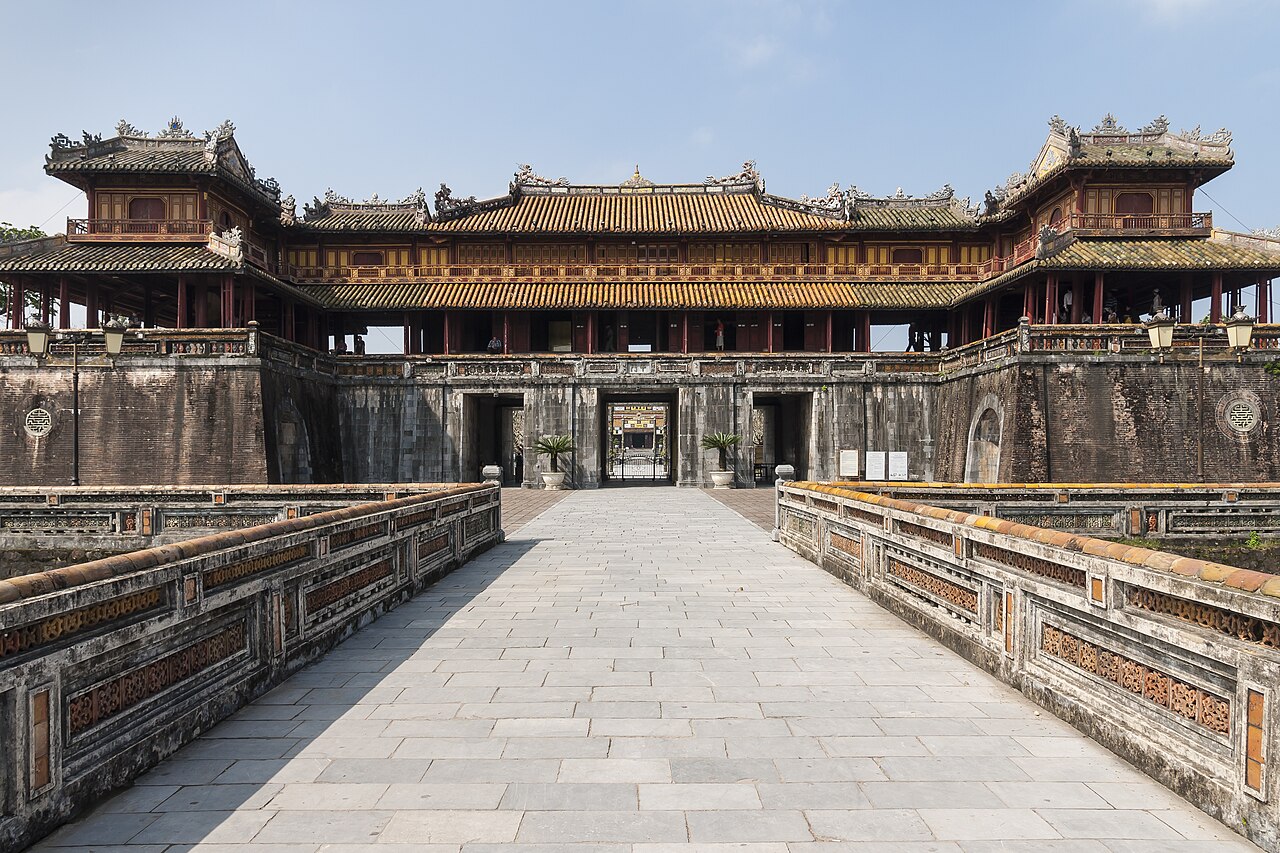
Two World Heritage sites lie within 100 km of the Complex of Hué Monuments: My Son Sanctuary (85 km) and Hoi An Ancient Town (95 km), both in Viet Nam. Phong Nha-Ke Bang National Park follows at 191 km. Hué itself was the capital of a unified Viet Nam from 1802 to 1945, a defended city planned and built by the Nguyen dynasty in the early 19th century.
The World Heritage sites within reach of Hué
The distances below are straight lines between the reference points that UNESCO publishes for each property, measured to the nearest component of a serial site. They show what is near, not how long the road takes.
| Site | Country | Distance | Inscribed | Type |
|---|---|---|---|---|
| My Son Sanctuary | Viet Nam | 85 km | 1999 | Cultural |
| Hoi An Ancient Town | Viet Nam | 95 km | 1999 | Cultural |
| Phong Nha-Ke Bang National Park and Hin Nam No National Park | Viet Nam, Laos | 191 km | 2003 | Natural |
| Vat Phou and the Champasak cultural landscape | Laos | 254 km | 2001 | Cultural |
| Temple of Preah Vihear | Cambodia | 381 km | 2008 | Cultural |
| Koh Ker (ancient Lingapura or Chok Gargyar) | Cambodia | 436 km | 2023 | Cultural |
The three nearest sites read as a sequence along the central coast. My Son was the religious and political capital of the Champa Kingdom for most of its existence, the centre of a culture that grew between the 4th and 13th centuries out of Indian Hinduism. Hoi An is a South-East Asian trading port dating from the 15th to the 19th century. Hué, from 1802, is the capital of a unified state. Phong Nha-Ke Bang is another kind of heritage altogether: a limestone karst whose formations began developing around 400 million years ago.
Who planned Hué, and how long did it take?
Gia Long, first ruler of the Nguyen dynasty, made Hué the national capital in 1802. ICOMOS, in its 1993 evaluation, gives the reasons: its position in the geographical centre of the country, and its easy access to the sea. The detailed planning was entrusted to Nguyen Van Yen, commander of an army unit specialising in the construction of citadels.
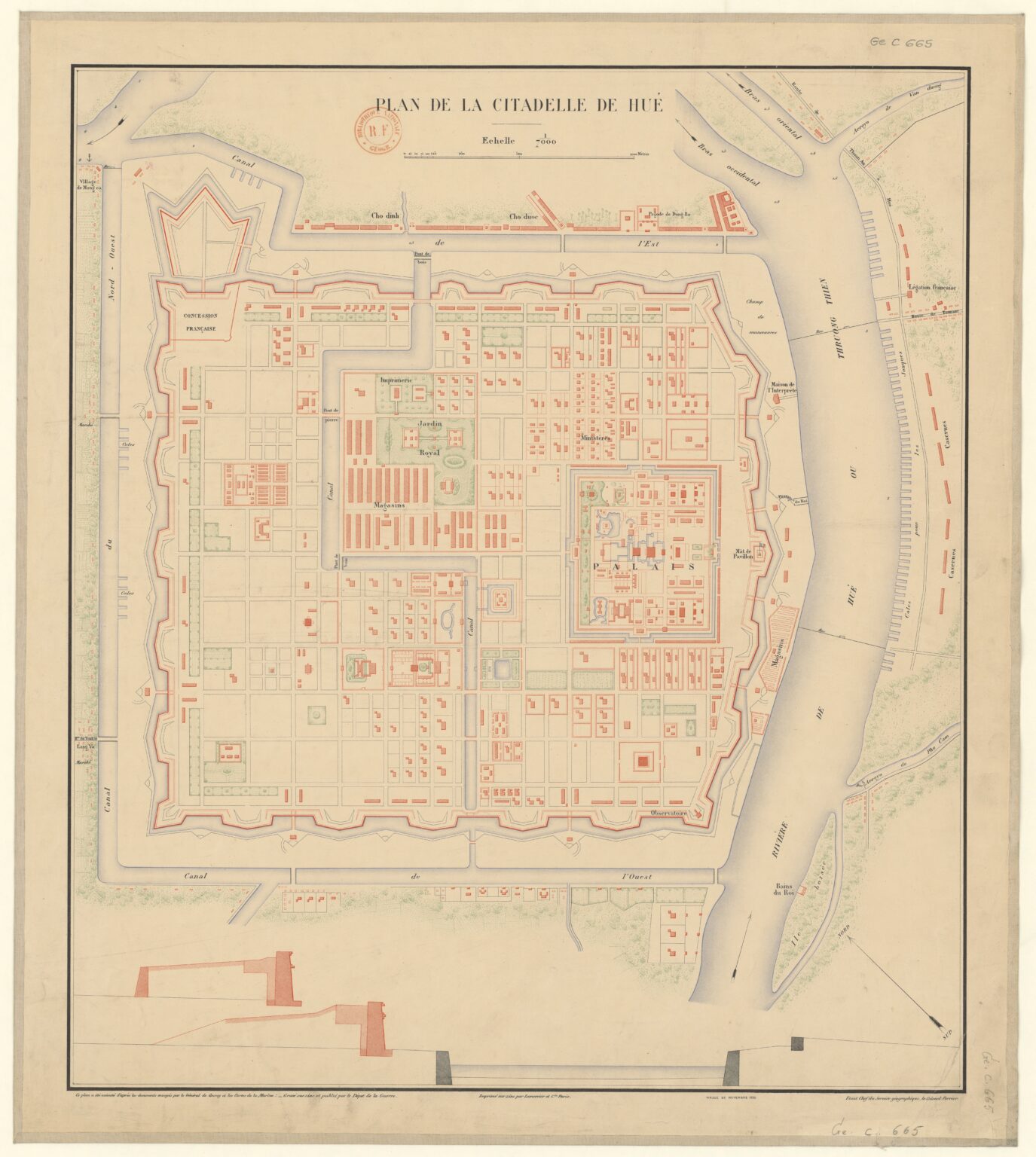
Planning ran from 1803 to 1805, and construction was not complete until 1832. Over 30,000 workmen and soldiers took part; they filled in two small tributaries of the Perfume River and dug new moats and canals. ICOMOS says the fortress was modelled on the European style of Vauban. UNESCO describes the layout as aligned with the five cardinal points, the five elements and the five colours, and placed against the Ngu Binh Mountain, the “Royal Screen”, with the Perfume River as its main axis. That speed is part of the case: UNESCO calls Hué a remarkable example of building a complete defended capital in a relatively short period.
What stood inside the walls?
The outer enclosure, the Capital City (Kinh Thanh), is square in plan, each side measuring 2,235 m, with ten gates and six projecting bastions on each side. Its walls were originally 21 m thick and 6.6 m high. Inside lies the Inner City (Dai Noi), 622 m by 604 m, divided into zones for ceremonies, worship, the king’s mother and grandmother, storage and workshops, and a garden and school for the princes. At its heart is the Forbidden Purple City (Tu Cam Thanh), 324 m by 290 m, with a single front gate reserved for the king.
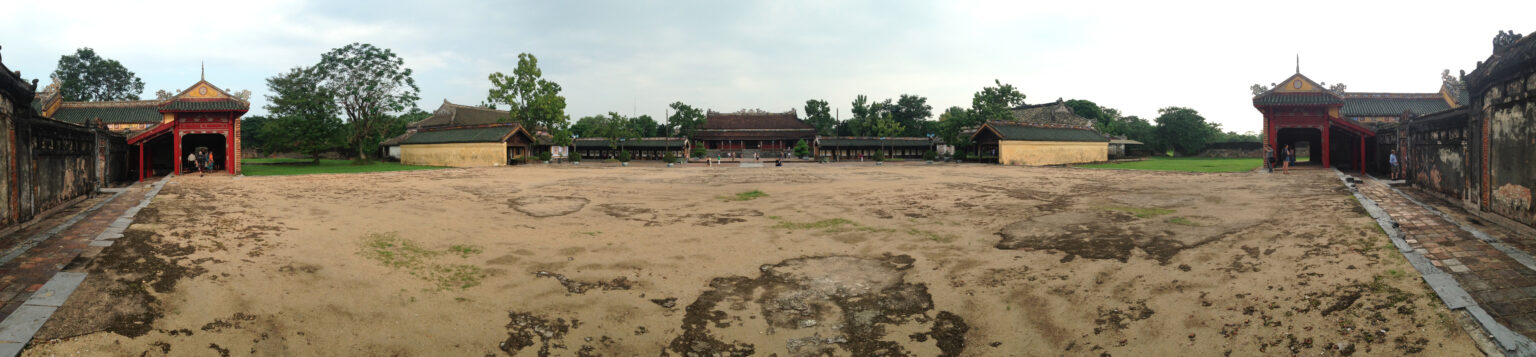
ICOMOS counted over 40 buildings in the Forbidden Purple City originally; by 1993 most were ruins and only their foundations survived. The complex, it notes, suffered considerably in military operations in 1885, 1947 and 1968. Among the survivors is the Thai Hoa Hall, the Palace of Supreme Harmony, built in 1805 and renovated in 1833 and 1923, according to the Hué Monuments Conservation Centre; it houses the throne and a gilded nine-dragon canopy. The Nine Dynastic Urns were cast from 1835 to 1837 under Minh Mang, each carrying 17 bas-reliefs and weighing between about 1,930 and 2,600 kg.
Why does the List carry one criterion when ICOMOS proposed two?
ICOMOS recommended inscription on criteria (iii) and (iv) in October 1993. Its criterion (iii) read: Hué is an outstanding demonstration of the power of the vanished Vietnamese feudal empire at its apogee in the early 19th century. UNESCO’s page for the property lists criterion (iv) only: an outstanding example of an eastern feudal capital. The documents we read do not explain the difference, so we do not guess at it.
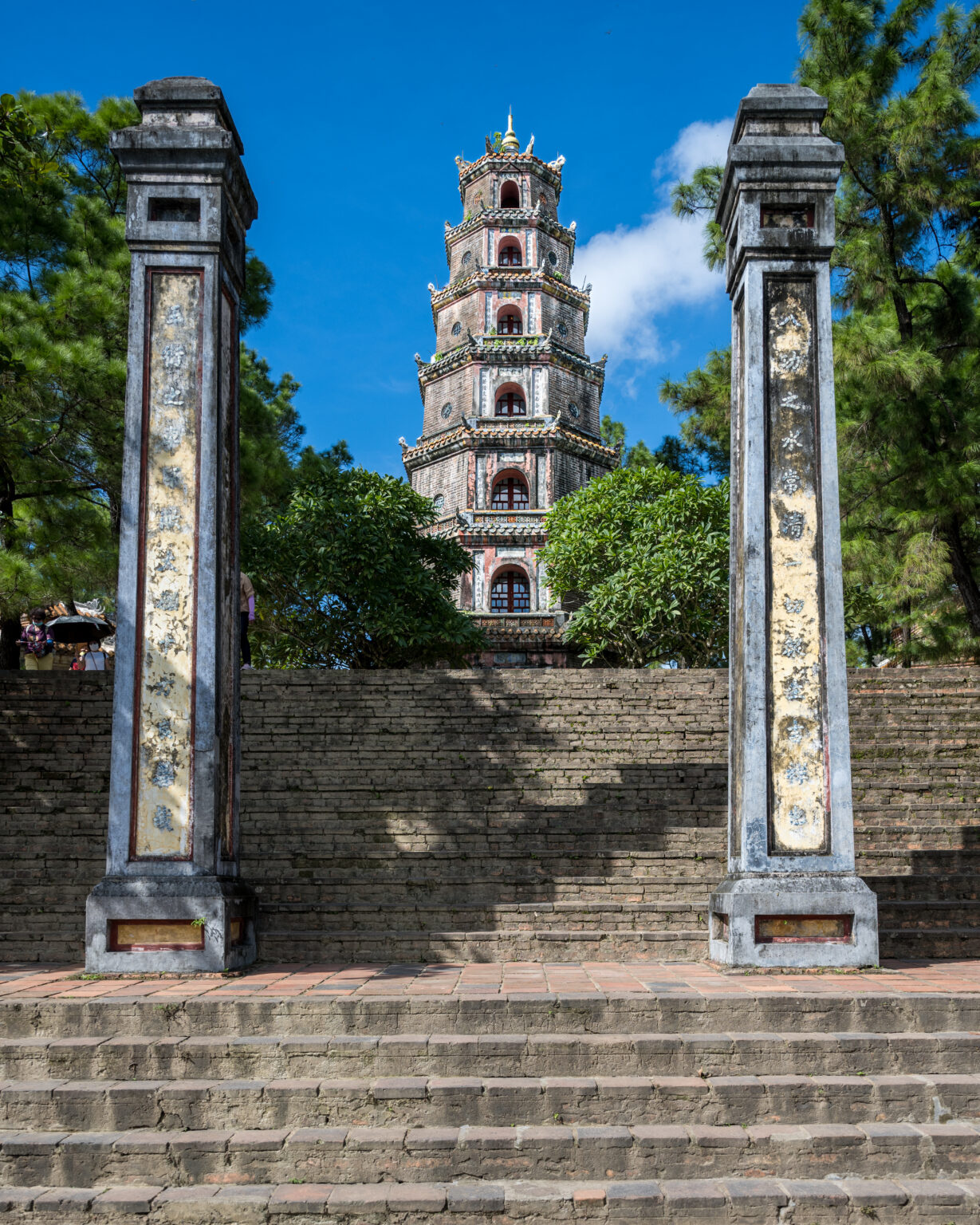
The wider setting is a related question. ICOMOS described the Nguyen emperors’ tombs south of the Perfume River as associated monuments, among them Gia Long, Minh Mang, Tu Duc and Khai Dinh. It called Khai Dinh’s tomb an unhappy fusion of traditional forms with modern materials, notably concrete, yet one to be kept as the last stage in royal tomb design. UNESCO’s current statement says other temples and tombs along the river are not within the property or its buffer zone. The Hué Monuments Conservation Centre, staffed by more than 700 people, manages the complex.
Frequently Asked Questions
Which UNESCO World Heritage sites are near Hué?
My Son Sanctuary is 85 km away in a straight line and Hoi An Ancient Town 95 km, both in Viet Nam. Phong Nha-Ke Bang National Park is 191 km, Vat Phou in Laos 254 km, and the Temple of Preah Vihear in Cambodia 381 km.
Who built the Imperial Citadel at Hué, and when?
Gia Long, first Nguyen ruler, made Hué the capital in 1802. Nguyen Van Yen, an army commander specialising in citadels, led the detailed planning. Planning ran from 1803 to 1805 and construction finished in 1832, with over 30,000 workmen and soldiers involved.
Under which criterion is the Complex of Hué Monuments inscribed?
Criterion (iv), in 1993: an outstanding example of an eastern feudal capital. ICOMOS had recommended criteria (iii) and (iv), but UNESCO’s page for the property lists only (iv). The site is not on the List of World Heritage in Danger.
How much of the Forbidden Purple City survives?
Little of the original fabric. ICOMOS reported in 1993 that the compound originally held over 40 buildings, most of them then in ruins with only foundations surviving. It had suffered in military operations in 1885, 1947 and 1968.
Sources
- UNESCO World Heritage Centre, Complex of Hué Monuments (inscribed 1993). https://whc.unesco.org/en/list/678/
- ICOMOS, Advisory Body Evaluation No 678, Hue (October 1993). https://whc.unesco.org/archive/advisory_body_evaluation/678.pdf
- Hue Monuments Conservation Centre, Thai Hoa Hall. https://www.hueworldheritage.org.vn/en-us/Heritage/Detail/tid/Thai-Hoa-Hall/pid/274E285A-6728-420C-83F9-76F76C1F3E7E/cid/CF768575-1665-47A7-A8DA-AF170097B750
- Hue Monuments Conservation Centre, Nine Dynastic Urns. https://www.hueworldheritage.org.vn/en-us/Heritage/Detail/tid/Nine-Dynastic-Urns/pid/60091C52-BD3D-44AF-A921-AFB600FADC5A/cid/BB5F094E-6AF6-4A5B-A9B8-AF170098E474
- UNESCO World Heritage Centre, My Son Sanctuary (1999). https://whc.unesco.org/en/list/949/
- UNESCO World Heritage Centre, Hoi An Ancient Town (1999). https://whc.unesco.org/en/list/948/
- UNESCO World Heritage Centre, Phong Nha-Ke Bang National Park and Hin Nam No National Park (2003). https://whc.unesco.org/en/list/951/
Spotted an error? Write to [email protected] and we correct it the same day.