
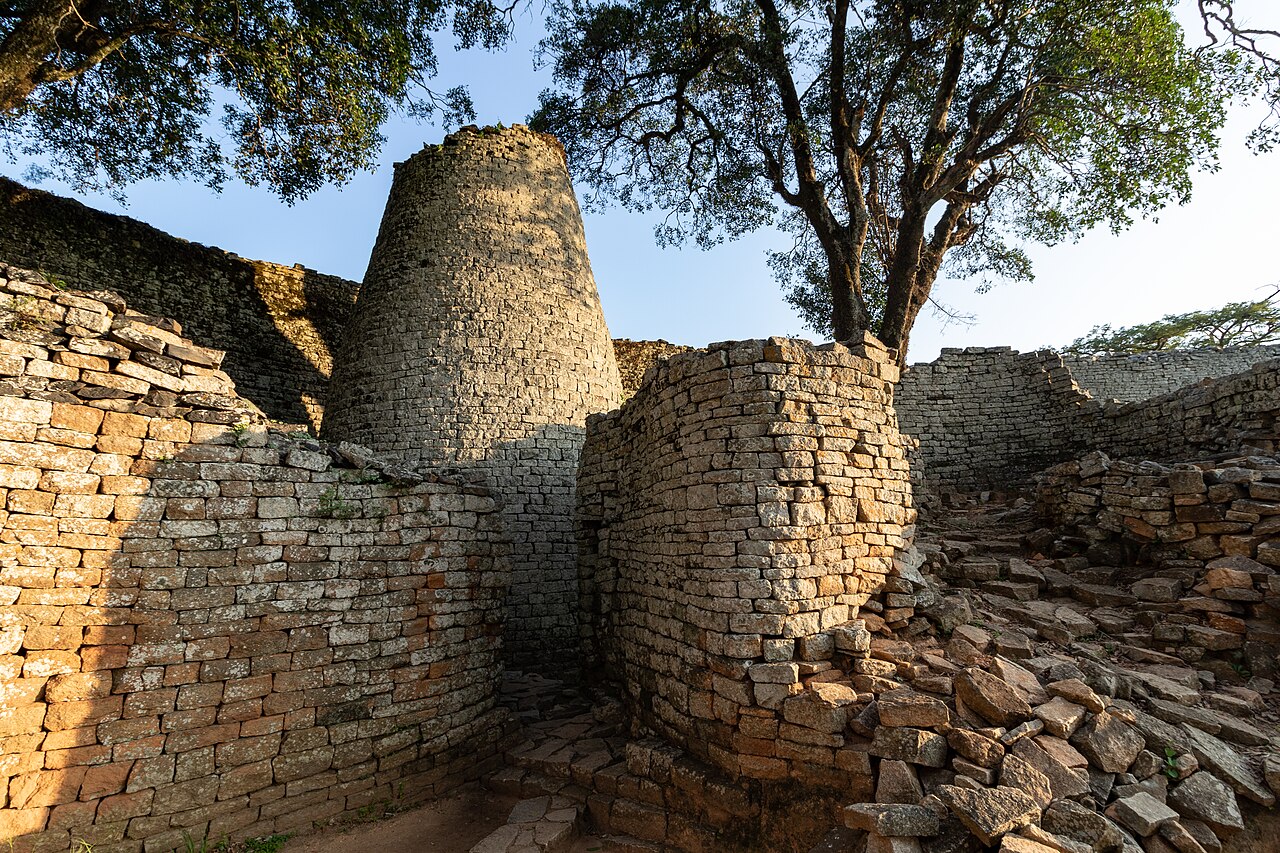
Great Zimbabwe National Monument, inscribed in 1986, is the largest ancient stone structure south of the Sahara (after the Egyptian pyramids) — the capital of the Zimbabwe Kingdom (c. 1100–1450 CE), built in dry-stone masonry without mortar by the Shona people of the Zimbabwe Plateau, the source of the modern nation’s name (“Zimbabwe” means “House of Stone” in Shona), and the centre of a sophisticated Iron Age trading empire that controlled the gold and ivory trade between the African interior and the Indian Ocean coast.
Great Zimbabwe: The Stone Capital of the Zimbabwe Kingdom Masvingo Province, south-central Zimbabwe, 290 km south of Harare
Great Zimbabwe National Monument (inscribed in 1986 under criteria (i), (iii), (vi)) is the site of the ancient capital of the Zimbabwe Kingdom (c. 1100–1450 CE) — a Shona state that controlled the gold and ivory trade across the Zimbabwe Plateau from at least the eleventh century CE, exporting through the Swahili coast port of Sofala (present-day Mozambique) to the Indian Ocean trade network that connected it with Arabia, India, and China. The site covers approximately 7 km² of the granite kopje (rocky hill) landscape of the Zimbabwe Plateau and contains three principal architectural zones: the Hill Complex (the oldest section, occupied from the eleventh to fifteenth centuries CE, built on the granite boulders of a natural hill and incorporating the boulders into the walls); the Great Enclosure (the most dramatic structure, built c. 1350–1450 CE, an elliptical wall approximately 250 metres in circumference, up to 11 metres high and 5 metres thick at the base, enclosing an area of approximately 0.9 hectares, with a Conical Tower approximately 10 metres high — a solid granite tower with no discernible function that is the most distinctive individual monument at the site); and the Valley Ruins (an extensive residential area between the Hill Complex and the Great Enclosure that accommodated the population of the capital, estimated at 10,000–18,000 at the height of the Zimbabwe Kingdom). The construction technique — dry-stone masonry without mortar, with carefully selected and shaped granite blocks laid in courses of diminishing thickness from base to top — represents a level of engineering and organizational complexity unprecedented in sub-Saharan Africa outside Egypt; the coursed dry-stone tradition of the Zimbabwe Plateau was practiced at more than 200 sites in Zimbabwe, Mozambique, and South Africa (the so-called zimbabwe tradition), of which Great Zimbabwe is the most accomplished example.
The Zimbabwe Birds and Colonial Denial Site museum, Great Zimbabwe
The Zimbabwe Bird (Hungwe in Shona) — carved soapstone figurines of a stylized bird (possibly representing the African Fish Eagle or a mythological eagle that is the messenger between the living and the ancestral spirits) approximately 40–50 cm tall — were found at Great Zimbabwe in eight examples during the excavations of the 1890s. The Zimbabwe Bird became Zimbabwe’s national symbol (it appears on the national flag and the national coat of arms of Zimbabwe); the original figurines (removed from Great Zimbabwe in the 1890s by the British South Africa Company’s agent Cecil Rhodes for his personal collection) are distributed between the Great Zimbabwe Site Museum, the Zimbabwe Museum of Human Sciences in Harare, and the Groote Schuur estate museum in Cape Town. The colonial denial of African authorship of Great Zimbabwe is one of the most documented cases of colonial ideological distortion of archaeological evidence: from the 1890s to the 1970s, the official position of the Rhodesian colonial administration was that Great Zimbabwe was built by an ancient Semitic (Phoenician or Arabian) people, not by the Shona ancestors of modern Zimbabwe — a position that was politically motivated (it was used to justify the marginalization of the indigenous African population from their own most important heritage site) and that has been comprehensively refuted by all archaeological evidence accumulated since the 1930s. UNESCO’s inscription of Great Zimbabwe in 1986 explicitly endorsed the African authorship of the site and the heritage connection between the ruins and the modern Shona and Ndebele peoples of Zimbabwe.
Practical information
Great Zimbabwe is 290 km south of Harare and 24 km southeast of Masvingo (the nearest town with accommodation). The site is accessible by road from Harare (3.5 hours) or Bulawayo (2.5 hours); no public transport reaches the site directly. The site entrance and museum are open daily 8 a.m.–5 p.m.; entry fee approximately USD 15. The site requires comfortable walking shoes and approximately 3–4 hours to see the three major zones (Hill Complex + Great Enclosure + Valley Ruins). The Zimbabwe Ruins Hotel adjacent to the site is the only accommodation directly at Great Zimbabwe. The best season is April–September (dry season, mild temperatures); October–March brings summer rains and lush vegetation but some paths become slippery.
Frequently Asked Questions
Is Great Zimbabwe a UNESCO World Heritage Site?
Yes. Great Zimbabwe National Monument was inscribed in 1986 under criteria (i), (iii), and (vi). Zimbabwe has 5 UNESCO World Heritage Sites (as of 2024): Mana Pools National Park, Sapi and Chewore Safari Areas (1984, natural), Khami Ruins National Monument (1986), Great Zimbabwe National Monument (1986), Victoria Falls / Mosi-oa-Tunya (1989, shared with Zambia), and Matobo Hills (2003). Zimbabwe has the most UNESCO World Heritage Sites of any landlocked country in Africa.
Why is the Great Enclosure’s Conical Tower mysterious?
The Conical Tower of the Great Enclosure at Great Zimbabwe is a solid granite tower approximately 10 metres high and 6 metres in diameter at the base, built without any internal chamber, opening, or stairway — a completely solid construction with no apparent function. Its purpose has been debated since the first European descriptions in the 1860s; proposed interpretations include: (1) a symbolic representation of a grain storage basket (the conical shape resembles the thatched granaries of the Zimbabwe Plateau), possibly a statement of royal abundance; (2) a phallic symbol representing the power of the king (proposed by some ethnographic analogies from Shona ritual); (3) a astronomical marker for the summer solstice (a theory proposed in the 1990s but not widely accepted by archaeologists); and (4) simply a prestige monument with no utilitarian function beyond demonstrating the organizational capacity of the Zimbabwe Kingdom (which could mobilize the labor and skill to build an entirely solid structure of this size). The mystery of the Conical Tower’s purpose is one of the most enduring puzzles of African archaeology; no consensus interpretation has emerged.
What happened to the Zimbabwe Kingdom and why did the capital move?
The Zimbabwe Kingdom reached its maximum extent and population approximately 1350–1420 CE and then declined relatively rapidly, with the capital apparently abandoned by approximately 1450 CE. The most commonly accepted explanation for the decline is a combination of environmental and political factors: (1) resource depletion — the estimated population of 10,000–18,000 at Great Zimbabwe would have required substantial agriculture and charcoal production in the surrounding area, and pollen analysis suggests significant deforestation and soil degradation by the late fourteenth century; (2) trade route disruption — the Portuguese arrival on the East African coast in the late fifteenth century disrupted the Swahili coast trading system that had been the economic foundation of the Zimbabwe Kingdom’s gold export trade; and (3) political fragmentation — the Zimbabwe Kingdom appears to have split between a northern successor state (the Mutapa Kingdom, which controlled the Zambezi valley trade with the Portuguese from the late fifteenth to eighteenth centuries CE) and a southwestern successor state (the Torwa Kingdom, which built the Khami Ruins — the second-most important site of the zimbabwe tradition). The abandonment of Great Zimbabwe was not a sudden collapse but a gradual population movement; the capital shift to Khami (in present-day Bulawayo) reflects a strategic reorientation of the successor state’s trade routes.
Sources
- S1 — Pikirayi, Innocent. The Zimbabwe Culture: Origins and Decline of Southern Zambezian States. AltaMira Press, 2001. ISBN 978-0-7591-0091-6.
- S2 — Garlake, Peter. Great Zimbabwe. Thames & Hudson, 1973. ISBN 978-0-500-39012-2.
Spotted an error? Write to editorial@culturalheritageonline.com and we correct it the same day.



.jpg)