
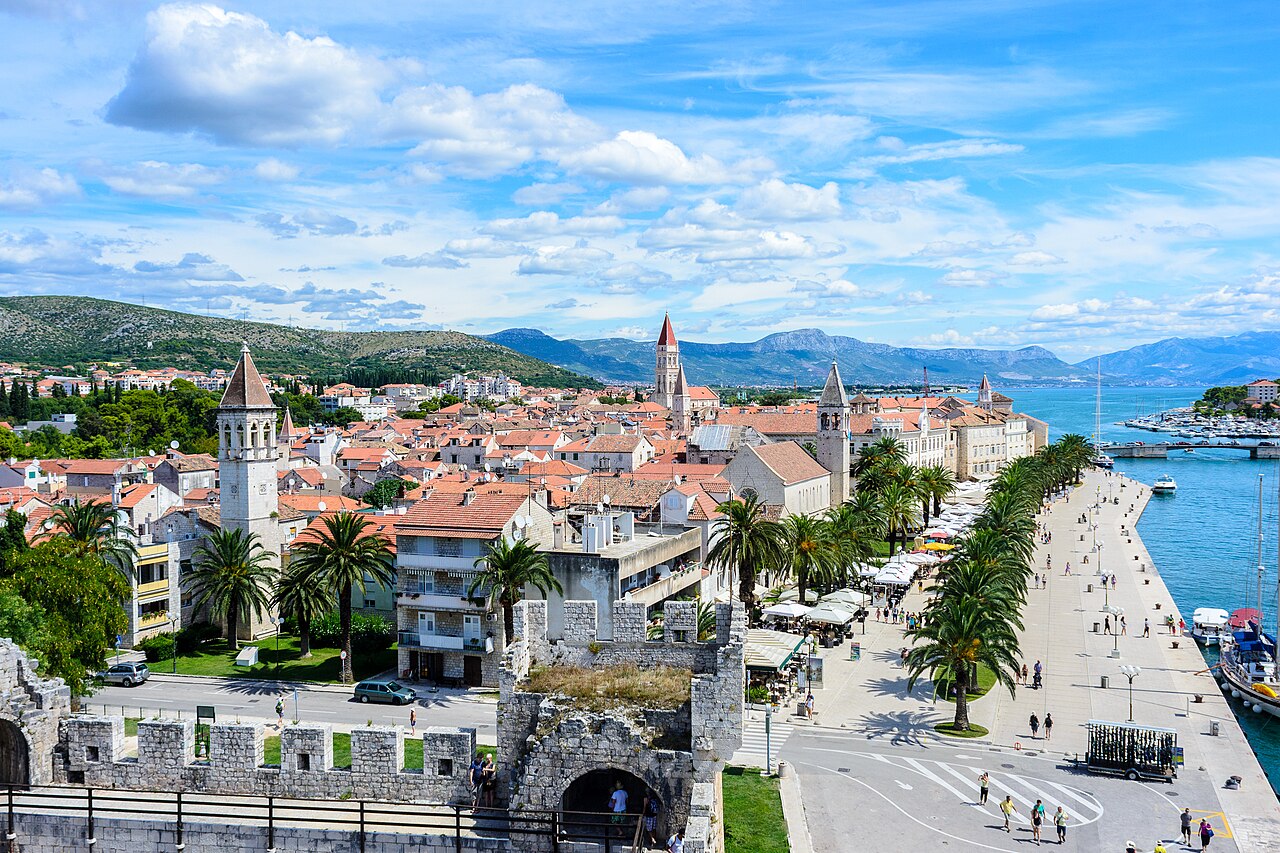
The Historic City of Trogir, inscribed in 1997, is the most complete example of a Romanesque-Gothic urban ensemble in Central Europe — a small island city of approximately 1 km² on the Dalmatian coast of Croatia, continuously inhabited since the Hellenistic period, whose medieval grid of stone streets, Romanesque-Gothic palaces, and the Cathedral of Saint Lawrence (with the Portal of Master Radovan of 1240 CE, the finest Romanesque carving in Croatia) has been described as one of the best-preserved medieval cities in the world.
Trogir: The Best-Preserved Romanesque-Gothic City in the Adriatic Split-Dalmatia County, Croatia, 27 km west of Split, Dalmatian coast
The Historic City of Trogir (inscribed in 1997 under criteria (ii), (iii), (iv)) is a small walled island city of approximately 600 × 300 metres, connected to the Croatian mainland by a short bridge and to the larger island of Čiovo to the south by another bridge — surrounded by the Adriatic Sea on three sides and by the Trogir Channel to the north. The city has been continuously inhabited from approximately 380 BCE (when it was founded as Tragurium, a colony of Issa, a Syracusan Greek settlement on the island of Vis) through the Roman period (Tragurium was a significant Dalmatian port in the early Roman Empire), the Byzantine period, the Croatian medieval kingdom (9th–12th centuries CE), and the long Venetian period (1420–1797 CE, during which the city’s most significant heritage fabric was built). The inscription covers the entire island and its historic urban fabric, which preserves one of the most coherent medieval urban grids in Europe: the Roman street plan (a modified Hippodamian grid with a central forum/square) is still legible beneath the medieval street pattern; the buildings that line the streets are overwhelmingly medieval (Romanesque, Gothic, Renaissance, and Baroque in chronological layers) with very few post-eighteenth century interventions. The Cathedral of Saint Lawrence (Katedrala sv. Lovre) is the most important individual monument: a Romanesque-Gothic cathedral begun in 1193 CE (on the site of a ninth-century church) and not completed until the seventeenth century, with a campanile of four different architectural styles (each storey built in a different century) — Romanesque ground floor, Gothic first storey, Renaissance second storey, Baroque crown — that serves as a visible chronicle of the city’s architectural history.
The Portal of Master Radovan: The Finest Romanesque Carving in Croatia Cathedral of Saint Lawrence, Trogir
The Portal of Master Radovan (Radovanovo pročelje, 1240 CE) is the main west portal of the Cathedral of Saint Lawrence and the most important work of Romanesque figural sculpture in Croatia and the eastern Adriatic — a richly carved portal approximately 4 metres wide and 8 metres high whose every surface is covered in carved limestone figures of extraordinary quality and iconographic complexity. The portal was carved by the local master sculptor Radovan (Radovanus, documented only by his own inscription at the base of the portal: “On the door of the church of the apostle Paul, the best of stones, decorated in 1240 by Radovan, the most excellent in his art among Croats” — one of the earliest surviving signed works of art in Croatia). The portal programme includes: (1) the outer arch (carved with the twelve months of the year, each shown as a human figure performing the characteristic agricultural activity of that month — one of the richest sculptural calendars in European Romanesque art); (2) the pilasters (carved with biblical scenes from Genesis and the life of Christ intermingled with figures of the Apostles, local saints, and grotesque monsters); (3) the lintel (the Nativity, with the ox and donkey, the shepherds, and the Magi in a continuous narrative frieze); and (4) the tympanum (the Baptism of Christ). The quality of the Portal of Master Radovan is comparable to the great French Romanesque portals (Moissac, Vézelay, Autun) and represents the point at which the Dalmatian Romanesque tradition fully absorbed the French Romanesque sculptural tradition through the Venetian intermediary.
Practical information
Trogir is 27 km west of Split (Split Airport, SPU, is 7 km from Trogir; the Split Ferry Terminal has connections to many Adriatic islands). Bus routes from Split to Trogir run every 20–30 minutes (approximately 30 minutes, HRK 20). Trogir’s island historic centre is approximately 600 × 300 metres — entirely walkable in 20 minutes. The Cathedral of Saint Lawrence is open daily; the climb to the top of the campanile (approximately 100 steps) gives the best view of the island and channel. The Kamerlengo Fortress (1430 CE, Venetian), the Loggia and Clock Tower (opposite the Cathedral), and the Cipiko Palace (a fine Gothic palace with a triple-arched loggia) are the other principal monuments. Split is 30 minutes away and has the Diocletian’s Palace (UNESCO 1979). The best season is April–June and September–October; July–August is extremely crowded with cruise ship and summer tourist visitors.
Frequently Asked Questions
Is Trogir a UNESCO World Heritage Site?
Yes. The Historic City of Trogir was inscribed in 1997 under criteria (ii), (iii), and (iv). Croatia has 10 UNESCO World Heritage Sites (as of 2024): the Old City of Dubrovnik (1979), the Historical Complex of Split with the Diocletian’s Palace (1979), the Plitvice Lakes National Park (1979, natural), the Episcopal Complex of the Euphrasian Basilica in Poreč (1997), the Historic City of Trogir (1997), the Cathedral of St. James in Šibenik (2000), the Stari Grad Plain (2008, cultural landscape, island of Hvar), the Stećci Medieval Tombstones (2016, shared), the Venetian Works of Defence (2017, shared), and Lastovo Archipelago (2024, natural).
Why is Trogir’s historic fabric so much better preserved than Dubrovnik’s?
Trogir’s exceptional state of preservation compared to Dubrovnik (which, while magnificent, has been more heavily restored after the 1667 earthquake and the 1991–92 siege damage) is the result of the small city’s economic marginalization after the seventeenth century: Trogir never became as wealthy or as strategically important as Dubrovnik, and consequently did not undergo the cycles of reconstruction and modernization that affected larger Dalmatian cities. The key moment in Trogir’s preservation was the earthquake of 1667, which devastated Dubrovnik and triggered a complete rebuilding of that city’s domestic architecture in Baroque style; Trogir (which was less severely affected) was not rebuilt, leaving the medieval fabric largely intact. The economic stagnation of Trogir from the eighteenth century onward — the city lost commercial significance when the main Dalmatian trade routes bypassed it in favor of Split — meant there was little investment pressure to demolish medieval buildings for commercial development. The city’s inscription in 1997 formalized conservation status that had effectively been maintained by poverty and marginalization for over two centuries.
What is the Dalmatian Romanesque and how does Trogir’s Cathedral exemplify it?
The Dalmatian Romanesque is a regional architectural tradition of the Croatian Adriatic coast that developed from approximately the 10th to the 13th century CE, combining elements of the Italian Romanesque (from Venice and the northern Adriatic) with local Dalmatian craftsmanship traditions. Its characteristic features include: dressed ashlar (squared stone) construction in the local white limestone; rounded arches and barrel vaults; carved stone capitals and portal sculptures in the French Romanesque tradition (transmitted via Venice from Burgundy and Provence); and a preference for elongated, relatively narrow nave proportions. The Cathedral of Saint Lawrence at Trogir exemplifies the Dalmatian Romanesque at its most sophisticated: the portal (by Master Radovan, 1240 CE) represents the full absorption of the French Romanesque portal tradition into a local artistic framework (Radovan’s calendar figures and his grotesque monsters, while thoroughly French Romanesque in type, are executed with an energy and physicality that is distinctive to the Dalmatian tradition); the interior (with later Gothic and Renaissance interventions) shows the characteristic evolution of the tradition through its successive building phases. The Šibenik Cathedral of Saint James (UNESCO 2000, 30 km from Trogir) is the most important late Gothic Dalmatian cathedral and the transition point to the Renaissance tradition.
Sources
- S1 — Fisković, Cvito. Radovan: Portal katedrale u Trogiru. Jugoslavenska akademija znanosti i umjetnosti, 1978. ISBN 978-953-163-120-4.
- S2 — Wilkes, John. The Illyrians. Blackwell, 1992. ISBN 978-0-631-19807-9.
Spotted an error? Write to editorial@culturalheritageonline.com and we correct it the same day.


.jpg)