Lebanon has six UNESCO World Heritage Sites, a compact but remarkable list that spans Phoenician ports, Roman temple complexes, early Islamic urbanism, ancient Christian monasteries, old-growth cedar groves, and a twentieth-century modernist fairground. Small in number, these sites compress several of the most consequential chapters in Mediterranean and Near Eastern history into a single country no larger than Connecticut. From Cultural Heritage Online.
Why Lebanon’s list looks the way it does
Lebanon ratified the World Heritage Convention on 30 October 1990, but its first five inscriptions came earlier, in 1984 — a single sweep that placed the country among the most internationally recognised heritage destinations in the Arab world. All six inscribed properties are classified as cultural sites; Lebanon has no natural World Heritage Sites on the official list, though the Cedars of God grove at the heart of the Ouadi Qadisha inscription is an ancient forest that would qualify on ecological grounds in almost any other context.
The pattern of the list reflects Lebanon’s layered past: Phoenician, Hellenistic, Roman, Byzantine, early Islamic, medieval Christian, and twentieth-century modernist phases are all present. What the list does not yet include — despite a tentative list of nine additional properties — is anything from the Ottoman period or from the country’s diverse vernacular architectural traditions. That gap may close in coming decades.
The first inscriptions
Five sites entered the World Heritage List together in 1984, giving Lebanon an unusually strong start. They are:
- Anjar — an 8th-century Umayyad palace city in the Bekaa Valley
- Baalbek — the Roman sanctuary complex of Heliopolis, one of the largest ever built
- Byblos — a Phoenician port city regarded as one of the oldest continuously inhabited settlements on earth
- Ouadi Qadisha (Holy Valley) and the Forest of the Cedars of God (Horsh Arz el-Rab) — a mountain gorge with ancient monasteries and a surviving grove of Lebanon cedars
- Tyre — the ancient Phoenician city whose purple-dye trade and grid-plan urbanism influenced the wider Mediterranean world
The 1984 group inscription was partly a product of its moment: Lebanon was in the middle of a prolonged civil conflict, and international recognition of its heritage carried both scholarly and political weight. That all five nominations were accepted simultaneously speaks to the density of exceptional significance concentrated in Lebanese territory.
The most visited — and the alternatives
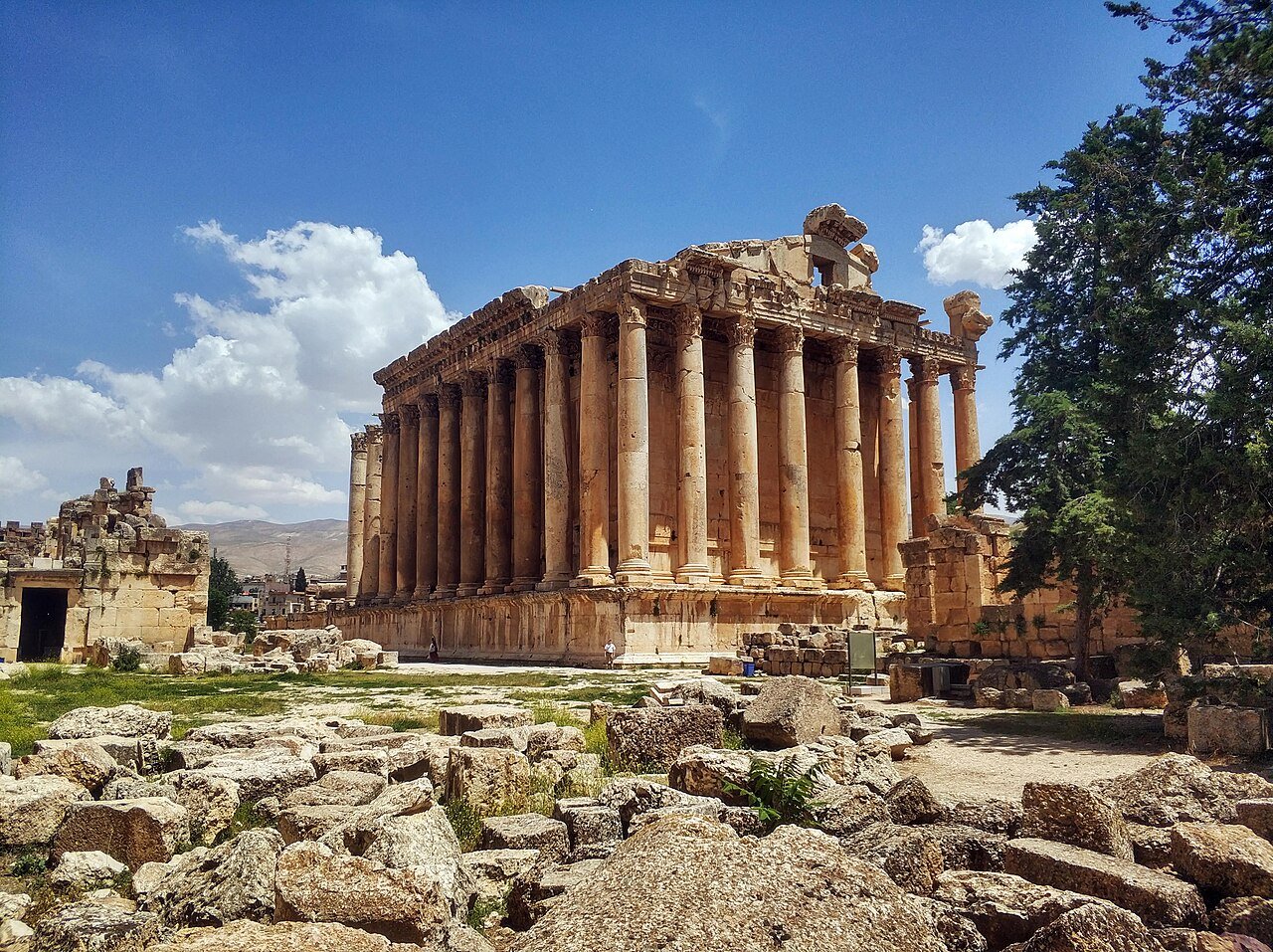
Baalbek draws the largest number of visitors of any site on the list. Its Temple of Jupiter, with six surviving Corinthian columns standing over twenty metres tall, and the near-intact Temple of Bacchus, are among the most photogenic Roman structures anywhere in the world. Byblos is the other obvious draw: its medieval Crusader castle, Phoenician temples, and Roman-era colonnaded street occupy a compact tell that has been inhabited since at least the Neolithic period.
For travellers willing to move beyond the headline sites, the list repays attention. Anjar is the only place in Lebanon where an Umayyad city plan survives above ground: its grid of colonnaded streets, twin palaces, bathhouses, and mosques dates entirely from the early 8th century and offers an uncluttered reading of early Islamic urbanism. Ouadi Qadisha is a steep gorge in the Mount Lebanon range whose clifftop monasteries — some still active — represent some of the oldest continuously occupied Christian monastic foundations in the world. Tyre, now the southern Lebanese city of Sur, preserves a Roman hippodrome, colonnaded road, and necropolis that remain only partially excavated and are less crowded than their counterparts in Rome or Jerash.
Natural and shared sites
Lebanon’s six inscribed properties are all officially classified as cultural, but the Ouadi Qadisha inscription contains the Horsh Arz el-Rab — the Forest of the Cedars of God — a remnant stand of Cedrus libani that once covered large parts of the Lebanese mountains and that appears in records reaching back to ancient Egypt and the Hebrew Bible. The grove is protected within the inscription boundary and managed as a nature reserve; its oldest individual trees are estimated to be over a thousand years old.
Lebanon does not currently participate in any transnational or serial World Heritage inscriptions. Its tentative list includes the Phoenician harbours and the medieval Castles of Mount Amel — five fortifications whose successive Crusader-period phases document nine centuries of military architecture — but neither has reached inscription stage. The most recent property to be inscribed was the Rachid Karami International Fair in Tripoli (2022), a modernist complex designed by Brazilian architect Oscar Niemeyer in the 1960s and never completed; it was added to the World Heritage in Danger list at the time of inscription, owing to deterioration and funding gaps.
How to find them
All six sites are reachable by road from Beirut, with Baalbek and Anjar in the Bekaa Valley to the east, Byblos and Ouadi Qadisha to the north, and Tyre to the south. The Rachid Karami Fair in Tripoli, Lebanon’s second city, requires a separate northern excursion. Conditions on the ground can change; current travel advisories from your government’s foreign affairs authority should be consulted before travel to Lebanon.
Lebanon’s World Heritage sites sit alongside thousands of other places on CHO’s interactive map, with GPS and sourced editorial history for each. See also our guides to Italy’s and France’s UNESCO sites, and our piece on cultural travel beyond mass tourism.
Frequently Asked Questions
How many UNESCO World Heritage Sites does Lebanon have?
Lebanon has six inscribed UNESCO World Heritage Sites as of 2026, all classified as cultural. Five were inscribed together in 1984 — Anjar, Baalbek, Byblos, Ouadi Qadisha and the Cedars of God, and Tyre — with the Rachid Karami International Fair-Tripoli added most recently in 2022.
What was Lebanon’s first UNESCO World Heritage Site?
Lebanon’s first inscriptions were a group of five sites added simultaneously to the World Heritage List in 1984: Anjar, Baalbek, Byblos, Ouadi Qadisha and the Forest of the Cedars of God, and Tyre. No single site holds seniority — all five share the same inscription year.
What is Lebanon’s most recently inscribed World Heritage Site?
The Rachid Karami International Fair in Tripoli was inscribed in 2022, making it Lebanon’s sixth and most recent World Heritage Site. Designed by Oscar Niemeyer in the 1960s and never fully completed, it was simultaneously placed on the World Heritage in Danger list due to deterioration and lack of maintenance funds.
Does Lebanon have any natural UNESCO World Heritage Sites?
All six of Lebanon’s World Heritage Sites are officially classified as cultural rather than natural. However, the Ouadi Qadisha inscription includes the ancient cedar grove known as the Forest of the Cedars of God — a remnant stand of Cedrus libani with individual trees estimated to be over a thousand years old.
Sources used in this article
- UNESCO — State Party Lebanon — World Heritage list.
- UNESCO — Lebanon: World Heritage Sites.
- CHO magazine — What is a World Heritage Site?
- CHO — Interactive map of heritage sites.
Sources
- S1 — Salibi, Kamal. A House of Many Mansions: The History of Lebanon Reconsidered. University of California Press, 1988. ISBN 978-0-520-06517-8.
- S2 — Ward-Perkins, J. B. Roman Imperial Architecture. Yale University Press, 1994. ISBN 978-0-300-05292-3.
Spotted an error? Write to editorial@culturalheritageonline.com and we correct it the same day.