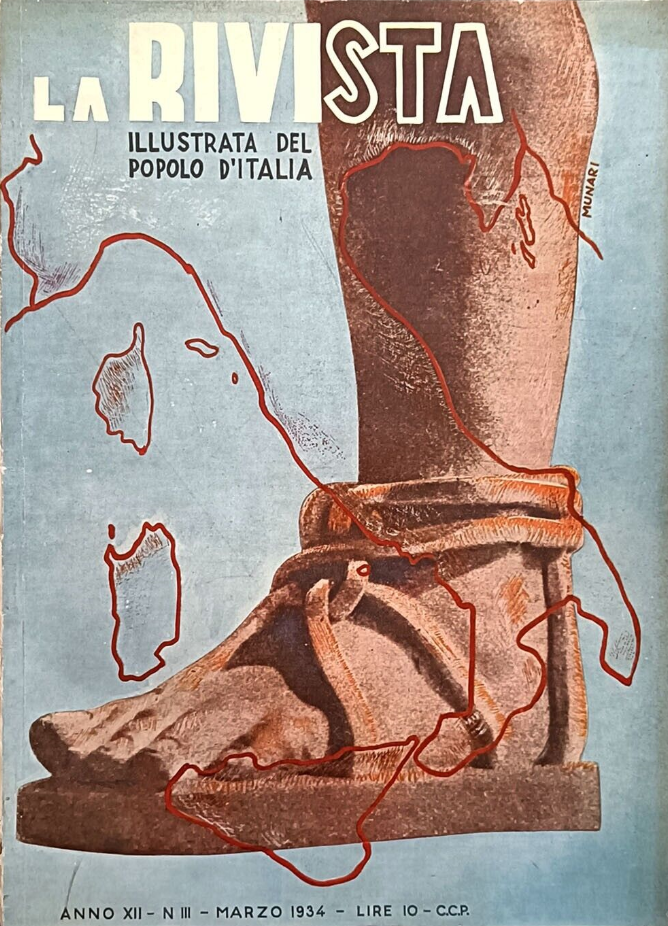
Rivista is a 1934 magazine design by Bruno Munari, the Italian modernist artist, designer, and inventor who shaped twentieth-century visual culture across multiple disciplines.
Munari’s career spanned modernism, futurism, and concrete art, with influential contributions to graphic design, industrial design, games, and didactic method. His philosophy rejected the separation of art from everyday life, insisting that functional objects must also be beautiful. This magazine represents his graphic work during a formative period of his multidisciplinary practice, when he was developing the visual language that would define his artistic identity across decades.
About Bruno Munari
Bruno Munari was a pioneering figure in twentieth-century modernism and design. Beyond graphics and fine art, he conducted research into movement, tactile learning, kinesthetic learning, and creative methodology, treating art as inseparable from the objects and experiences people encounter daily.
Details
- Creator: Bruno Munari
- Year: 1934
- Medium: Magazine design
- Movement: Modernism, Futurism, Concrete Art
Frequently asked questions
Who was Bruno Munari?
Bruno Munari was an Italian artist, designer, and inventor recognized as one of the greatest figures of twentieth-century art, design, and graphics. He contributed fundamentally to modernism, futurism, concrete art, and research in games, didactic methods, and tactile learning.
What was Munari’s philosophy on art and design?
Munari believed art should not be separated from life, stating that objects which are good to look at but bad to use should not exist. He insisted that functional design and beauty must coexist.
What fields did Munari work in beyond painting?
Munari worked across graphics, industrial design, games, didactic methodology, and research into movement and kinesthetic learning, treating all these fields as extensions of creative practice.