
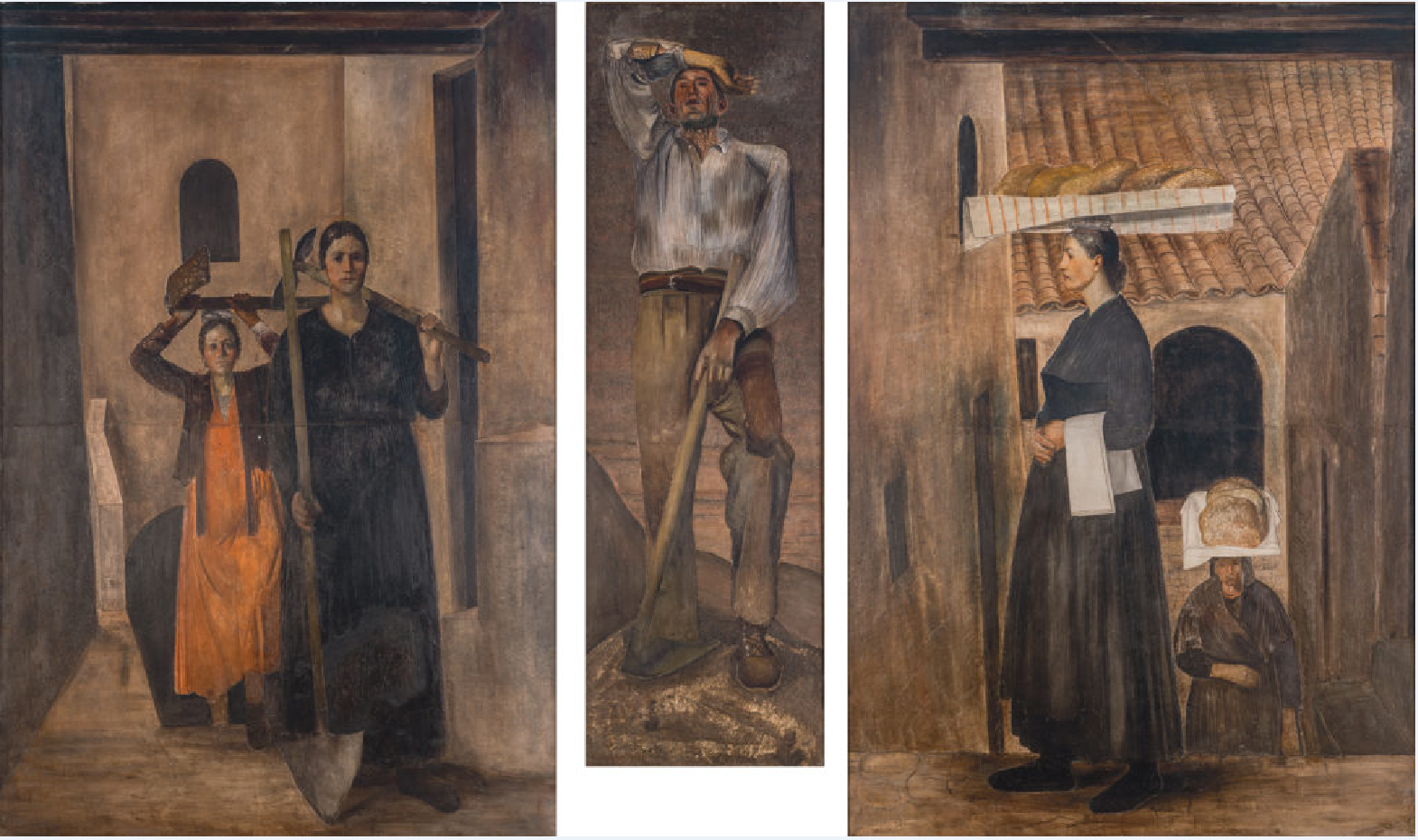
Il grano is a painting by Pietro Gaudenzi, created around 1940. Gaudenzi (1880–1955) was an Italian painter born in Genoa who built a distinguished career spanning more than five decades.
Gaudenzi trained at the Accademia Ligustica of Genoa under Cesare Viazzi, and later in Rome in the studio of Francesco Carena following a five-year scholarship awarded in 1903. His artistic reputation was established early: his 1910 submission I Priori received a gold medal in Milan and now resides in the Galleria Nazionale d’Arte Moderna in Rome. He went on to win the gold medal for a Torso of a Young Woman at the 1913 Munich Exposition and the Principe Umberto prize in 1915 for The Deposition.
Throughout his career, Gaudenzi was known for maternal genre scenes and portraiture, executing commissions of prominent figures including Wally Toscanini and Maresciallo Enrico Caviglia. He served as professor emeritus at the academies of Genoa, cementing his role in Italian artistic education.
About Pietro Gaudenzi
Pietro Gaudenzi was a leading figurative painter of his generation, whose work bridged academic training and contemporary subject matter. His early recognition and sustained output established him as a significant voice in Italian painting during the first half of the twentieth century.
Details
- Artist: Pietro Gaudenzi (1880–1955)
- Title: Il grano
- Date: circa 1940
- Medium: Painting
- Birthplace and base: Genoa
Frequently asked questions
Who was Pietro Gaudenzi?
Pietro Gaudenzi was an Italian painter born in Genoa in 1880 who studied at the Accademia Ligustica and in Rome, winning multiple gold medals and the Principe Umberto prize throughout his career.
What subjects did Gaudenzi typically paint?
Gaudenzi was known for maternal genre scenes and portraiture, executing works ranging from figurative studies to commissions of prominent sitters.
What is the significance of his early work?
His 1910 painting I Priori received a gold medal at a Milan exhibition and is now housed in the Galleria Nazionale d’Arte Moderna in Rome, marking his early establishment in Italian art.
Sources
- S1 — Salvagnini, Sileno. Il sistema delle arti in Italia 1919–1943. Minerva Edizioni, 2000. ISBN 978-88-7381-008-7.
- S2 — Braun, Emily. Mario Sironi and Italian Modernism. Cambridge University Press, 2000. ISBN 978-0-521-48015-4.
Spotted an error? Write to editorial@culturalheritageonline.com and we correct it the same day.


