
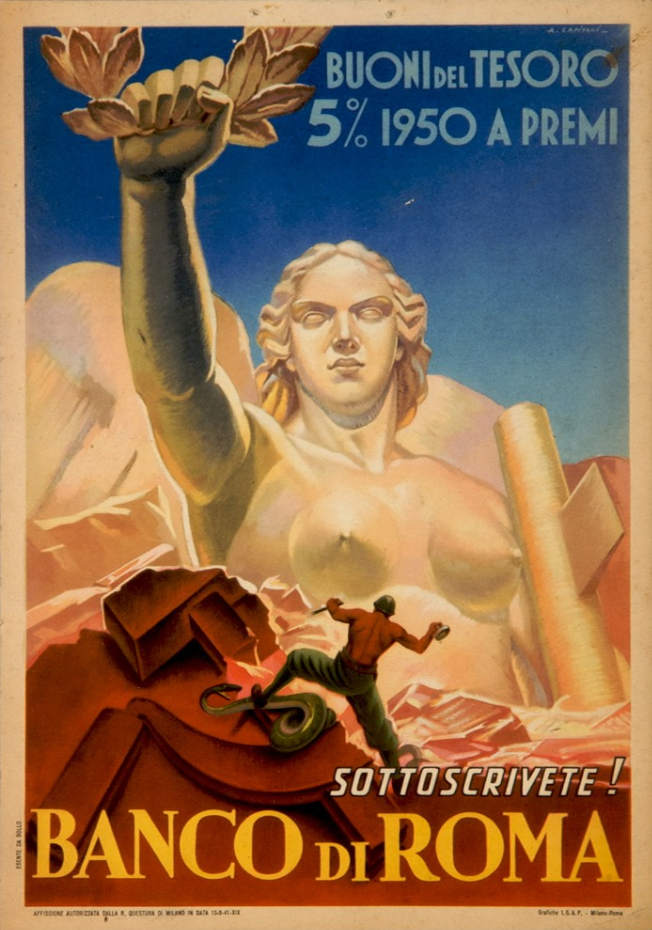
An advertising poster designed by Alfredo Capitani in 1941. Capitani was an Italian scenographer, graphic artist, and painter who became a prominent designer of cinema posters and theatrical set designs during the early-to-mid twentieth century.
Capitani trained at the Accademia Inglese di Belle Arti in Rome, initially specializing in stage design for theatre productions. In 1919 he established a studio dedicated to poster design and advertisement graphics, collaborating with other painters on cinema installations, including large-scale wall posters and paintings displayed in cinemas across Italy. He worked with both Italian and American production companies, including MGM, Fox, and Columbia Pictures, creating cinema posters for films such as Gilda, Moby Dick, Oceano rosso, Sfida infernale, and Gli amori di Carmen.
About Alfredo Capitani
Born in Ciampino on 3 March 1895, Capitani was active as a poster designer and painter for several decades. In partnership with Luigi Martinati, he founded the Maralca company to promote film releases. He maintained his work in graphic design until 1960, when he transitioned to painting full-time until his death in Rome on 9 September 1985.
Details
- Creator: Alfredo Capitani
- Year: 1941
- Object type: Advertising poster
- Career context: Italian scenographer, graphic designer, and painter active 1919–1960
Frequently asked questions
Who was Alfredo Capitani?
Alfredo Capitani (1895–1985) was an Italian scenographer and graphic artist trained at the Accademia Inglese di Belle Arti in Rome. He became a prolific designer of cinema posters and theatrical environments, working for major Italian and American film studios.
What films did Capitani design posters for?
Capitani created cinema posters for Gilda, Moby Dick, Oceano rosso, Sfida infernale, and Gli amori di Carmen, among other productions released by Italian and American studios including MGM, Fox, and Columbia Pictures.
When did Capitani stop working as a graphic designer?
Capitani closed his poster design studio in 1960 and devoted himself to painting until his death in Rome in 1985 at the age of ninety.


