
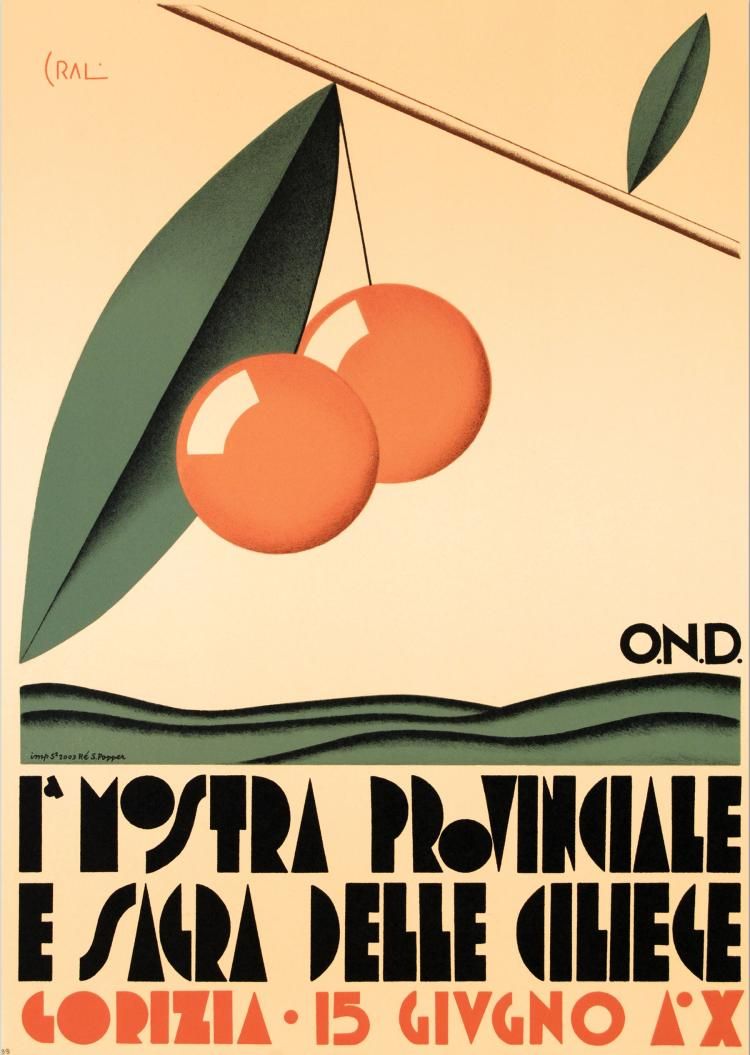
An advertising poster designed by Tullio Crali in 1932. The work exemplifies the Futurist artist’s engagement with themes of speed and modern mechanisation.
Crali, a Dalmatian Italian artist, joined the Futurist movement in 1929 as a self-taught painter. His artistic practice is characterised by realistic compositions that synthesise elements of velocity, aerial mechanisation and the mechanics of aerial warfare—subjects that defined much of his early career. This poster represents his application of Futurist principles to commercial graphic design during the interwar period.
About Tullio Crali
Crali was a late adherent to Futurism, having entered the movement in 1929 despite being largely self-taught. Throughout a lengthy career, he worked across multiple styles while maintaining a distinctive focus on dynamism and technological modernity. His realistic approach to Futurist subjects set him apart from more abstractionist tendencies within the movement.
Details
- Creator: Tullio Crali
- Year: 1932
- Object type: advertising poster
- Movement: Futurism
- Origin: Italy
On video
Frequently asked questions
Who was Tullio Crali?
Tullio Crali was a Dalmatian Italian artist and self-taught painter who joined the Futurist movement in 1929, becoming known for realistic works combining speed, aerial mechanisation and aerial warfare mechanics.
What movement does this poster represent?
The poster belongs to Futurism, an Italian avant-garde movement that celebrated speed, technology and modernity. Crali’s work emphasised realistic representation of these themes rather than pure abstraction.
What subjects did Crali typically depict?
Crali focused on speed, aerial mechanisation and the mechanics of aerial warfare throughout his early career, bringing these Futurist preoccupations to advertising design and fine art alike.
Sources
- S1 — Menegazzi, Luigi. Il manifesto italiano: 1882-1925. Electa, 1995. ISBN 978-88-435-5134-7.
- S2 — Pontiggia, Elena. Il Novecento Italiano. Abscondita, 2003. ISBN 978-88-8416-048-5.
Spotted an error? Write to editorial@culturalheritageonline.com and we correct it the same day.


