
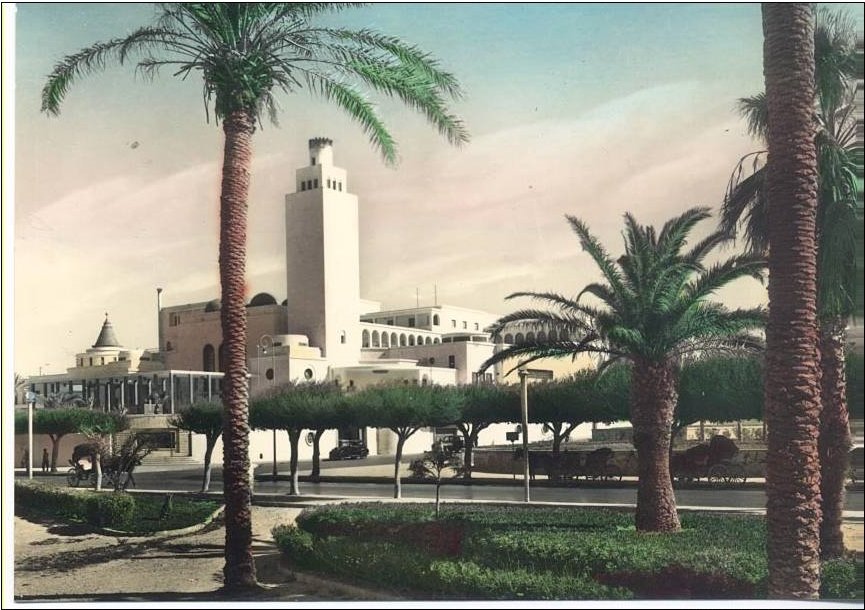
Di Fausto’s hotel-casino on the Tripoli waterfront, built in 1935 with a 500-seat theatre and a casino dressed in white domes. Once called the “Waldorf Astoria of Tripoli”, it still operates today.
At a glance
The Uaddan was the flagship of colonial Tripoli’s leisure architecture: a hotel, casino and 500-seat theatre in one complex overlooking the bay, just east of the Grand Hotel. Florestano Di Fausto (1890–1965), the most prolific architect of Italian Libya, designed it in collaboration with Stefano Gatti-Casazza, and it was built in 1935, at the same time as the nearby Hotel Al Mehari. Historically the grandest hotel in the city — an American journalist called it “the Waldorf Astoria of Tripoli” — it was restored for 16 million dollars in 2007–2009 and returned to service as a luxury hotel, for several years under InterContinental management. It is named after the waddan, the Barbary sheep of the Libyan desert.
Key facts
- Architect: Florestano Di Fausto (1890–1965), with Stefano Gatti-Casazza
- Built: 1935, on the seafront east of the Grand Hotel Tripoli
- Programme: hotel, casino and 500-seat theatre in a single complex
- Reputation: “the Waldorf Astoria of Tripoli”; praised as “a jewel of modern African architecture”
- Restored: 2007–2009, at a cost of about 16 million US dollars; managed for some years by InterContinental
- Today: operating as the Al Waddan Hotel
History
The context, stated plainly: the Uaddan was built for the colonists and visitors of an occupied country, in the same decade in which the Italian “pacification” of Libya — documented by the historiography with its camps and reprisals — reached its end. The building is presented here as part of that record, not apart from it.
Within the colonial city, the Uaddan anchored the seafront that governor Italo Balbo’s administration was rebuilding as the shop-window of the “fourth shore”. Di Fausto, who in those same years produced the waterfront buildings and much of official Tripoli, gave the complex the manner scholarship calls his “architecture of the Mediterranean”: white walls, arcades, courtyards and domes that quote the vernacular of the Libyan coast rather than the monumental classicism of Rome. Casino evenings, theatre seasons and the tourism promoted around the Tripoli Grand Prix and the International Fair made the hotel the social centre of Italian Tripoli.
The complex outlived the colony as one of the city’s institutions. After decades of mixed fortunes it was fully restored between 2007 and 2009 and reopened as an international luxury hotel; the InterContinental group managed it for several years. It continues to operate under its old name — one of the few buildings of Italian Tripoli whose original function, hospitality, has never really changed.
What you see
Period photographs show the original composition best: an assembly of white volumes stepping along the shore, punctuated by shallow domes over the casino halls and by a squared tower that reads from a distance like a minaret. The complex was designed to look less like one building than a small vernacular quarter — the point of Di Fausto’s Mediterranean manner — with pergolas and arcades opening toward the sea.
The building stands today in renovated form, its walls now in a warm salmon tone, with the arcaded perimeter and the domes still legible behind the trees of the seafront boulevard. The theatre survives inside the complex. New towers have risen around it, and the contrast makes the Uaddan’s low, courtyard-based massing easier to appreciate, not harder.
Practical information
- The Al Waddan operates as a hotel; the building is best appreciated from the seafront and, for guests, from the internal courtyard.
- Libya is not, at present, a straightforward destination for leisure travel; check official travel guidance before planning any visit.
Getting there
The hotel stands on the Tripoli seafront east of the castle and medina, with its main entrance on Sidi Isa Street. GPS: 32.89333, 13.19111 · Open in Google Maps.
Related places and reading
- Italian Libya: Architecture, Roads and the Colonial Project of the “Fourth Shore” — the wider frame
- Tripoli International Fair (1927) — the colony’s shop-window, a short walk west
- Former Tripoli Cathedral (1928) — official architecture of the same city
Sources
- English Wikipedia, “Al Waddan Hotel” (architects, 1935 construction, casino and 500-seat theatre, “Waldorf Astoria of Tripoli”, 2007–2009 restoration and InterContinental management).
- Studies on Florestano Di Fausto and the “architecture of the Mediterranean” in Italian Libya (as framed in our Italian Libya article).
- Wikidata Q4704929 (coordinates); Wikimedia Commons, Uaddan Hotel & Casino category (period and current photographs).
Find it on the map
See this place and what’s around it →Record researched and written by Luigi De Marchi for Cultural Heritage Online, 2026.
📷 Become a Cultural Heritage Online photographer
Share your photos of places: they stay published under your name as the author. The more they're seen, the more you get noticed — and soon a contest will reward the most appreciated photos.
Log in or sign up free to add a photoIs this page about you?
This page is read by travellers and heritage enthusiasts who find it on Google. Tell us how you are connected to this place and we will take it from there.