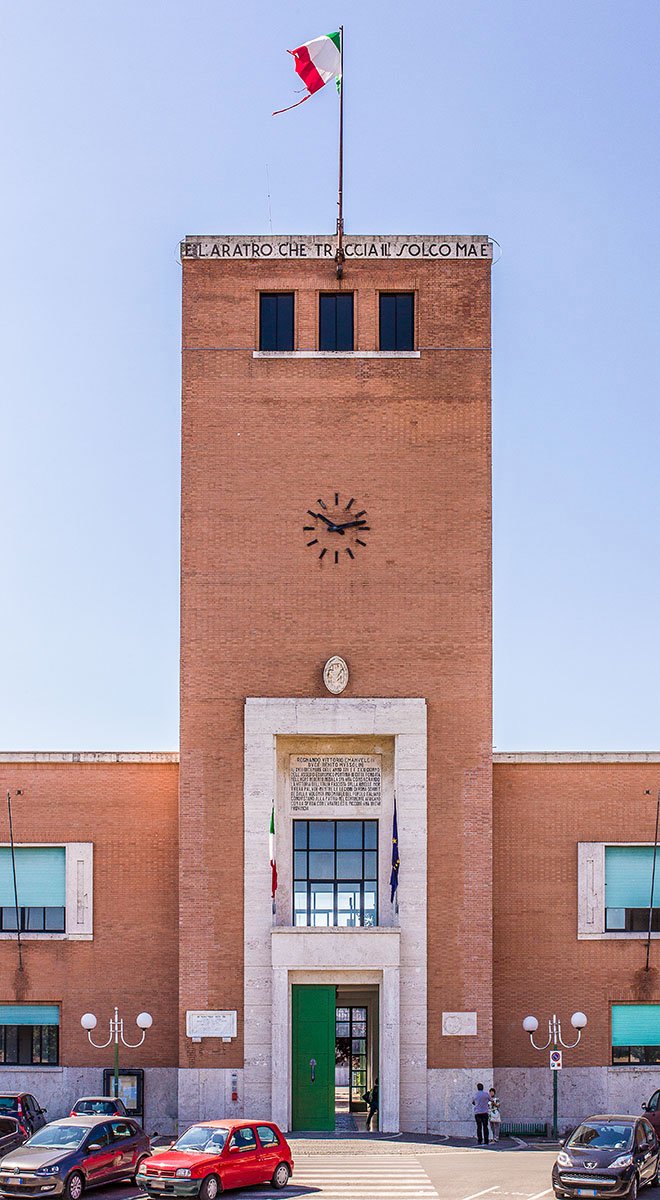
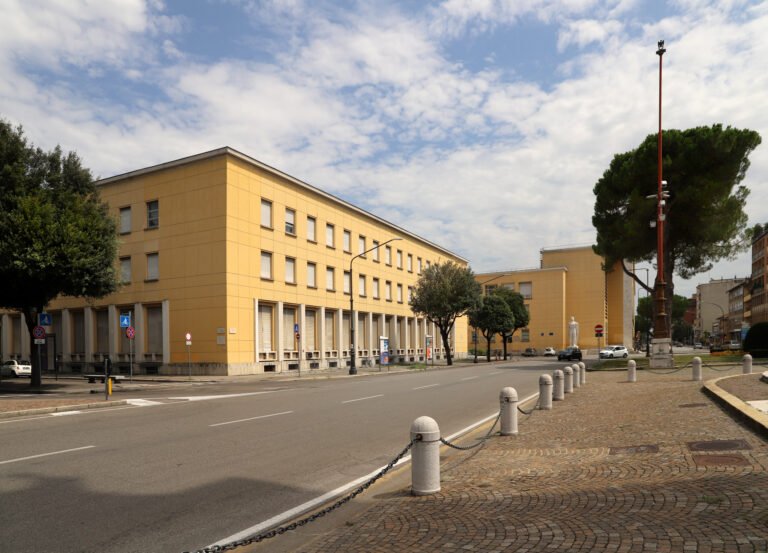
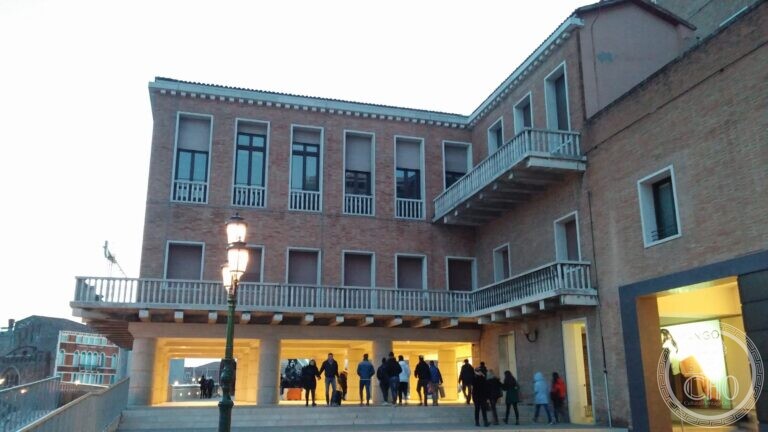
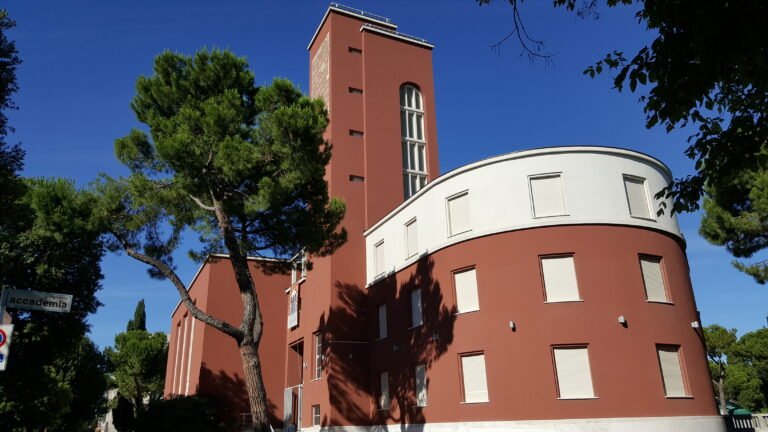
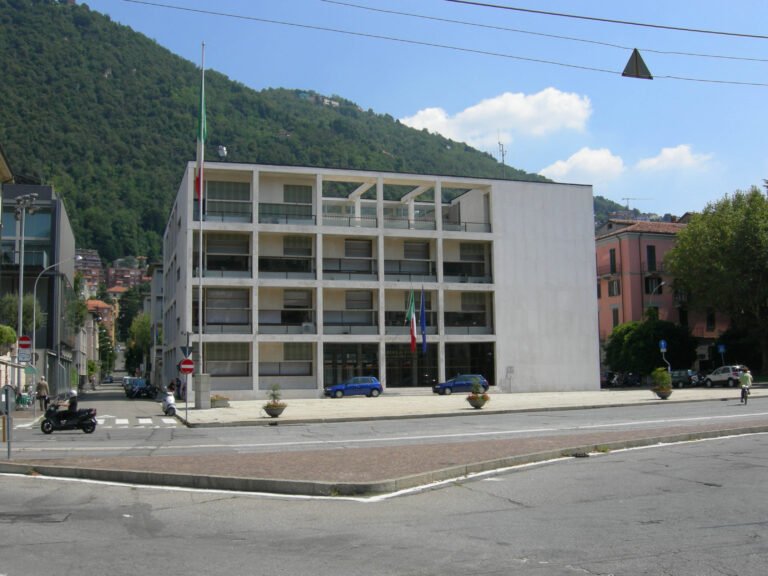
“Fascist architecture” is the label commonly used for the Italian architecture of the Ventennio, the two decades from 1922 to 1944. The label is convenient but imprecise: as the historiography notes, it covers a series of different — and partly opposed — styles and currents, often blurred into one vague notion. There is no single “Fascist style” the way there is a Gothic or a Baroque; there is an era in which Italy built enormously, and in which several architectural languages — some radically modern, others bound to tradition — coexisted, argued, and competed for public commissions.
Telling these currents apart is not an academic exercise. It is the condition for reading correctly the buildings that still inhabit Italian cities: knowing whether a palace is rationalist or monumentalist means knowing who conceived it, with what ideas and for what purpose. This piece is the overall map; each current has its own dedicated study.
The three currents
Italian Rationalism was the most modern current, in tune with European functionalism and the international Modern Movement. Its works are recognised by simple forms, smooth surfaces and a functional approach to design: use first, then form. Its leading figure was Giuseppe Terragni, author of the Casa del Fascio in Como (1932–1936), the movement’s masterpiece; beside him Luigi Figini and Gino Pollini, Adalberto Libera, Giuseppe Pagano and Giovanni Michelucci, author of Florence’s Santa Maria Novella station. The full story is in Italian Rationalism and the Modern Movement.
The Novecento Movement represented a “return to order”. Its architects rejected both the avant-gardes of the early century — Art Nouveau, Futurism, Cubism — and, later, rationalism itself; they drew on nineteenth-century Lombard neoclassicism and adopted an austere, simplified style that took the elements of the classical tradition apart and recomposed them in modern key. Among its exponents: Giovanni Muzio — author of Ca’ Brutta, the movement’s built manifesto — with Gio Ponti, Paolo Mezzanotte and Emilio Lancia. The dedicated study is The Novecento Movement in Architecture.
Monumentalism, or Simplified Neoclassicism, was the style most directly promoted by the regime for its official image: monumental, scenographic buildings meant to convey grandeur and power through the simplified citation of Roman classicism. Its leading figure was Marcello Piacentini, coordinator of the University City of Rome and of the EUR plan, site of the Palazzo della Civiltà Italiana; alongside him the historiography places figures such as Armando Brasini, Pietro Aschieri, Mario De Renzi and Innocenzo Sabbatini. The dedicated study is Monumentalism, or Simplified Neoclassicism.
Three currents, one era
The three currents did not live in sealed compartments. They fought over public competitions, criticised one another in the journals, and sometimes shared the same building site — at Rome’s University City, coordinated by the monumentalist Piacentini, architects of rationalist formation worked too. Before the war the regime’s official image identified above all with monumentalism; rationalism, after a season of hopes, was progressively marginalised; the Novecento dissolved as an organised movement but lived on in its protagonists’ work.
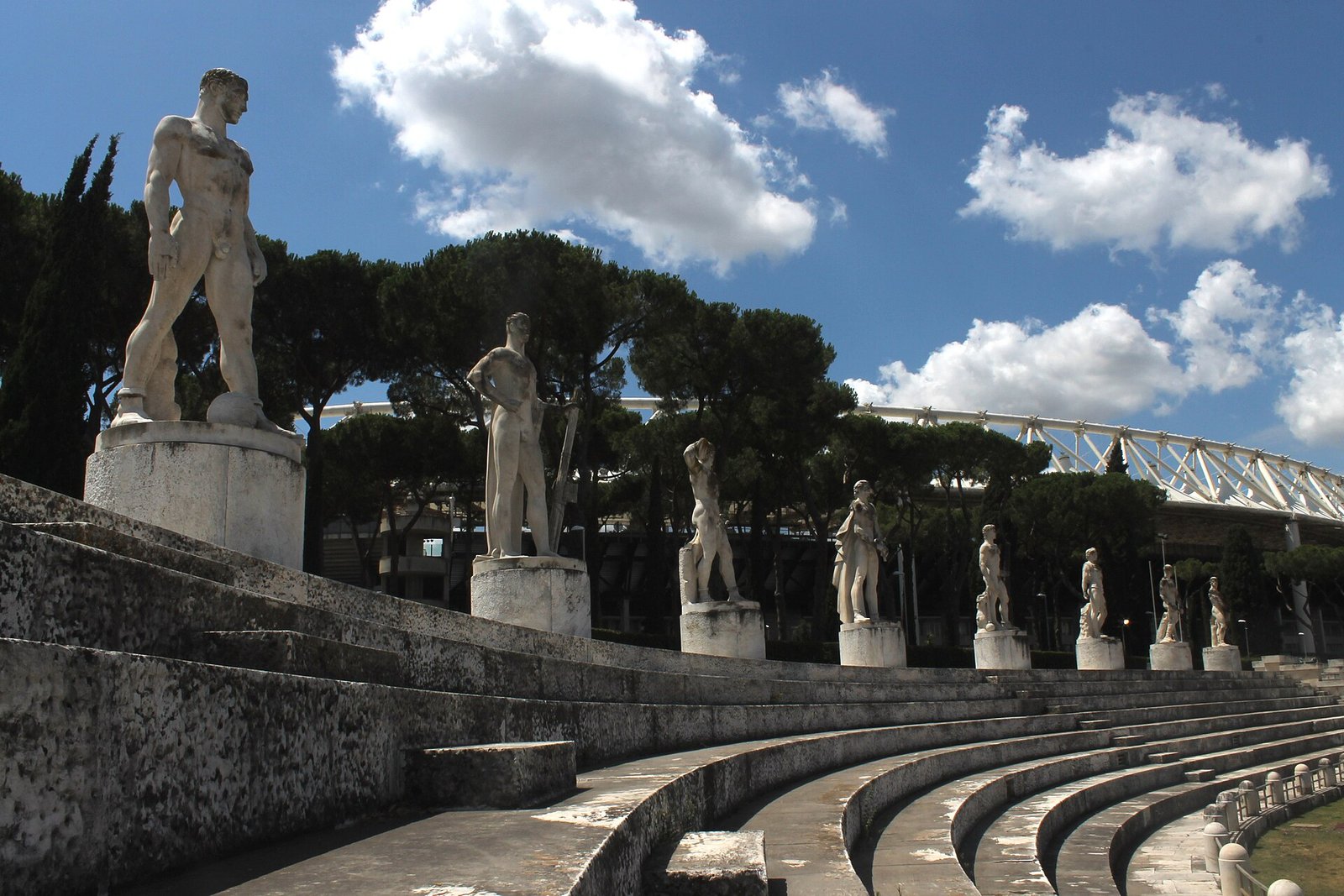
The picture is completed by the great building programmes that cut across all currents: the new towns of the Pontine Marshes, from Sabaudia to Latina; the seaside colonies of the Adriatic coast; the case del fascio, post offices and stations across the country; the great Roman complexes, from the Foro Italico — the former Foro Mussolini of Enrico Del Debbio, with the Stadio dei Marmi of the opening image — to the EUR district.
How to tell them apart at a glance
Before a building of the Twenties to Forties, three questions help place it in the right current. Is the structure exposed? If the façade is a grid of piers and beams, with large glazing and smooth unornamented surfaces, you are before rationalism: form declares function and technique. Is classicism quoted in fragments? If isolated classical elements — a cornice, an oculus, rustication — appear on a modern building beside broad bare walls, with measure rather than rhetoric, it is the Novecento. Is classicism staged? If the building is symmetrical, massive, clad in travertine or marble, with simplified colonnades and arches designed to impose, it is monumentalism: classicism as the scenography of power.
Like every scheme, it works in most cases but not all: many real buildings sit halfway, because architects moved between currents and building sites imposed compromises. The scheme helps you begin to see; the individual place records make you understand.
The debate of the era
The coexistence was not peaceful. Throughout the 1930s Italian architecture was crossed by a heated debate over which language should represent the State: the rationalists claimed modernity as the authentic spirit of the age, the traditionalists accused them of importing foreign models, and the journals — Giuseppe Pagano’s Casabella on one side, the more academic positions on the other — were the battlefield. The great public competitions, from the Palazzo del Littorio to the University City, became so many trials of strength. The outcome is known: before the war Piacentini’s monumentalism prevailed as the official image, while rationalism was progressively marginalised. But quality did not follow the political hierarchy: international criticism today recognises precisely in the rationalist works — the Casa del Fascio first — the summits of Italian architecture of the period.
Isolated from Europe? A misconception
A recurrent judgement holds that Italian architecture of the period was isolated from Europe’s most advanced tendencies. The historiography has scaled this back: while developing characters of its own, the architecture of the Ventennio absorbed the influences of the European Modern Movement and was, if anything, a national reinterpretation of it. The rationalists dialogued openly with international functionalism and with experiences such as the Bauhaus; and when the Italian debate of the time dismissed the International Style, it often discussed a superficial version of it. The result is a heritage that sits inside the history of twentieth-century European architecture, not at its margins: the Casa del Fascio is studied worldwide as a masterpiece of the Modern Movement, and the Adriatic seaside colonies appear in international surveys of modern architecture.
Architecture as message
What held such different currents together was the political use of building. According to the historiography, the regime employed construction and town planning as an instrument of propaganda, to project an image of security, strength and order — and of modernity. Each current interpreted the task its own way: the transparency of the rationalist “glass house”, the classical measure of the Novecento, Piacentini’s monumental scenography. It is a documented reading, reported as such; how power used architecture is explored in Architecture and Power in Fascist Italy.
After 1945, and what remains
With the fall of the regime this heritage did not disappear. In most cases the most directly political symbols — fasces, inscriptions, insignia — were removed, while the buildings stood and changed function: case del fascio became town halls and barracks, colonies were converted or abandoned, EUR was completed in the 1950s as a business district. The Foro Mussolini became the Foro Italico and hosted the Rome Olympics of 1960. Only more recently have historians and critics taken up the whole again, distinguishing the currents, re-establishing attributions and assessing the works for their architectural quality as well as their political context.
Much of this heritage stands and is in use: offices, courts, universities, stations, entire districts. It belongs today to what scholars call difficult heritage — conserved and studied precisely because it documents a complex past, neither celebrated nor erased. This archive documents the places of that era one by one, describing what they are, who designed them and when. The facts speak; the reader judges.