
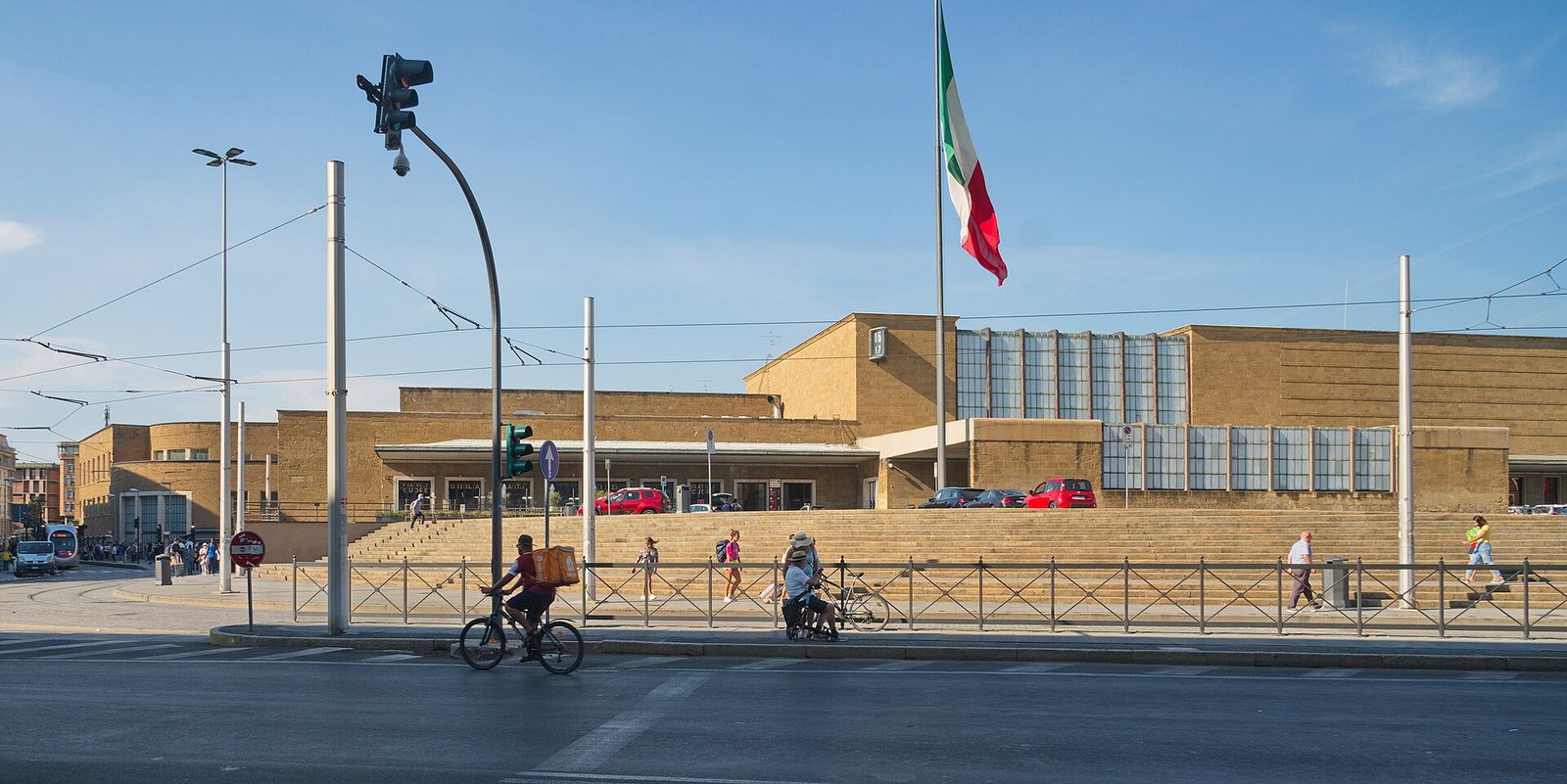
A masterpiece of Italian Rationalism, designed by Giovanni Michelucci and the Gruppo Toscano and set, without apology, right in front of a medieval basilica.
At a glance
Florence’s main station faces the apse of the fourteenth-century basilica of Santa Maria Novella, and the confrontation is the point. Designed by the Gruppo Toscano under Giovanni Michelucci and completed in 1934, it is widely regarded as one of the finest works of Italian Rationalism: low, horizontal, functional, faced in the same pietraforte stone as the historic city. It belongs to the same interwar decades as the monumental architecture of the regime, but speaks the opposite language — restraint instead of rhetoric — which is exactly why it matters in the story of the period.
Key facts
- Architects: Gruppo Toscano, led by Giovanni Michelucci, with Nello Baroni, Pier Niccolò Berardi, Italo Gamberini, Sarre Guarnieri and Leonardo Lusanna.
- Competition: won in 1932; built 1933–1934.
- Inaugurated: 30 October 1935.
- Style: Italian Rationalism (Movimento Moderno), not monumentalism.
- Cladding: pietraforte, the traditional stone of Florentine architecture.
- Signature element: the glazed metal “head gallery” (galleria di testa) along the front.
History
By the late 1920s Florence needed a new passenger station to replace the outdated Maria Antonia terminus. A national competition was held in 1932 for a site immediately beside Santa Maria Novella, one of the most sensitive locations in the city. The winning entry came from the Gruppo Toscano, a team of young architects led by Giovanni Michelucci; it was chosen over more monumental proposals, including designs closer to the official taste of the regime.
The station was built between 1933 and 1934 and inaugurated on 30 October 1935. Its low, horizontal profile and its refusal of triumphal ornament put it at odds with the monumental architecture then favoured by the state — yet it received the approval of Mussolini himself, a rare case of a rigorously modern building accepted at the highest level. Michelucci went on to become one of the central figures of twentieth-century Italian architecture, and the station remains the work by which the Gruppo Toscano is best remembered.
Michelucci himself was cautious about labels: while critics classed the building as rationalist, he preferred to describe it as the free synthesis of several tendencies rather than the product of a single doctrine.
What you see
The station reads as a long, low horizontal block, deliberately kept below the height of the basilica behind it. Its walls are faced in pietraforte, the warm brown sandstone of Florence’s palaces and churches, so that a resolutely modern building is tied to the material memory of the old city. The most striking element is the galleria di testa, the glazed metal gallery that runs across the front and floods the concourse with light; a projecting flat canopy marks the entrance below it.
Inside, the same clarity governs the plan: circulation is direct and legible, and the finishes — fine marbles at the ticket hall, the metal-and-glass roof over the platforms — are precise rather than decorative. Nothing is added for effect; the drama comes from proportion, light and the meeting of stone and glass.
Practical information
- Access: a working main-line station, open daily; the concourse and exterior are freely accessible.
- Best light: the pietraforte front warms in late-afternoon sun, seen from Piazza della Stazione.
- Time needed: 15–20 minutes to take in the facade, canopy and concourse.
- Note: it is a busy transport hub — mind your belongings as in any major station.
Getting there
The station is the central transport hub of Florence, a few minutes’ walk from the Duomo and the historic core. It is served by national high-speed and regional trains, city buses and the tram network, so most visitors arrive here first. On foot, it is directly opposite the basilica of Santa Maria Novella.
Coordinates: 43.7764, 11.2480 — open in Google Maps.
Nearby
- Basilica of Santa Maria Novella — the medieval church the station faces.
- Historic centre of Florence — the Duomo and the Renaissance core, a short walk east.
Sources
- Fondazione Giovanni Michelucci — life and works of Michelucci and the Gruppo Toscano (michelucci.it).
- Arte.it — Stazione di Santa Maria Novella, Firenze (competition 1932, inauguration 30 October 1935).
- Wikimedia Commons — file description for the Santa Maria Novella railway station, Gruppo Toscano.
Find it on the map
See this place and what’s around it →

📷 Become a Cultural Heritage Online photographer
Share your photos of places: they stay published under your name as the author. The more they're seen, the more you get noticed — and soon a contest will reward the most appreciated photos.
Log in or sign up free to add a photoIs this page about you?
This page is read by travellers and heritage enthusiasts who find it on Google. Tell us how you are connected to this place and we will take it from there.