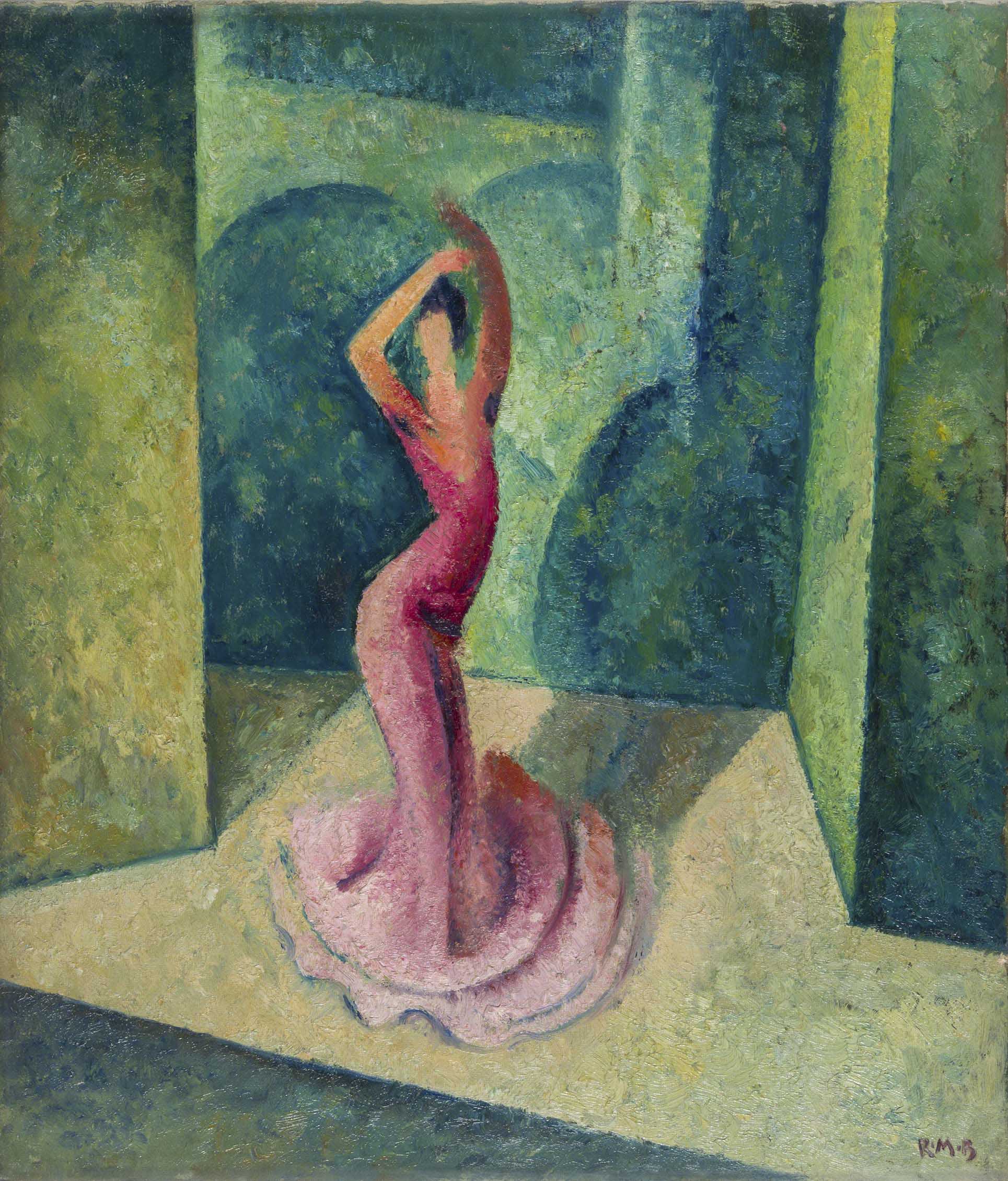
Ballerina spagnola is a painting by Roberto Iras Baldessari, completed in 1922 during the artist’s experimental period in early interwar Europe.
Created while Baldessari was traversing Central Europe in the early 1920s, the work belongs to a phase when the artist engaged with Dada and abstract tendencies, marking a departure from his earlier Futurist commitments. Baldessari had been active in the Florentine Futurist circle at Caffè Le Giubbe Rosse before undertaking these European journeys, which proved formative in broadening his artistic vocabulary. The painting documents the restless artistic climate of the period, when Italian modernists were absorbing and synthesizing movements across the continent.
About Roberto Iras Baldessari
Roberto Marcello Baldessari (1894–1965) was an Italian painter and engraver born in Innsbruck. After studying at the Academy of Fine Arts in Venice, where he encountered artists of the Ca’ Pesaro circle, he moved to Florence in 1915 and engaged with Futurism. Following his Central European sojourns and experimental phase, he settled in Rome, then definitively in Rovereto, where he devoted himself to printmaking, landscape painting, and fresco work.
Details
- Artist: Roberto Iras Baldessari
- Title: Ballerina spagnola
- Year: 1922
- Movement: Avant-garde experimentation (Dada and abstract tendencies)
- Context: Created during artist’s European travels in early 1920s
Frequently asked questions
Who was Roberto Iras Baldessari?
Baldessari was an Italian painter and engraver (1894–1965) who studied in Venice, engaged with Futurism in Florence, and later experimented with Dada and abstract approaches during his Central European travels in the early 1920s before settling in Rome and Rovereto.
What movement does this work represent?
The painting dates from Baldessari’s experimental phase in the early 1920s, when he worked with Dada and abstract tendencies during his European sojourns, prior to his later return to figurative landscape and printmaking.
Where did Baldessari create his major works?
After his formative years in Venice and Florence, Baldessari eventually settled in Rome, then definitively in Rovereto, where he focused on engraving, landscape painting, and frescoes.
Sources
- S1 — Pontiggia, Elena. Il Novecento Italiano. Abscondita, 2003. ISBN 978-88-8416-048-5.
- S2 — Menegazzi, Luigi. Il manifesto italiano: 1882-1925. Electa, 1995. ISBN 978-88-435-5134-7.
Spotted an error? Write to editorial@culturalheritageonline.com and we correct it the same day.