
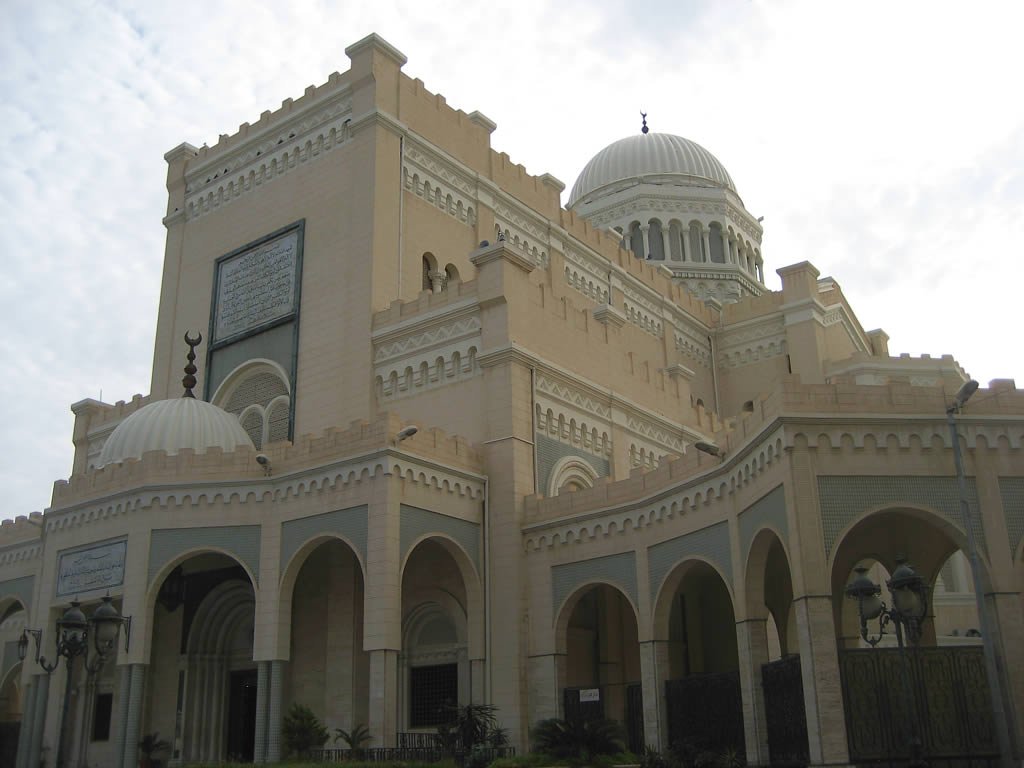
For three decades Italy reshaped Tripoli’s waterfront and squares with cathedrals, arcades and fair pavilions. Much of that fabric still stands, repurposed by the independent Libya that followed.
At a glance
Tripoli was the administrative heart of Italian Libya from the occupation of 1911 until the Italian collapse in North Africa in 1943. During those years the colonial government laid out a new urban quarter beside the old medina, building a cathedral, civic palaces, commercial arcades and the pavilions of an international trade fair. The architecture moved through several registers, from early Italianate and Moorish-revival experiments to the stripped Novecento and Rationalist language of the 1930s. After independence and the 1969 revolution many of these buildings were renamed and reused — the cathedral became a mosque, the squares took new names — but the Italian-era skeleton of the city centre remains legible today.
Key facts
- Country: Libya
- Key period: 1911–1943 (Italian rule)
- Essential sites: the former Cathedral of Tripoli (now the Algeria Square Mosque), the Red Castle (Assaraya al-Hamra), and the Tripoli International Fair grounds
- Architects (where verified): Saffo Panteri (cathedral), Alessandro Limongelli (Fair entrance pavilion), Armando Brasini (Red Castle redesign)
- Styles: Italianate, Romanesque Revival, Moorish revival, Novecento and Rationalism
History
Italy declared war on the Ottoman Empire on 29 September 1911 and announced its intention to annex Tripoli; the Treaty of Lausanne the following year acknowledged Italian sovereignty over Tripolitania and Cyrenaica. In the 1920s and 1930s the colonial authorities pursued an ambitious building programme in the capital, adding a sewage system, a modern hospital, port works and an airfield at Mellaha, now Mitiga, established in 1923. Tripolitania and Cyrenaica were unified into a single colony of Italian Libya on 1 January 1934, and in 1939 the coastal regions were incorporated into metropolitan Italy as the so-called “Fourth Shore.”
The centrepiece of the colonial townscape was the Cathedral of Tripoli, designed by the architect Saffo Panteri in a Romanesque Revival idiom. Built from around 1923, it was officially opened in 1928 while still partially complete and finished by December 1931. It rose over the square then known by Italian names, its cupola reaching 46 metres and its campanile some 60 metres. Nearby, the medieval Red Castle was adapted by the colonial administration, with architect Armando Brasini redesigning it in the early 1920s and a section converted to a museum in 1919.
Tripoli also became a showcase for the regime’s idea of modernity. The Tripoli International Fair was founded by the Italian government in 1927 and is the oldest trade fair in Africa; through the 1930s it was promoted alongside the Tripoli Grand Prix, run between 1925 and 1940, as advertisements for Italian colonial achievement. Italian rule ended with military defeat on 13 May 1943, and Italy formally relinquished its claim in 1947.
What you see
The most conspicuous survivor is the former cathedral on what is now Algeria (Elgazayer) Square. Confiscated in 1970 after the revolution, it was converted into the Gamal Abdel Nasser Mosque, also called the Algeria Square Mosque. The building keeps its essential mass — the high cupola and the tall bell tower — though the facade and interior were substantially altered in the conversion; as of 2020 it is open to the public. Around the central squares run the Italianate commercial blocks and arcades, including the Galleria De Bono, that gave the colonial quarter its character.
Visitors can read the colonial layer alongside far older Tripoli. The Red Castle (Assaraya al-Hamra), whose roots are medieval and which carries Brasini’s interventions, now houses the national museum with collections spanning some five thousand years of Libyan history. At the edge of the city the Tripoli International Fair grounds preserve the memory of the entrance pavilion attributed to Alessandro Limongelli. Travel to Libya carries serious security and entry restrictions, so any visit depends on current conditions and official advice.
Practical information
- Travel advisories: most foreign governments advise against travel to Libya; check your own government’s current guidance before any trip.
- The former cathedral, now the Algeria Square Mosque, was reported open to the public as of 2020; mosque visiting etiquette applies.
- The Red Castle museum closed during the 2011 conflict and reopened in 2025; opening hours are subject to local conditions.
- Entry to Libya requires a visa and is heavily restricted; independent tourism is limited.
- The central sites — the former cathedral, Algeria Square and the Red Castle — lie close together in downtown Tripoli.
Getting there
Tripoli is served principally by Mitiga International Airport, on the site of the former Italian-era Mellaha air base established in 1923, a short distance east of the city centre; Tripoli International Airport to the south was damaged in the post-2011 conflict. Access by air depends entirely on the security situation and the availability of international flights, which has varied considerably over recent years.
Related in CHO
- Asmara — Africa’s Modernist City and Italian Rationalism
- Rome — Liberty Romano, EUR and Italian Rationalism
- Milan — Liberty, Rationalism and the World Capital of Design
Sources
.jpg)
Find it on the map
See this place and what’s around it →📷 Become a Cultural Heritage Online photographer
Share your photos of places: they stay published under your name as the author. The more they're seen, the more you get noticed — and soon a contest will reward the most appreciated photos.
Log in or sign up free to add a photo