
Curated Itinerary
Nile Heritage Trail: Giza to Lalibela
The Nile Heritage Trail traces one of humanity’s oldest and most consequential rivers — from the plateau of Giza, where the pyramids have stood for 4,500…
Take this route into Google Maps
From Great Sphinx of Giza – Virtual Tour 360° to Lalibela Rock-Hewn Churches – Virtual Tour 360°, in the order we curated them.
➤ Open the stops in Google MapsThese places are spread over thousands of kilometres, and Google will not always join them into one route. It opens with the stops loaded in our order: from there pick two that are close to each other, choose how you travel, and add places of your own. For a single leg, the directions on each stop's own page work better.
The Nile Heritage Trail traces one of humanity’s oldest and most consequential rivers — from the plateau of Giza, where the pyramids have stood for 4,500 years, south through Pharaonic Thebes, past the temples carved into living rock at Abu Simbel, and on into the highlands of Ethiopia where ancient Axum and rock-hewn Lalibela carry the heritage of a different civilisation altogether.
This is not a route you complete in a week. It spans three modern nations (Egypt, Sudan’s border zone, Ethiopia), requires internal flights at several junctures, and crosses climatic zones from Saharan desert to East African highlands. What holds it together is the river itself and the corridor of extraordinary human achievement it made possible.
Stage 1 — The Giza Plateau (Egypt)
Begin where the ancient world’s most recognisable monument complex still dominates the western desert. The Giza Pyramid Complex — three pyramids built between 2589 and 2504 BCE — represents the apex of Old Kingdom engineering and theological ambition. The Great Pyramid of Khufu remained the world’s tallest human-made structure for almost 3,800 years. Beside it, the Great Sphinx guards the necropolis with its limestone profile still carrying traces of the original paint applied when Khafre’s pyramid workers shaped it around 2500 BCE.
Allow a full day. The plateau is best before 9am; the sound and light show at night is worth attending once.
Stage 2 — Theban Necropolis & Karnak (Luxor)
Fly or take the overnight sleeper train south to Luxor — ancient Thebes, cult centre of Amun and capital of the New Kingdom. Karnak is not a temple but a vast precinct of temples, chapels, pylons and sacred lakes built and rebuilt over 2,000 years, every pharaoh adding their layer. The Hypostyle Hall alone — 134 massive columns in 16 rows — is among the largest religious interiors ever created.
On the West Bank, the Mortuary Temple of Hatshepsut at Deir el-Bahari rises in three colonnaded terraces against the cliffs of the Valley of the Kings. Hatshepsut, one of the most successful pharaohs of the New Kingdom, ruled for about 20 years disguised in royal regalia — her temple is the architectural counterpart of that remarkable reign.
Stage 3 — Abu Simbel (Nubia)
The drive or short flight from Aswan to Abu Simbel takes you to what many consider Egypt’s most dramatic ancient monument. Ramesses II had two temples cut directly into the sandstone cliff around 1264 BCE. The facade of the Great Temple features four colossal seated statues of the king, each 20 metres high. In 1968, in one of the greatest feats of archaeological conservation, the entire complex was cut into blocks and relocated 65 metres uphill to save it from the rising waters of Lake Nasser after the Aswan High Dam was built.
The temples are oriented so that twice a year — around 22 February and 22 October — the rising sun illuminates the sanctuary’s inner chamber and strikes the statues of three gods (leaving only Ptah, god of the underworld, in darkness).
Stage 4 — Axum (Ethiopia)
Cross from Egypt into the Ethiopian Highlands via Addis Ababa and fly north to Tigray. Axum was the capital of the Aksumite Empire from roughly the 1st to 7th centuries CE — one of the great powers of the late antique world, trading with Rome, Persia, India and Arabia. Its towering granite stelae (obelisks), the largest of which stands 24 metres, marked royal tombs. The Church of St Mary of Zion is said by Ethiopian tradition to house the original Ark of the Covenant.
Axum is UNESCO-listed and remains an active pilgrimage centre — the Ethiopian Orthodox faith has been practised here continuously since the 4th century CE.
Stage 5 — Lalibela (Ethiopia)
The trail ends in the highlands south of Axum at Lalibela, a site that defies easy categorisation. In the 12th and 13th centuries, King Lalibela directed the excavation of eleven churches directly from the living rock of the mountainside. They are not built; they are carved downward and inward, connected by tunnels, trenches and ceremonial courtyards. Bet Giyorgis (St George’s Church), a perfect Greek-cross plan sunk into a pit, is the most photographed — and still holds daily liturgy.
Ethiopian Orthodox Christmas (Genna, 7 January) at Lalibela is one of the most extraordinary religious spectacles in the world, with pilgrims arriving from across Ethiopia in white robes.
Practical Notes
- Duration: 14–21 days for the full trail, including transit days
- Best season: October–April (cooler, drier); avoid Egyptian sites in July–August heat
- Logistics: Internal flights are essential (Aswan–Abu Simbel; Addis–Axum; Axum–Lalibela)
- Visas: Egypt e-visa available online; Ethiopia visa on arrival or e-visa
- GPS files: Download the GPX or KML to load into OsmAnd, Garmin, or Google Earth
Get this route — explore at your own pace
The walk and the notes are open to everyone, right here. To take the route with you — the GPX and KML tracks for your phone — you need a CHO account, and a free one is enough. We do not sell these routes: we build them ourselves and give them to the people who read us.
Create a free accountAlready have one? Log in.
This route was built with the tools we give operators.
Guides, associations and cultural operators build their own routes here: pick the stops from the archive, add your notes, and the map, the GPX and the printable version come out on their own. Your programme gets a permanent page, your events go on the city pages people read while planning — and if you sell your route as a road-book or a virtual tour, you receive 80% of the price net of tax.
See how an operator account worksStep by step

Great Sphinx of Giza – Virtual Tour 360°
A colossal limestone sphinx carved from bedrock during Egypt's Old Kingdom, the Great Sphinx remains the world's oldest monumental sculpture…
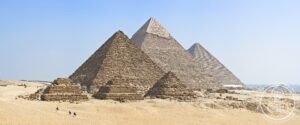
Giza Pyramid Complex – Virtual Tour 360°
The last surviving Ancient Wonder, Giza's three pyramids and Great Sphinx still raise more questions about ancient engineering and labour than they answer.

Karnak – Virtual Tour 360°
A monumental temple complex near Luxor, Karnak spans nearly 2,000 years of Egyptian construction and served as the primary sanctuary of the god Amun.

Mortuary temple of Hatshepsut
One of ancient Egypt's supreme architectural achievements, this terraced temple at Deir el-Bahari honours Pharaoh Hatshepsut with a revolutionary design…
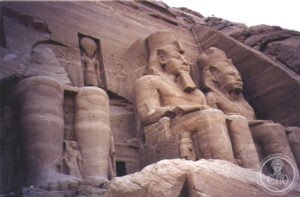
Abu Simbel – Virtual Tour 360°
Ramesses II cut two temples into the living rock of Nubia to assert Egyptian dominion over the south — the Great Temple’s four 20-metre seated colossi of the…

Axum
The ancient capital of the Aksumite Empire, Axum preserves towering stelae and archaeological ruins from Africa's most influential pre-Islamic civilizations.
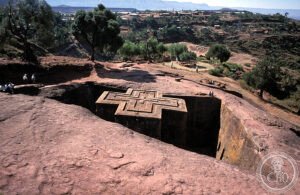
Lalibela Rock-Hewn Churches – Virtual Tour 360°
Eleven churches carved downward from volcanic rock at Lalibela form Ethiopia's New Jerusalem, a working Orthodox Christian pilgrimage site inscribed by UNESCO in 1978.
Download for tour navigation
🔒 The walk and the notes are open to everyone on this page. The files to take with you — the stop list as a PDF, and the GPX and KML tracks for your phone — come with a CHO account, and the free one includes them.
Walk it with the navigator on
These places are spread over thousands of kilometres, and Google will not always join them into one route. It opens with the stops loaded in our order: from there pick two that are close to each other, choose how you travel, and add places of your own. For a single leg, the directions on each stop's own page work better.