
How Budapest turned a political argument into one of the most original architectural movements in Europe
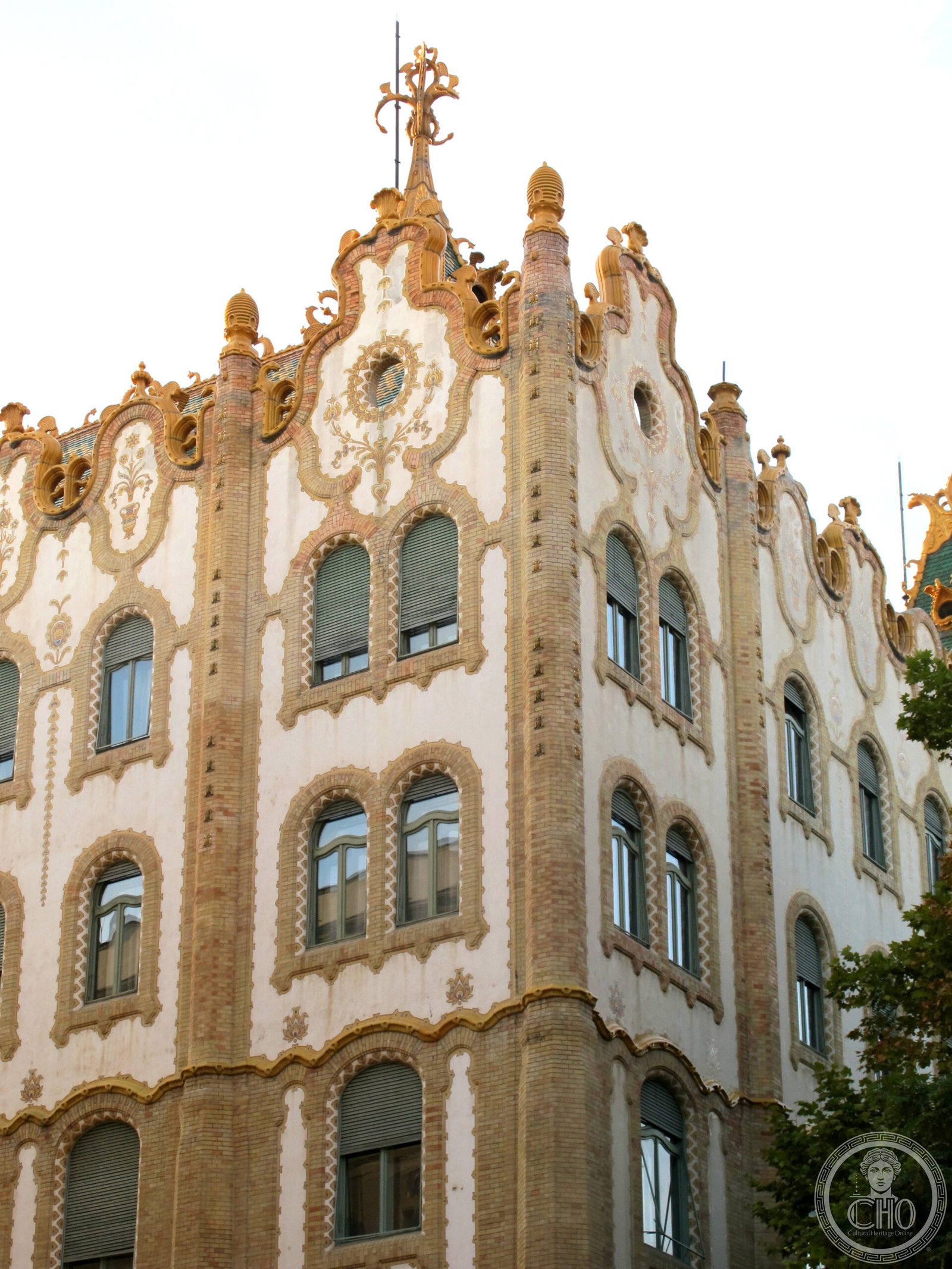
There is a building in the fifth district of Budapest, on a street called Hold utca, where you can stand at the main entrance and see almost nothing unusual. The facade is red brick, the windows have arched frames, the proportions are solid late-nineteenth century. Then you look up, and above the roofline you see bees. Dozens of ceramic bees, glazed in yellow and gold, perched on tile-covered surfaces between ceramic flower urns. They are far too high to be seen clearly from street level. Architect Ödön Lechner, when asked why he placed ornament where no one could see it, reportedly said they were designed for God and for the birds.
This story — possibly apocryphal, certainly characteristic — captures something essential about Budapest’s Art Nouveau moment. The Hungarian Szecesszió, as it was called, was not primarily a commercial style. It was a political position expressed in ceramic and brick: a declaration that Hungary’s architecture would look like nothing in Vienna, nothing in Paris, nothing borrowed from the Western European styles that dominated official taste. It would look like Hungary, whatever that meant.
The political argument
Understanding the Szecesszió requires understanding what Budapest was in the 1880s and 1890s. The Austro-Hungarian Compromise of 1867 had given Hungary internal autonomy within the Habsburg empire, but the cultural subordination to Vienna remained acute. Hungarian intellectuals and artists were in the middle of a sustained effort to define a distinctly Magyar culture — in music, literature, visual art, and architecture.
Ödön Lechner, born in 1845 and trained in Berlin and Paris before returning to Budapest, became the architect of this argument. He was not a nationalist in any simple sense; he was equally informed by the structural rationalism of Viollet-le-Duc and the aesthetic philosophy of John Ruskin. But he concluded that the right material for Hungarian architecture was Zsolnay pyrogranite ceramic — a material developed in the 1870s by the Zsolnay factory in Pécs, frost-resistant and available in colours that no Western European style had exploited at architectural scale. And the right decorative language was Magyar folk art: the embroidery patterns, the floral motifs, the geometric arrangements found in traditional Hungarian textiles and pottery.
The result was a style that looked like nothing else in Europe. Lechner’s buildings are not Vienna Secession — they are warmer, more organic, more rooted in specific ornamental traditions. They are not quite French Art Nouveau either, though they share the preference for botanical motifs and the rejection of historical revival. They are something that could only have happened in Budapest at a specific historical moment, and that moment lasted roughly from the 1890s to the First World War.
The buildings
Lechner’s first fully realised Szecesszió building was the Museum of Applied Arts, completed in 1896 for the Millennium celebrations marking a thousand years of the Hungarian kingdom. Emperor Franz Joseph I attended the opening. The building gave him nothing to object to technically — the iron structure was as modern as anything in Vienna — but the aesthetic was a provocation. The dome carried Zsolnay tile patterning that drew on Moorish and Central Asian sources as filtered through Magyar folk tradition. The atrium inside was white Zsolnay ribbed vaulting against pale green walls. Nothing about it looked Habsburg.
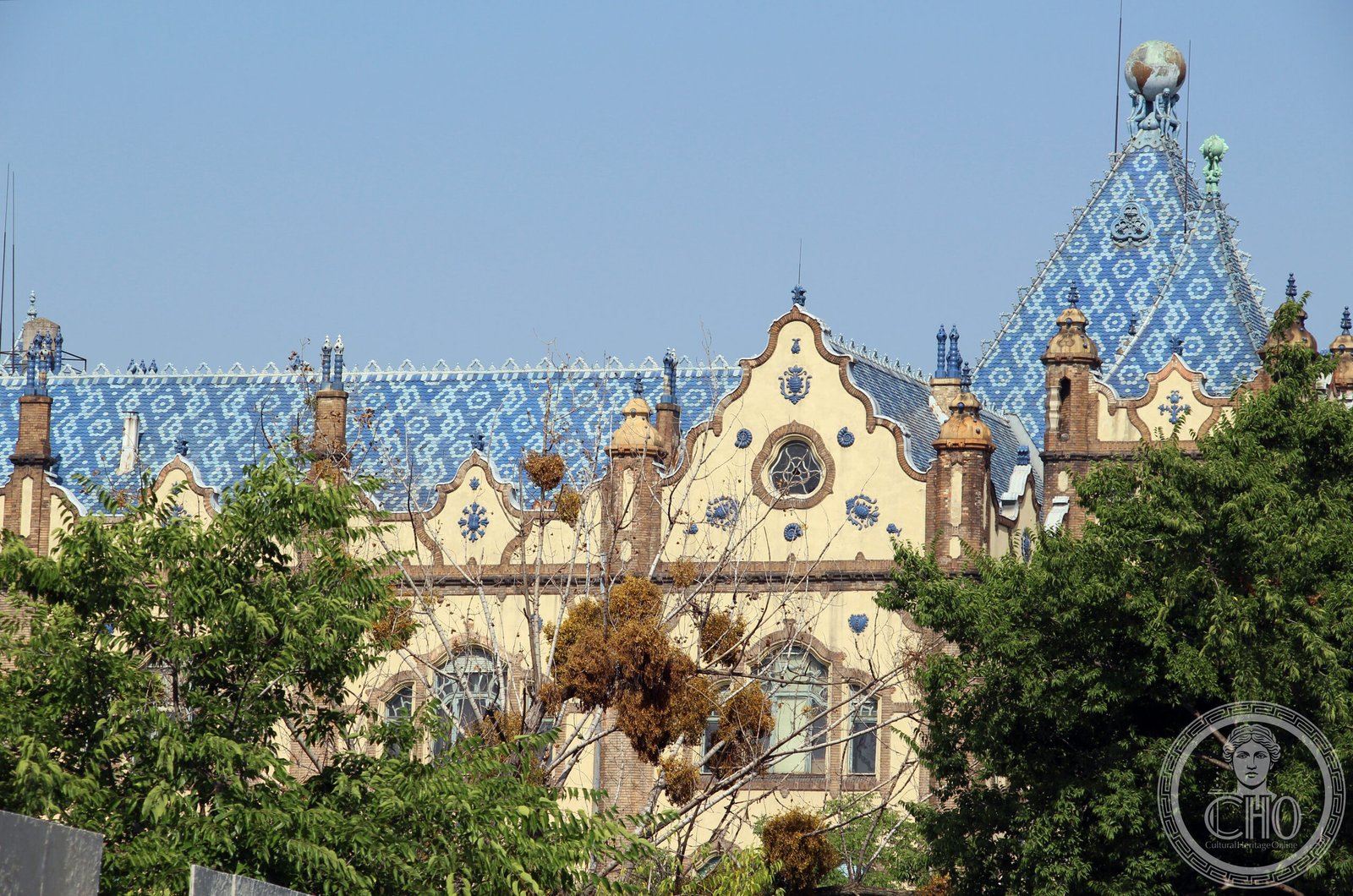
Three years later Lechner completed the Geological Institute on Stefánia út, a building that took his programme further. Here the brief was scientific: a headquarters for Hungary’s geological survey, an institution that wanted a building projecting intellectual authority. Lechner gave them ceramic globe-bearers on the roofline, a blue-green Zsolnay tile roof that shifts colour in changing light, and facade patterning so dense with folk-embroidery motifs that the building looks different at every scale of view. The Zsolnay collaboration was at its closest here: every ceramic element was custom-designed for the building.
The Postal Savings Bank on Hold utca, built 1899–1901, is the most extreme of the three. The bees and flower urns are only the beginning: the ceramic covering of the upper sections is so detailed, so varied in texture and colour, that the building reads differently depending on the distance and angle. Lechner placed the most elaborate ornament where it would be least visible, apparently convinced that architecture had an obligation to its own internal consistency that was separate from the audience’s viewing distance.
The wider movement
Lechner was not the only practitioner of the Szecesszió. Two of the six buildings on the walking trail associated with this period were built by other architects working in related modes.
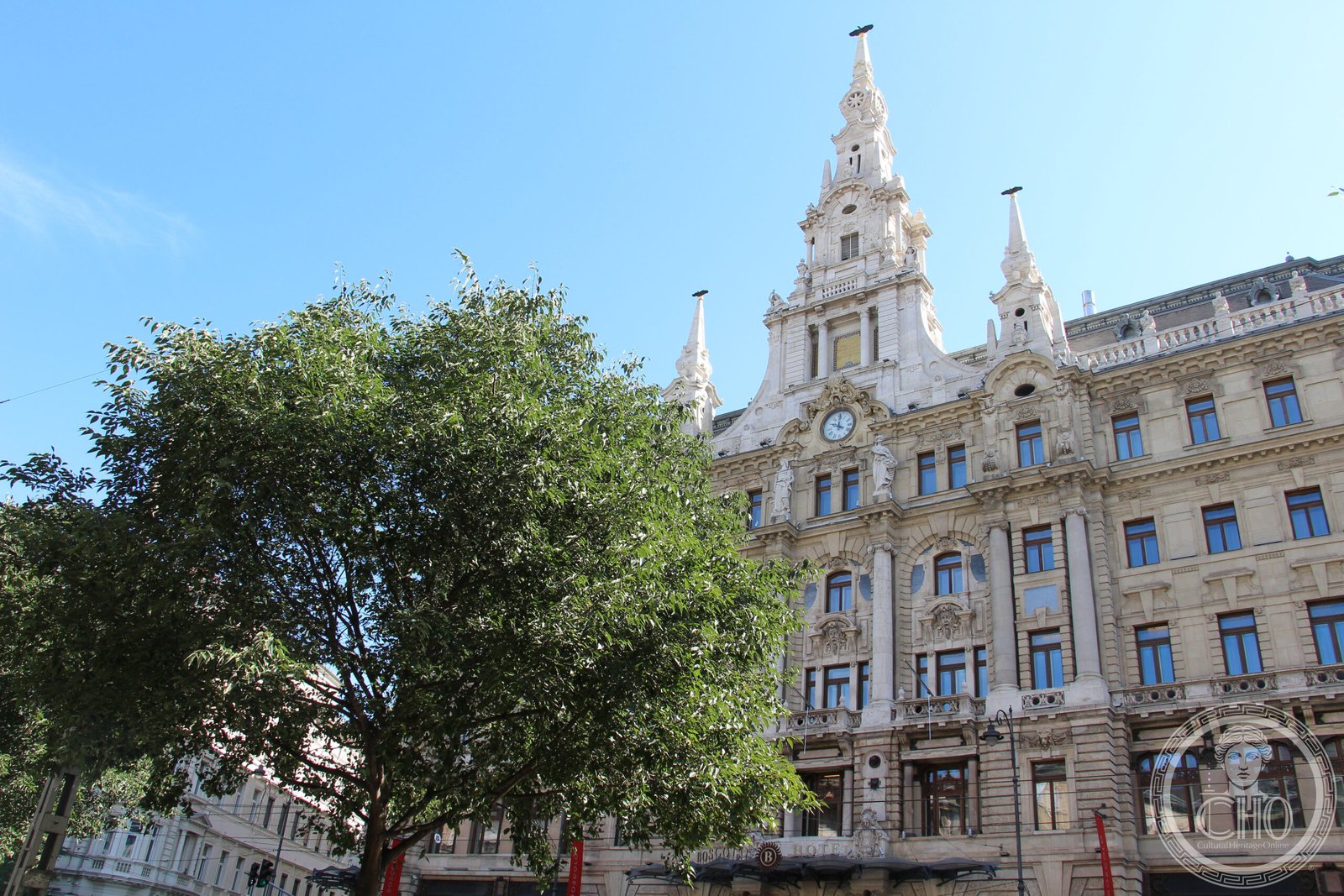
Flóris Korb and Kálmán Giergl designed the New York Palace in 1891–1894 for an American insurance company with a brief that was explicitly international and commercial. Their solution was Eclectic in structure — Baroque and Renaissance borrowings at the facade level — but Szecesszió in the details and entirely Szecesszió in the interior café, where three tiers of gilded galleries and frescoed vaults created the most theatrical coffee-house space in Central Europe. The Café New York became the meeting place for Budapest’s literary and artistic community almost immediately after opening, and the Nyugat journal — the engine of Hungarian literary modernism — was edited, argued over, and sometimes written at its marble tables.
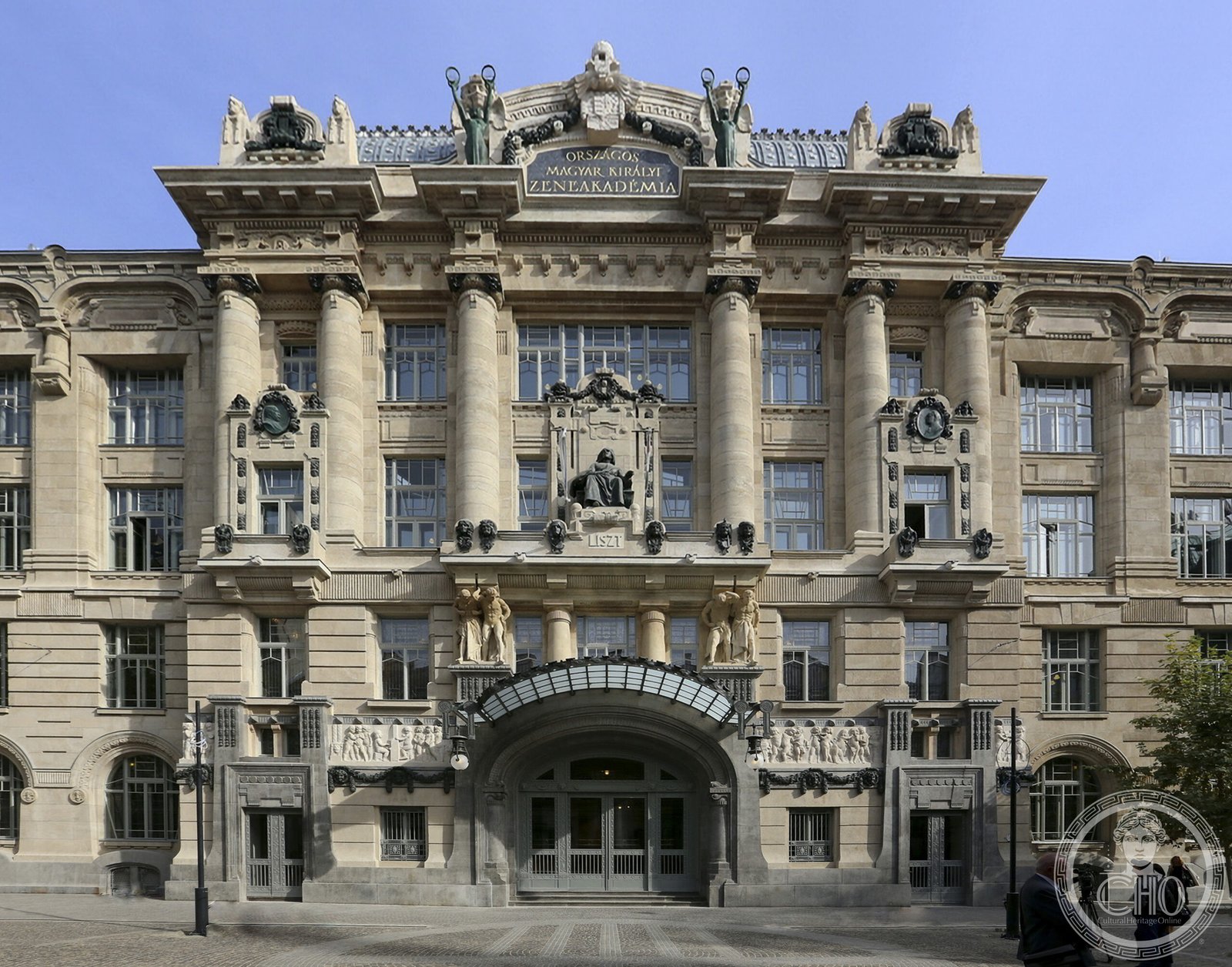
The Franz Liszt Academy of Music, completed in 1907 by Kőrössy Albert Kálmán and Márkus Géza, represents the institutional consolidation of the style. Where Lechner’s buildings were provocations, the Academy was a cultural monument. The brief demanded the best concert hall in the country, and the architects delivered: 900 seats, acoustics ranked among the finest in Europe for chamber orchestras, and a Zsolnay ceramic interior of considerable refinement. The Academy was inaugurated with a concert conducted by Gustav Mahler, then in his last months as director of the Vienna Court Opera — a symbolic handoff from the Habsburg cultural capital to its Hungarian counterpart.
The Gresham Palace, built 1904–1906 for the Gresham Life Assurance Society of London, sits at the most commercially oriented end of the Szecesszió spectrum. Architects Zsigmond Quittner and the Vágó brothers gave the building a fully articulated Art Nouveau exterior, with Zsolnay ceramic inserts in the ironwork grilles and mosaic floors in the atrium. It faces the Chain Bridge across the Danube embankment: the most prominent site in the city, and the one that announced to arriving visitors that Budapest had its own version of the European moment.
The collapse and the legacy
The Szecesszió’s moment was relatively brief. The First World War disrupted everything; the subsequent decades brought political upheaval, economic contraction, and an architectural culture that moved toward modernism and then, under communism, toward socialist realism. Lechner died in 1914, at the beginning of the collapse. His buildings survived, though not always well: the communist decades nationalised them, repurposed them, and deferred their maintenance. The New York Café became a sports goods store. The Geological Institute’s ceramic figures weathered unattended. The Museum of Applied Arts struggled with structural problems in its iron dome.
The wave of restorations that began in the 1990s and continued through the 2010s brought most of the buildings back to something close to their original condition. The Liszt Academy’s 2013 restoration is considered the most precise: the Zsolnay factory in Pécs, still operating after more than a century, produced replacement tiles using the original pyrogranite process, matching the 1907 originals almost exactly. The Gresham’s 1999–2004 restoration uncovered original mosaic floors that had been painted over during the communist period. The New York Café’s 2006 restoration returned the gilded galleries to their 1894 appearance.
What the Szecesszió left behind is a city that wears its Art Nouveau moment more lightly than Vienna or Paris. Vienna has the Secession Building and the ring of Jugendstil apartment houses in the inner districts; Paris has the Metro entrances and the grands magasins. Budapest has Lechner’s three major public buildings, the New York Palace, the Liszt Academy, and the Gresham — scattered across districts that are still working neighbourhoods rather than tourist zones, accessible by tram and on foot, frequented by the people who live and work nearby. The bees on the Postal Savings Bank roofline are still there, still for the birds.
Walk it yourself
The Budapest Szecesszió walking trail connects all six buildings in a single day, with transport notes, café recommendations, and building histories for each stop. The route is designed to be walked rather than rushed, with time to sit in the Café New York, to look at the Geological Institute from two directions, and to catch an evening concert at the Liszt Academy if the schedule allows.