
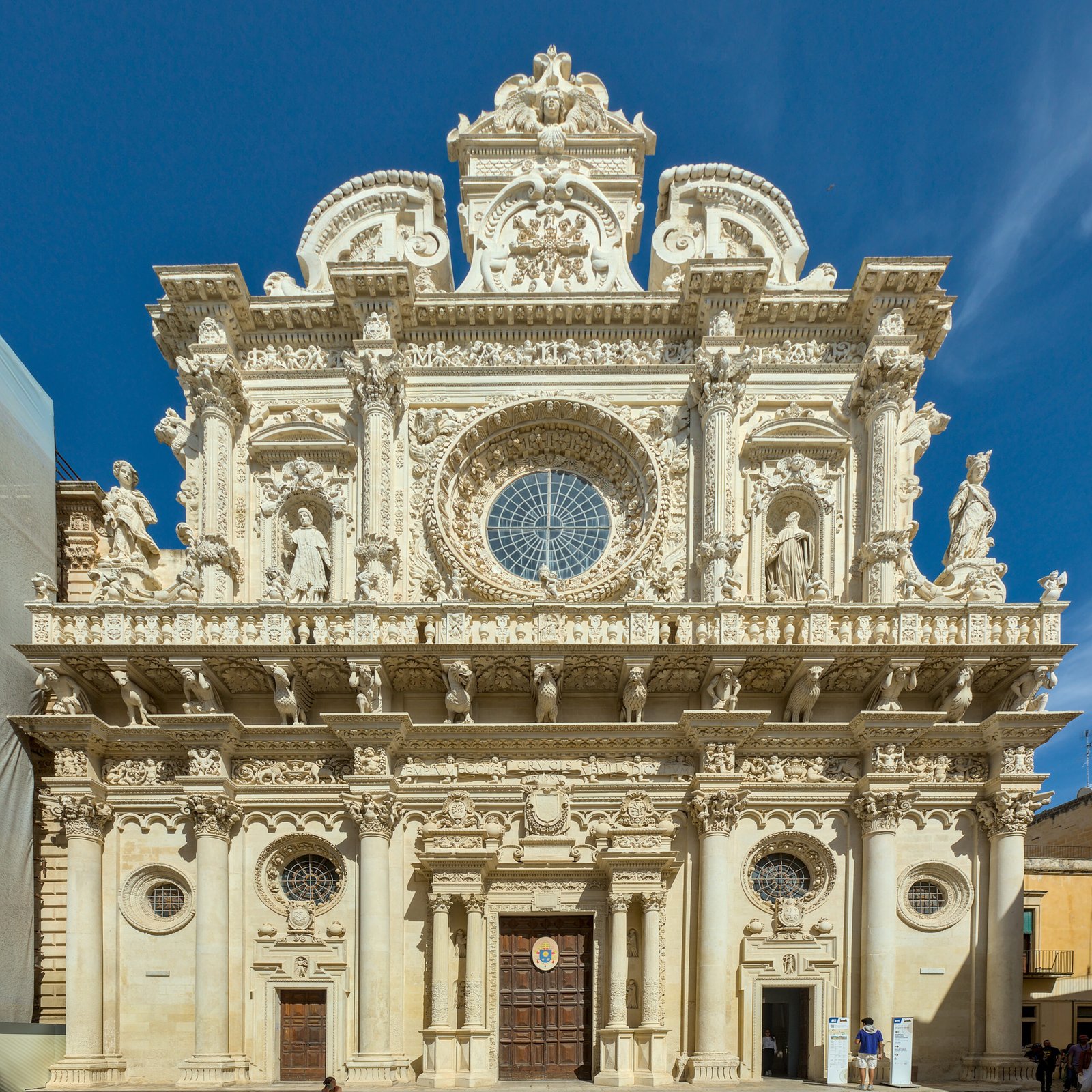
The most exuberant single monument of the Barocco leccese, built over 150 years — a vertical anthology of carved pietra leccese supported by thirteen putti, grotesques and caryatids.
At a glance
The Basilica di Santa Croce stands in the heart of Lecce’s historic centre and is the most exuberant single monument of the Barocco leccese — the regional Baroque style that flourished in southern Puglia between the late sixteenth and the early eighteenth centuries. Built over almost 150 years on the site of an earlier Celestine church, Santa Croce concentrates the carved limestone vocabulary of the Salento into a single facade.
Key facts
- Location: Via Umberto I, Lecce, Puglia
- Coordinates: 40.3547° N, 18.1733° E
- Construction: begun 1549, facade completed 1646, full work to 1695
- Style: Barocco leccese (Lecce Baroque)
- Architects: Gabriele Riccardi (lower order) · Cesare Penna and Giuseppe Zimbalo (upper facade and rose window) · Giuseppe Cino (adjoining Palazzo dei Celestini)
- Material: pietra leccese — a soft, fine-grained yellow limestone of the Salento
History
A Celestine monastic community was established on the site in 1353. The present church was begun in 1549 under Gabriele Riccardi, who designed the lower order of the facade and the interior. Work paused after his death and was resumed in 1606 by Francesco Antonio Zimbalo. His grandson Giuseppe Zimbalo, the leading Lecce architect of his generation, completed the upper register and the great rose window between 1644 and 1646.
The adjoining Palazzo dei Celestini — now the seat of the Province of Lecce — was finished by Giuseppe Cino in 1695. The Celestine order was suppressed by Joachim Murat in 1807; the church passed to the diocese of Lecce and remains a parish today.
What you see
Santa Croce reads in two registers. The lower order, by Riccardi, is restrained: paired columns, a classical cornice, a band of allegorical figures. The upper order, by Penna and Zimbalo, abandons restraint. A balustrade of thirteen putti and grotesques — wyverns, harpies, a Saracen, an Arab, a Germanic warrior — supports the upper facade. The rose window is set inside a frame of carved acanthus and pomegranates; flanking columns are wound with vines.
The carving exploits the workability of pietra leccese, which is soft enough to be tooled with a knife when freshly quarried and hardens on exposure to air. The same stone produces the warm honey colour that defines Lecce at sunset. The interior is calmer: a Latin-cross plan with seventeen side altars, the most celebrated being the altar of San Francesco da Paola by Francesco Antonio Zimbalo (1614), carved with twelve scenes from the saint’s life.
Practical information
- Entry: free; donations welcomed.
- Hours: daily, with a midday closure typical of southern parishes (roughly 12:00–17:00).
- Palazzo dei Celestini: the provincial seat next door — the courtyard can usually be visited during office hours.
- Time needed: 30 minutes for the facade and interior; 60 minutes if combined with the Palazzo and the nearby Duomo.
Getting there
Lecce is the terminus of the main Adriatic railway line from Bologna and Bari. Stazione Centrale is a 15-minute walk from the basilica through Porta Napoli and Piazza Sant’Oronzo. Long-distance buses (FlixBus, Marozzi) and the Brindisi airport shuttle stop at the city bus terminal beside the station. GPS: 40.3547, 18.1733 — open in Google Maps.
Nearby
- Piazza del Duomo — Lecce’s cathedral square, also by Giuseppe Zimbalo, 5 minutes south.
- Piazza Sant’Oronzo — Roman amphitheatre and Colonna di Sant’Oronzo, 3 minutes south.
- Castello di Carlo V — Aragonese fortress remodelled for Charles V, 5 minutes east.
- Sant’Irene and Santa Chiara — two further Barocco leccese churches within a 10-minute walk.
Sources
- Comune di Lecce, Assessorato alla Cultura — portale istituzionale.
- Regione Puglia — Sistema museale e siti culturali.
- MiBACT, Soprintendenza ABAP per le province di Brindisi e Lecce.
- Treccani, Enciclopedia Italiana — voce “Zimbalo, Giuseppe”.
Find it on the map
See this place and what’s around it →
📷 Become a Cultural Heritage Online photographer
Share your photos of places: they stay published under your name as the author. The more they're seen, the more you get noticed — and soon a contest will reward the most appreciated photos.
Log in or sign up free to add a photoIs this page about you?
This page is read by travellers and heritage enthusiasts who find it on Google. Tell us how you are connected to this place and we will take it from there.