

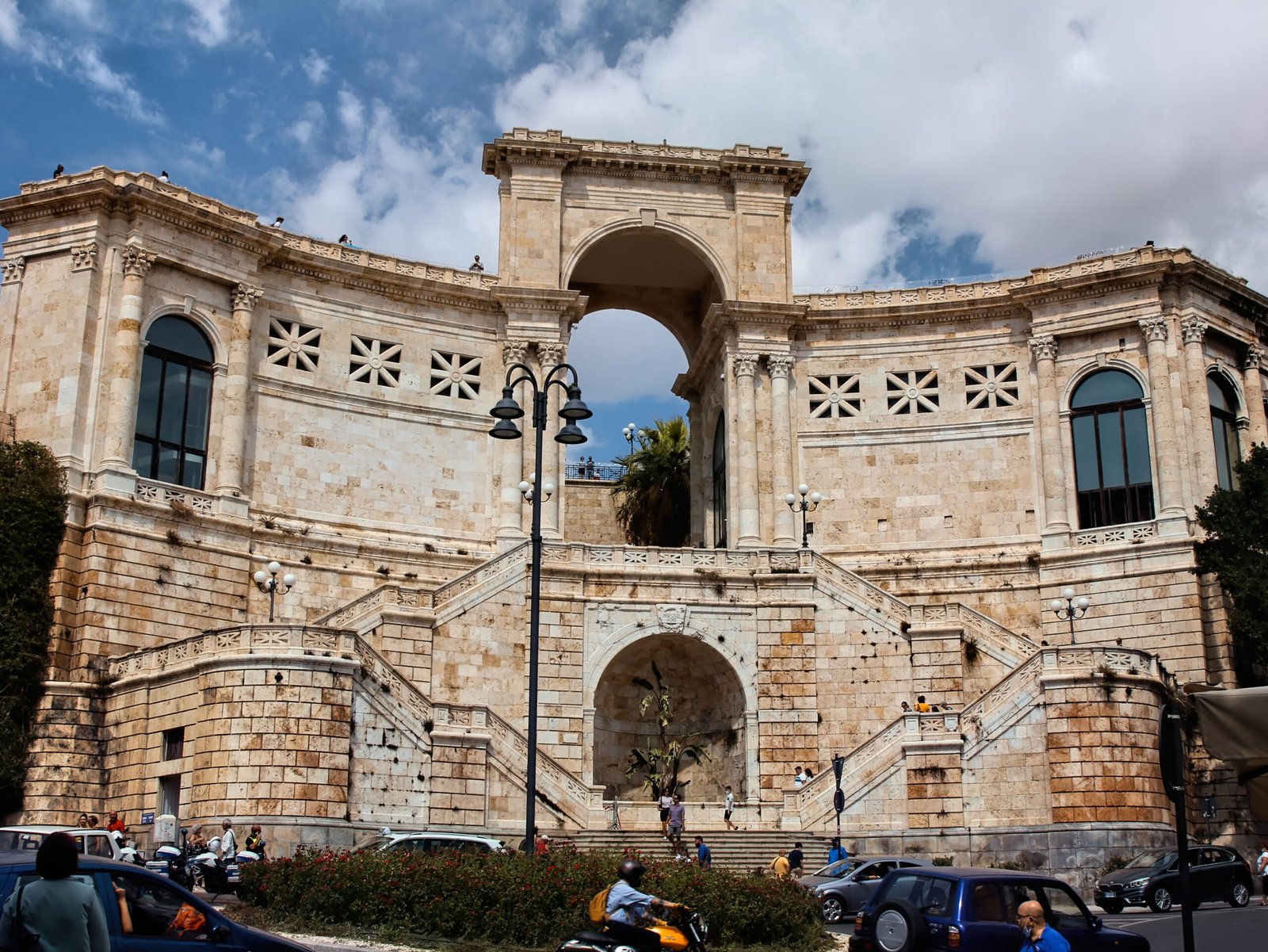
A monumental belvedere and ceremonial staircase built over the Spanish bastions of Cagliari’s medieval Castello — a piece of late-nineteenth-century civic theatre in white and yellow limestone.
At a glance
The Bastione di Saint Remy is a monumental terrace and ceremonial staircase built into the southern flank of the Castello district of Cagliari, the medieval upper town of the Sardinian capital. Constructed between 1896 and 1902 over earlier Spanish fortifications, it serves as both a panoramic belvedere over the Gulf of Cagliari and a piece of late-nineteenth-century civic architecture in white and yellow limestone.
Key facts
- Location: Castello district, Cagliari, Sardegna
- Coordinates: 39.2163° N, 9.1164° E
- Built: 1896–1902
- Architects: Giuseppe Costa and Fulgenzio Setti
- Named after: Filippo Guglielmo Pallavicini di Saint Remy, first Piedmontese viceroy of Sardinia (1720)
- Material: local limestone in two contrasting tones (warm yellow Bonaria and cooler white Cagliari)
History
The Castello quarter of Cagliari was fortified by the Pisans in the thirteenth century and reinforced by the Aragonese and Spanish over the following four hundred years. By the late nineteenth century the bastions were obsolete as military works but still cut the upper town off from the expanding lower districts of Villanova and Marina.
In 1896 the municipality commissioned a monumental connection between Piazza Costituzione, in the lower town, and the Castello above. The architects Giuseppe Costa and Fulgenzio Setti designed a triumphal staircase rising to a wide panoramic terrace — the Terrazza Umberto I — and a covered hall, the Passeggiata Coperta, dug into the old bastion wall. The work was inaugurated in 1902 and dedicated to the first Savoyard viceroy of Sardinia, who had arrived in Cagliari in 1720 after the island’s transfer from Spain to the House of Savoy.
The bastion was hit by Allied bombing in 1943; the great triumphal arch over the lower staircase collapsed and was rebuilt in simplified form in the 1950s. A long restoration programme reopened the Passeggiata Coperta to the public in 2015.
What you see
The Bastione is read from below as a piece of urban scenography: a symmetrical double staircase climbs from Piazza Costituzione to a first landing, then a single flight rises to the terrace above. The contrast between the warm yellow limestone of Bonaria and the cooler white limestone of Cagliari gives the facade its characteristic two-tone pattern.
Behind the terrace, the Passeggiata Coperta is a long vaulted hall carved into the bastion, lit by tall openings facing south. Highlights include the Terrazza Umberto I, with views to the salt pans and the Sella del Diavolo; the Passeggiata Coperta, used for temporary exhibitions and civic events; and the monumental staircase, the photographic icon of the city.
Practical information
- Access: free, day and night, for the terrace and the staircase.
- Passeggiata Coperta: open during exhibitions; hours vary.
- Best moment: sunset — busiest between 18:00 and 20:00 in summer.
- Time needed: 30 minutes for the bastion alone; 2–3 hours to combine with the Castello walking circuit.
Getting there
Cagliari Centrale railway station is a 10-minute walk from Piazza Costituzione, at the foot of the bastion staircase. From the airport (Cagliari-Elmas), the dedicated train service reaches Cagliari Centrale in 7 minutes. The Castello upper town is best explored on foot; lifts at Via Santa Croce and Viale Regina Elena connect the lower districts to the historic centre. GPS: 39.2163, 9.1164 — open in Google Maps.
Nearby
- Cattedrale di Santa Maria — Pisan-Romanesque cathedral with seventeenth-century facade, 5 minutes north.
- Torre dell’Elefante — Pisan defensive tower of 1307, 5 minutes west.
- Museo Archeologico Nazionale — Sardinian Nuragic and Phoenician collections, in the Cittadella dei Musei, 10 minutes north.
- Anfiteatro Romano — second-century AD amphitheatre cut into the hill, 15 minutes north-west.
Sources
- Comune di Cagliari — portale istituzionale.
- Regione Autonoma della Sardegna, Assessorato della Pubblica Istruzione, Beni Culturali.
- Treccani, Enciclopedia Italiana — voce “Cagliari”.
- MiBACT, Soprintendenza ABAP per la città metropolitana di Cagliari.
Find it on the map
See this place and what’s around it →📷 Become a Cultural Heritage Online photographer
Share your photos of places: they stay published under your name as the author. The more they're seen, the more you get noticed — and soon a contest will reward the most appreciated photos.
Log in or sign up free to add a photoIs this page about you?
This page is read by travellers and heritage enthusiasts who find it on Google. Tell us how you are connected to this place and we will take it from there.