
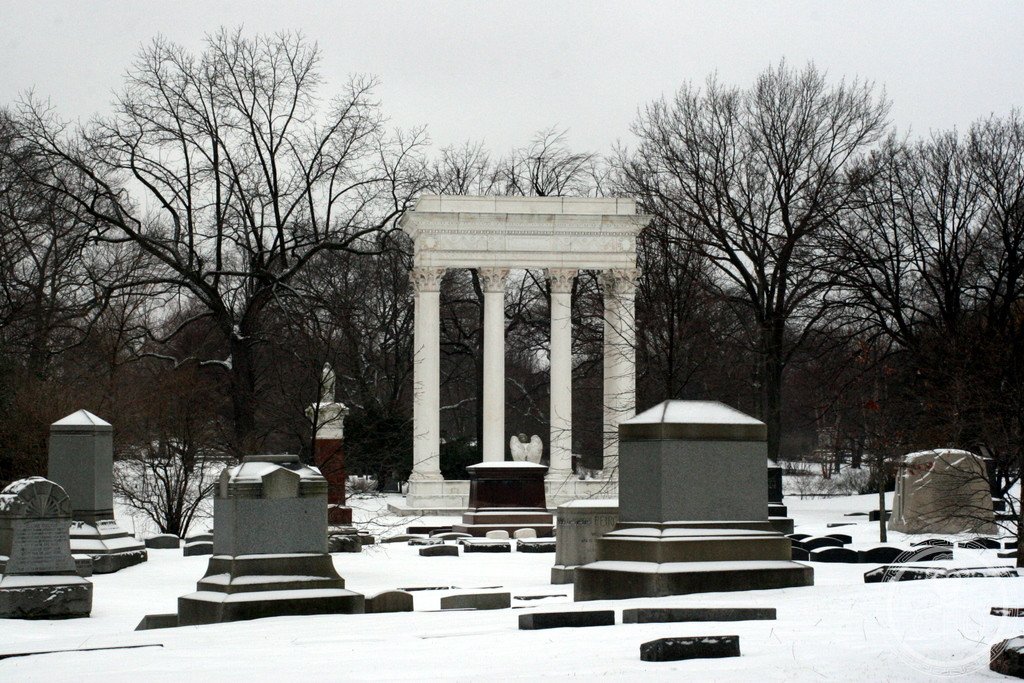
Graceland Cemetery is a nationally significant garden-style cemetery and outdoor museum of funerary architecture and sculpture located in the Lake View neighbourhood of Chicago, Illinois, established in 1860. Covering approximately 121 acres along the North Shore Channel, Graceland is the final resting place of many of Chicago’s most prominent 19th and early 20th-century figures, including architects Louis Sullivan, Daniel Burnham, and Ludwig Mies van der Rohe, as well as industrialists, civic leaders, and several Chicago mayors. Designated a National Historic Landmark in 2001, its landscape and monuments together constitute one of the finest collections of memorial art and architecture in North America.
- Type
- Garden cemetery / outdoor museum of funerary architecture
- Period
- Established 1860; continuous expansion through early 20th century
- Style
- Garden cemetery movement; eclectic funerary monuments from Neoclassical to early Modernist
- Location
- 4001 N Clark Street, Lake View, Chicago, Illinois, USA
- Coordinates
- 41.9546° N, 87.6619° W
At a glance
- Type
- Historic garden cemetery; National Historic Landmark
- Period
- Established 1860
- Style
- Garden cemetery movement with monuments from Neoclassical to Modernist
- Location
- Lake View, Chicago, Illinois, USA
- Architect
- William Saunders (landscape, 1861); monuments by Louis Sullivan, Solon Borglum, and others
Overview
Graceland Cemetery opened in 1860, designed in the English garden cemetery tradition as a landscaped park intended for quiet reflection as much as burial. The 121-acre grounds feature mature trees, a small lake, naturalistic plantings, and meandering paths connecting monuments of exceptional artistic and historical merit. Among its most celebrated works are Louis Sullivan’s ornate Getty Tomb (1890), one of the finest examples of his ornamental architectural work; Daniel Chester French’s brooding bronze figure “Eternal Silence” (1909) marking the Graves family plot; and the modernist steel-and-glass Mies van der Rohe-designed Resor House (the architect himself is buried here).
History
The cemetery was chartered in 1860 and landscape architect William Saunders laid out its grounds in 1861. It was conceived as an alternative to the crowded and unsanitary urban burial grounds then common in Chicago, following the rural cemetery movement pioneered by Mount Auburn in Cambridge, Massachusetts. Through the late 19th century it became the preferred burial ground for Chicago’s business and cultural elite, with families commissioning leading architects and sculptors to create elaborate family monuments. The cemetery’s close association with the architectural figures of the Chicago School makes it particularly significant in the history of American architecture.
What you see
Walking Graceland’s shaded paths, visitors encounter an extraordinary sequence of funerary monuments: Sullivan’s intricately ornamented Getty Tomb in Romanesque Revival limestone; the solemn hooded bronze “Eternal Silence” by Daniel Chester French; and the simple flat stone marking architect Ludwig Mies van der Rohe’s grave. A small ornamental lake near the centre reflects surrounding willows and the larger mausolea. The grounds are maintained as a public green space and are freely accessible during daylight hours.
Cultural significance
Graceland Cemetery is a National Historic Landmark and a living anthology of American funerary art and landscape design. Its monuments trace the arc of Chicago’s architectural history from the post-Fire rebuilding era through the Chicago School to 20th-century Modernism, making it an essential destination for those interested in American architectural and cultural heritage.
Practical information
Address: 4001 N Clark Street, Chicago, IL 60613, USA. Open daily sunrise to sunset; admission is free. The cemetery office offers maps and guided walking tours. Check the official Graceland Cemetery website for current tour schedules and special events.
Getting there
By CTA Red Line, take the train to Sheridan station and walk approximately 10 minutes north along Clark Street to the cemetery entrance. Bus routes along Clark Street (No. 22) also serve the area. Street parking is available on Clark Street adjacent to the main gate.
Sources & resources
See the place
Find it on the map
See this place and what’s around it →📷 Become a Cultural Heritage Online photographer
Share your photos of places: they stay published under your name as the author. The more they're seen, the more you get noticed — and soon a contest will reward the most appreciated photos.
Log in or sign up free to add a photo