
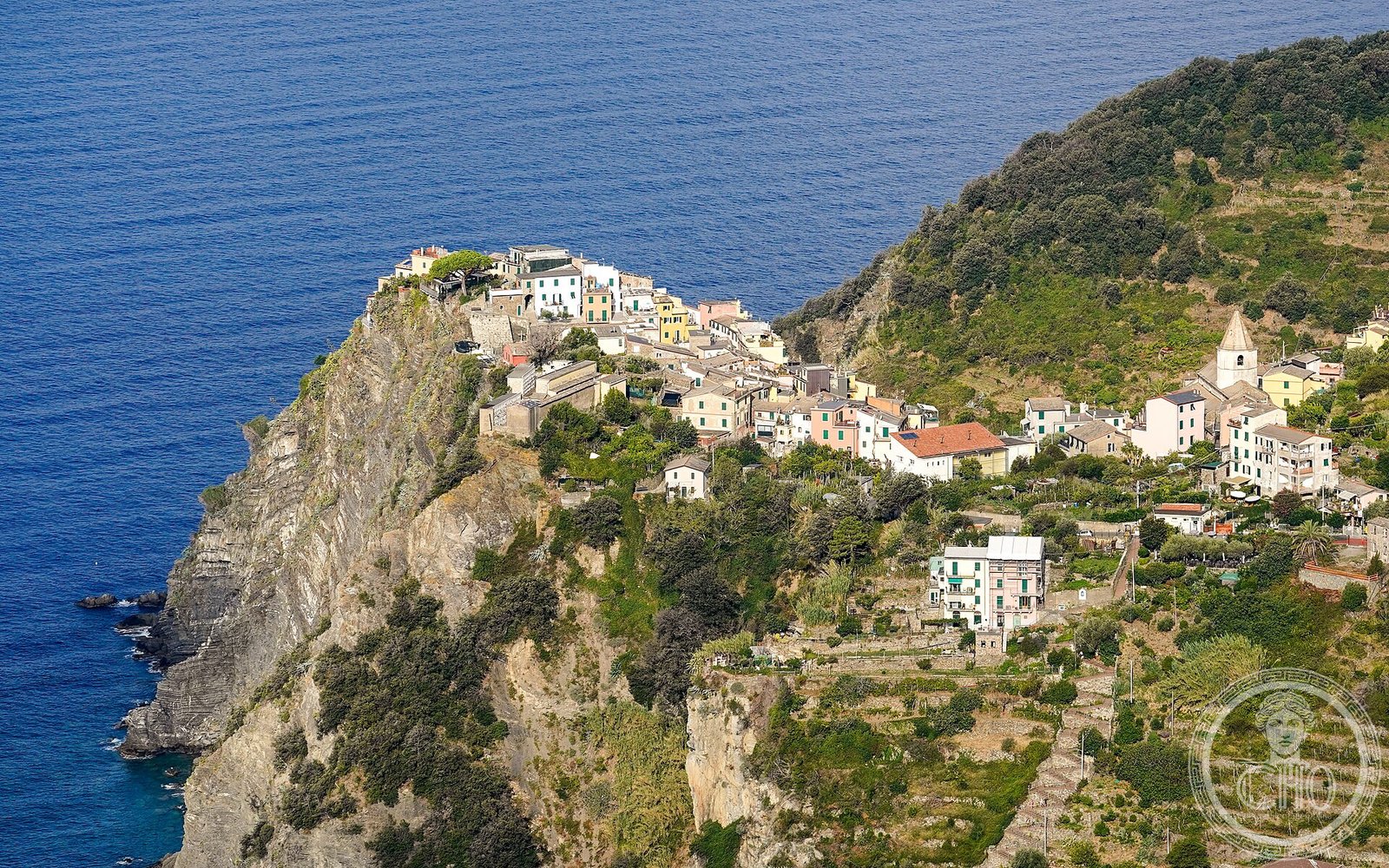
Corniglia is the middle village of the five — the only one not on the water. It sits on a one-hundred-metre promontory of vine-terraced rock between Vernazza and Manarola, reached by 382 steps from the train station, and reads from the sea as a single line of tall, narrow Ligurian houses against the sky.
- Address
- Corniglia, Vernazza (SP), 19018 Liguria
- Type
- Frazione (hamlet) of the Comune di Vernazza, La Spezia province
- Population
- Around 150 permanent residents
- Status
- Part of Cinque Terre, UNESCO World Heritage Site since 1997; Cinque Terre National Park since 1999
- Access
- Train (Cinque Terre Express, Genova–La Spezia line); footpaths from Vernazza and Manarola; no through road
- Coordinates
- 44.1199° N, 9.7080° E
Visit on the map
Corniglia, Vernazza (SP), Liguria · 44.1199° N, 9.7080° E
Download for your navigator
A single waypoint, ready for GPS apps, navigators, and contacts.
The name Corniglia is usually traced to a Roman owner, Cornelius, whose family is thought to have run a farm on this stretch of coast in the imperial period. Wine amphorae found at Pompeii bearing the inscription “Cornelia” are sometimes cited as evidence of the connection, although the link is suggestive rather than proven. What is certain is that Corniglia appears in medieval documents from the 12th century onward as a settlement of the Fieschi family, and that its main artery, Via Fieschi, still carries that name.
“The Cinque Terre is a cultural landscape of great scenic and cultural value. The layout and disposition of the small towns and the shaping of the surrounding landscape, overcoming the disadvantages of a steep, uneven terrain, encapsulate the continuous history of human settlement in this region over the past millennium.”
UNESCO World Heritage List — Inscription criteria, 1997
Of the five villages, Corniglia is the quietest. The absence of a harbour means no ferry service, no waterfront restaurants, no descent of day-trippers off the boats. Visitors arrive by train (the station is at sea level, with the Lardarina staircase climbing through the terraces) or on foot along the Sentiero Azzurro, the blue trail that connects all five villages. The reward at the top is a single main square — Largo Taragio — the parish church of San Pietro (rebuilt in 1334), a wine bar or two, and a long balcony of vineyard above the open sea.
The terraces themselves are the heritage. Roughly seven thousand kilometres of dry-stone walls hold the soil to the slopes of the Cinque Terre; many were laid in the medieval and early modern period and are still maintained, with difficulty, by the surviving farmers and by the national park. The Sciacchetra dessert wine, a pressing of partially dried local grapes, is the most celebrated product of this landscape and one of the reasons it remains under cultivation.
Resources & References
Editorial picks across Wikipedia, photo archives, and the official institution.
Photographs via Wikimedia Commons (CC-BY-SA) unless otherwise stated. Editorial text Cultural Heritage Online, OASIS Tech LLC USA.
Plan your visit
Open to visitors year-round; check local tourism offices for seasonal hours, admission fees, and guided tour availability. GPS coordinates: 44.119857813395534, 9.707971215248108.
See the place
Find it on the map
See this place and what’s around it →
📷 Become a Cultural Heritage Online photographer
Share your photos of places: they stay published under your name as the author. The more they're seen, the more you get noticed — and soon a contest will reward the most appreciated photos.
Log in or sign up free to add a photo