
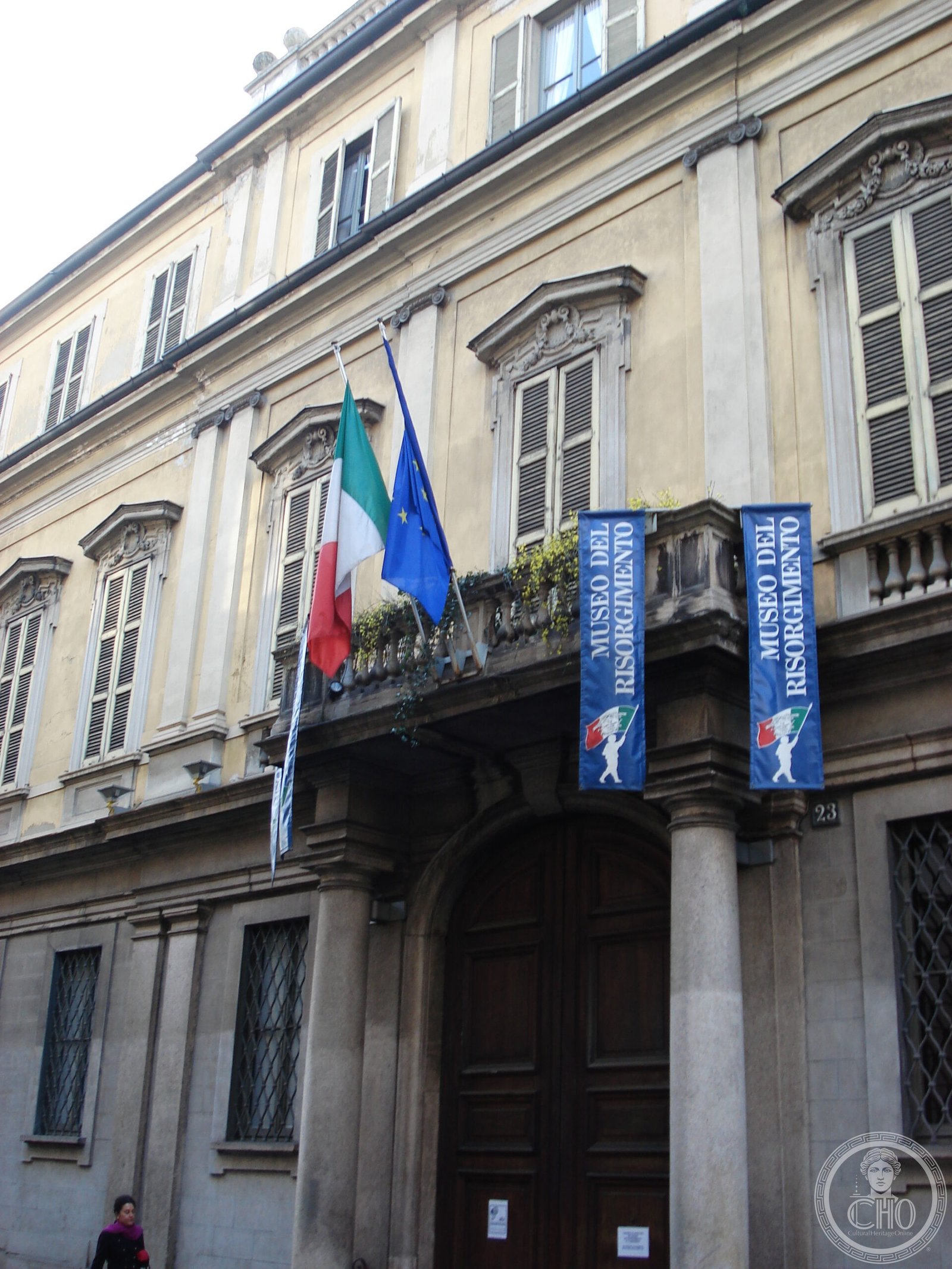
The Museo del Risorgimento in Milan, housed in the 18th-century Palazzo Moriggia designed by Giuseppe Piermarini, is one of Italy’s most important museums dedicated to the history of the Italian unification movement (Risorgimento, 1796–1870). Its collections of documents, portraits, military artefacts, uniforms, weapons, and memorabilia trace the political and military struggle that transformed the Italian peninsula from a patchwork of foreign-dominated states into a unified kingdom, with particular emphasis on the Milanese and Lombard dimension of these events.
- Type
- Civic history museum (Museo del Risorgimento)
- Period
- Palazzo built 18th century; museum collections span 1796–1870; institution founded 1886
- Style
- Neoclassical palazzo (Giuseppe Piermarini, c. 1775)
- Location
- Via Borgonuovo 23, 20121 Milano MI
- Architect
- Giuseppe Piermarini (palazzo)
- Coordinates
- 45.4722° N, 9.1898° E
Overview
The Museo del Risorgimento occupies Palazzo Moriggia, a serene neoclassical palace in the Brera district of Milan, designed by Giuseppe Piermarini — the same architect responsible for La Scala — in the 1770s. Founded in 1886 to commemorate the movement that created modern Italy, the museum holds one of the most significant Risorgimento collections in the country, offering an immersive walk through portraits of key figures such as Garibaldi, Cavour, Mazzini, and Victor Emmanuel II alongside the material culture of their era. Cultural Heritage Online documents this institution as essential for understanding the civic identity of Milan and modern Italy.
History
Palazzo Moriggia was built for the noble Moriggia family in the third quarter of the 18th century, exemplifying Piermarini’s restrained neoclassical style. The Comune di Milano acquired the building and established the Museo del Risorgimento there in 1886, sixteen years after the fall of Rome completed Italian unification. The collections were expanded continuously through donations by Risorgimento veterans and their families, and the museum has been managed by the city’s Civiche Raccolte Storiche ever since, accumulating archival and material heritage that spans the Napoleonic period through the Breccia di Porta Pia.
What you see
Visitors move through chronologically arranged rooms whose painted ceilings and elegant proportions provide a period-appropriate setting for the collections. Highlights include portraits and personal effects of major Risorgimento figures, original letters and proclamations, battle standards and military equipment from the Five Days of Milan (1848) and the Expedition of the Thousand (1860), and a remarkable collection of commemorative medals, prints, and popular imagery that shows how the unification narrative was constructed and disseminated. The palace’s neoclassical interior is itself a heritage monument, its architectural restraint contrasting with the passionate political content of its displays.
Cultural significance
The Museo del Risorgimento in Palazzo Moriggia stands at the intersection of two kinds of heritage: the architectural legacy of Piermarini’s neoclassicism and the political memory of the movement that gave Italy its modern form. For visitors from abroad, it offers an unparalleled narrative entry point into the ideological and emotional foundations of the Italian state, topics that remain central to understanding Italian national identity today.
Practical information
Address: Via Borgonuovo 23, 20121 Milano MI. The museum is managed by the Civiche Raccolte Storiche del Comune di Milano. Admission is typically free or at reduced cost for EU citizens under 26 and over 65; check the official Comune di Milano culture portal for current opening hours, admission fees, and any temporary exhibition programming.
Getting there
The museum is a 10-minute walk from Montenapoleone station (Metro M3, yellow line) or from Lanza station (Metro M2, green line). Tram line 12 runs along Via Pontaccio nearby. The Brera Pinacoteca is a 5-minute walk away, making a combined visit to both institutions a natural pairing for a full cultural day in central Milan.
Sources & resources
See the place
Find it on the map
See this place and what’s around it →Historical events at this place (2)
📷 Become a Cultural Heritage Online photographer
Share your photos of places: they stay published under your name as the author. The more they're seen, the more you get noticed — and soon a contest will reward the most appreciated photos.
Log in or sign up free to add a photoIs this page about you?
This page is read by travellers and heritage enthusiasts who find it on Google. Tell us how you are connected to this place and we will take it from there.