
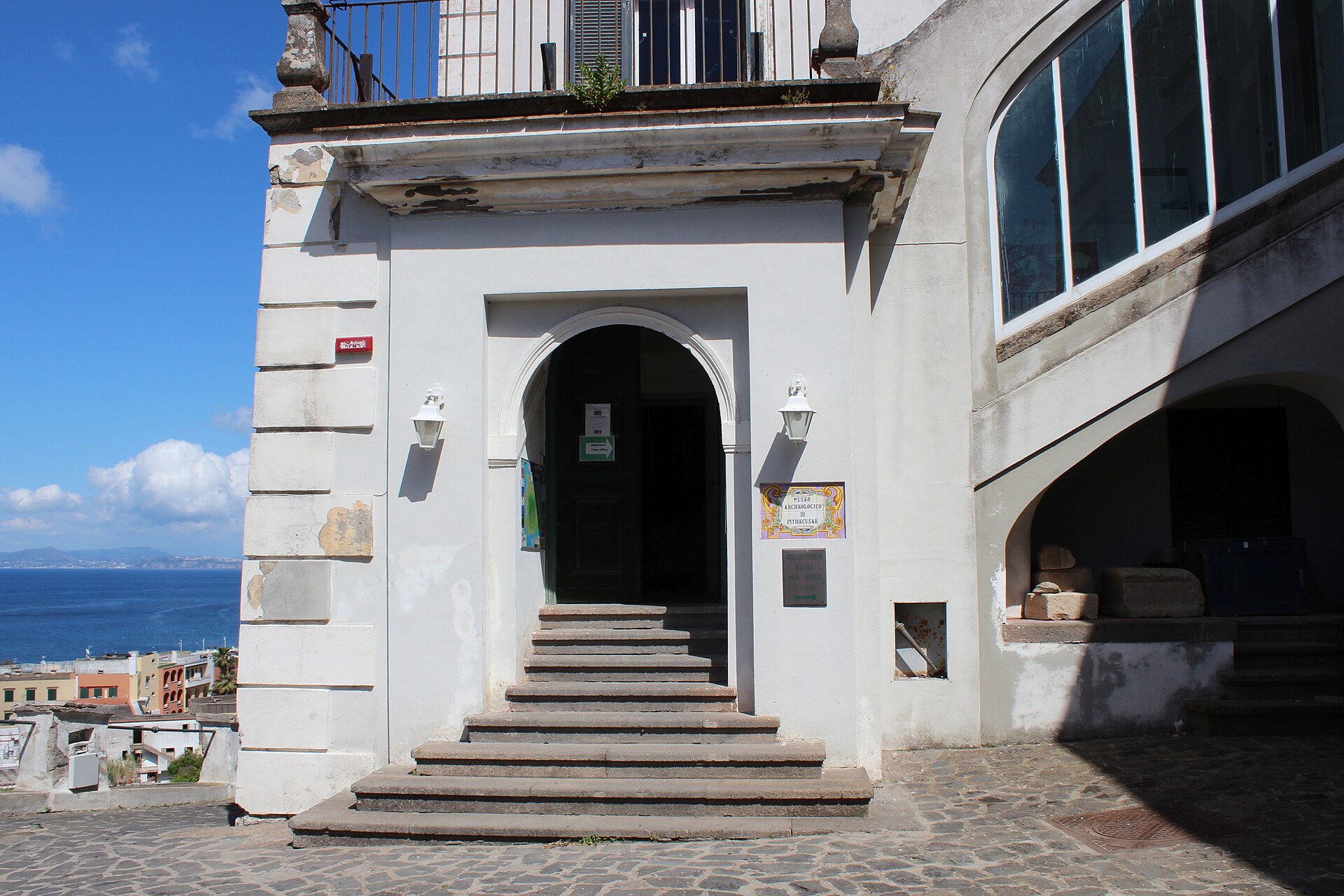
The Archaeological Museum of Pithecusae, housed in the 18th-century Villa Arbusto in Lacco Ameno on the island of Ischia, holds the most important collection of artefacts from ancient Pithecusae — the first Greek colonial settlement in the western Mediterranean, established around 770 BCE. Its centrepiece is the Nestor’s Cup (Coppa di Nestore), a Rhodian skyphos discovered in a child’s cremation burial in 1954, bearing one of the earliest known Greek inscriptions and providing direct evidence of Homer’s world in the ancient West. The museum’s collection spans the 8th to 5th centuries BCE and charts the transition from indigenous Italic culture to Euboean Greek colonisation.
At a glance
- Type
- Archaeological museum
- Period
- Collection covers c. 770–400 BCE; Villa Arbusto built 1785; museum opened 1999
- Style
- Neoclassical villa housing ancient Greek and Italic artefacts
- Location
- Corso Angelo Rizzoli 210, 80076 Lacco Ameno, Ischia, Campania, Italy · 40.7525° N, 13.8829° E
Overview
The island of Ischia, known in antiquity as Pithecusae (Pithekoūsai), holds the distinction of being the site of the earliest attested Greek presence in the western Mediterranean, predating the more famous colonies of Cumae on the nearby mainland. The museum at Villa Arbusto was established to house and display the extraordinary finds from excavations of the ancient necropolis at San Montano in Lacco Ameno, carried out from the 1950s onward by archaeologist Giorgio Buchner. It stands as the primary repository for understanding the very origins of Greek cultural transmission to western Europe.
History
Archaeological investigation of Ischia’s ancient past began seriously in 1952 when Giorgio Buchner commenced systematic excavation of the San Montano necropolis in Lacco Ameno, eventually uncovering over 1,300 burials spanning the 8th to 5th centuries BCE. The most celebrated discovery came in 1954: a child’s cremation tomb (Tomb 168) containing a Rhodian skyphos dated to approximately 730–720 BCE, inscribed in early Greek hexameters — the so-called Nestor’s Cup, referencing the mythological cup of the Homeric king Nestor. Villa Arbusto itself was built in 1785 as a private residence and was later adapted to house the municipality’s cultural collections before the archaeological museum formally opened its doors in 1999.
What you see
The museum’s permanent collection is arranged to guide visitors through the chronological development of Pithecusan society, from the earliest Euboean Greek settlers through the height of the colony’s commercial activity. The undisputed highlight is Nestor’s Cup in its dedicated display case, a small clay drinking cup whose three lines of incised Greek script represent one of the oldest alphabetic inscriptions in the world. Alongside it, funerary goods from San Montano include imported Corinthian pottery, locally made ceramics showing Greek influence, bronze fibulae, amber beads, and iron weapons, all providing a vivid picture of the cosmopolitan, trade-oriented society of early Pithecusae.
Cultural significance
Nestor’s Cup is arguably the most important single object for understanding how the Greek alphabet — and with it, the foundation of western literacy — was disseminated across the Mediterranean in the 8th century BCE. The museum’s collection as a whole is irreplaceable evidence for the earliest phase of Greek colonisation in the west and for the cultural contacts between Greeks, Phoenicians, and indigenous Italic peoples that shaped the subsequent history of the entire Mediterranean world.
Practical information
Address: Corso Angelo Rizzoli 210, 80076 Lacco Ameno, Ischia (NA). Opening hours and admission fees vary seasonally; check the Comune di Lacco Ameno or Campania Musei websites for current information before visiting. Guided tours may be available; booking recommended in peak season.
Getting there
Ischia is reached by ferry or hydrofoil from Naples (Molo Beverello or Pozzuoli), with crossings taking between 30 minutes (hydrofoil) and 90 minutes (car ferry). From Ischia Porto or Casamicciola, take a bus or taxi to Lacco Ameno (approximately 10–20 minutes). The Villa Arbusto is on the main corso of Lacco Ameno, walkable from the central piazza.
Sources & resources
See the place
Find it on the map
See this place and what’s around it →📷 Become a Cultural Heritage Online photographer
Share your photos of places: they stay published under your name as the author. The more they're seen, the more you get noticed — and soon a contest will reward the most appreciated photos.
Log in or sign up free to add a photoIs this page about you?
This page is read by travellers and heritage enthusiasts who find it on Google. Tell us how you are connected to this place and we will take it from there.