
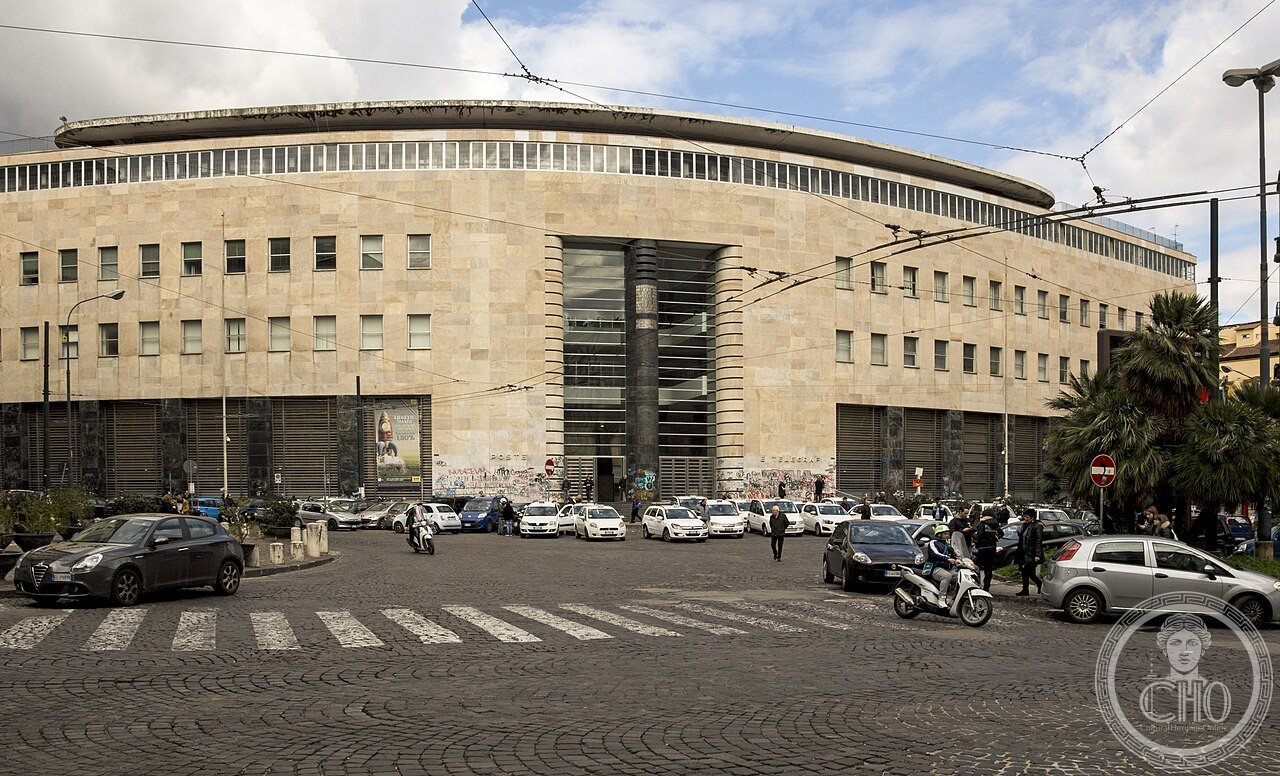
The Palazzo delle Poste in Piazza Matteotti is one of the most commanding examples of Italian Rationalist architecture in Naples, built during the Fascist era as part of a sweeping urban renewal of the city centre. Its monumental facade and rigorous geometric composition made it an emblem of the regime’s ambition to project modernity through civic infrastructure, and it remains a central Naples landmark more than eighty years after its completion.
At a glance
- Type
- Post office and civic building
- Period
- Constructed in the 1930s during the Fascist government of Benito Mussolini
- Style
- Italian Rationalism; monumental civic architecture
- Location
- Piazza Matteotti, central Naples, Campania, Italy
- Coordinates
- 40.8435° N, 14.2512° E
Overview
The Palazzo delle Poste stands in Piazza Matteotti, a square reshaped under Fascist urban planning to give Naples a monumental new civic core. The building exemplifies the rationalist style that dominated Italian public architecture in the 1930s, combining stripped classical references with modern functional planning. It sits within a cluster of period buildings that together form one of the most coherent ensembles of twentieth-century civic architecture in southern Italy.
History
The construction of the Palazzo delle Poste was part of a broader Fascist-era transformation of Naples that included the demolition of older neighbourhood fabric to create wide new thoroughfares and grand piazzas. The building was commissioned as a visible statement of the state’s efficiency and modernity, housing the city’s main postal and telecommunications services. Piazza Matteotti and the surrounding streets were redesigned to showcase a group of new public buildings, including the Palazzo della Questura and other institutions, all built in a related rationalist idiom. The post office remained in active use throughout the post-war decades and continues to function today.
What you see
The building’s facade is characterised by a strong horizontal emphasis, large expanses of smooth stone cladding, and rhythmic window bays that suppress ornament in favour of geometric precision. The ground floor opens onto a generous public lobby still fitted with period fittings. Across Via Monteoliveto stands the Renaissance Palazzo Orsini di Gravina, creating a striking architectural dialogue between a sixteenth-century aristocratic palace and a twentieth-century state building. The scale of the Palazzo delle Poste, deliberately oversized relative to its surroundings, conveys the rhetorical ambition of its patrons.
Cultural significance
The Palazzo delle Poste is a document of the contested urban modernity of 1930s Italy, when rationalist architects sought to reconcile the classical heritage of the peninsula with the European avant-garde. Its survival intact allows visitors to read both the architectural aspirations and the political programme of the era. As Fascist-era civic architecture in Italy is increasingly studied and debated, buildings like the Naples post office occupy an important place in the heritage discourse of the twentieth century.
Practical information
The building functions as an active post office; the public lobby can be visited during post office opening hours (typically Monday–Saturday, morning and afternoon). Admission to the public areas is free. The exterior can be viewed at any time. Check the Poste Italiane website for current service hours.
Getting there
Piazza Matteotti is in the heart of central Naples, within easy walking distance of Piazza del Plebiscito and the Municipio. Metro Line 1 (Toledo station) is approximately 500 m away. Numerous bus lines stop along Via Monteoliveto. Arriving from the port or Piazza Garibaldi, the journey by metro takes under ten minutes.
Sources & resources
Find it on the map
See this place and what’s around it →Record researched and written by Stefano Vigolo for Cultural Heritage Online, 2026.
📷 Become a Cultural Heritage Online photographer
Share your photos of places: they stay published under your name as the author. The more they're seen, the more you get noticed — and soon a contest will reward the most appreciated photos.
Log in or sign up free to add a photoIs this page about you?
This page is read by travellers and heritage enthusiasts who find it on Google. Tell us how you are connected to this place and we will take it from there.