
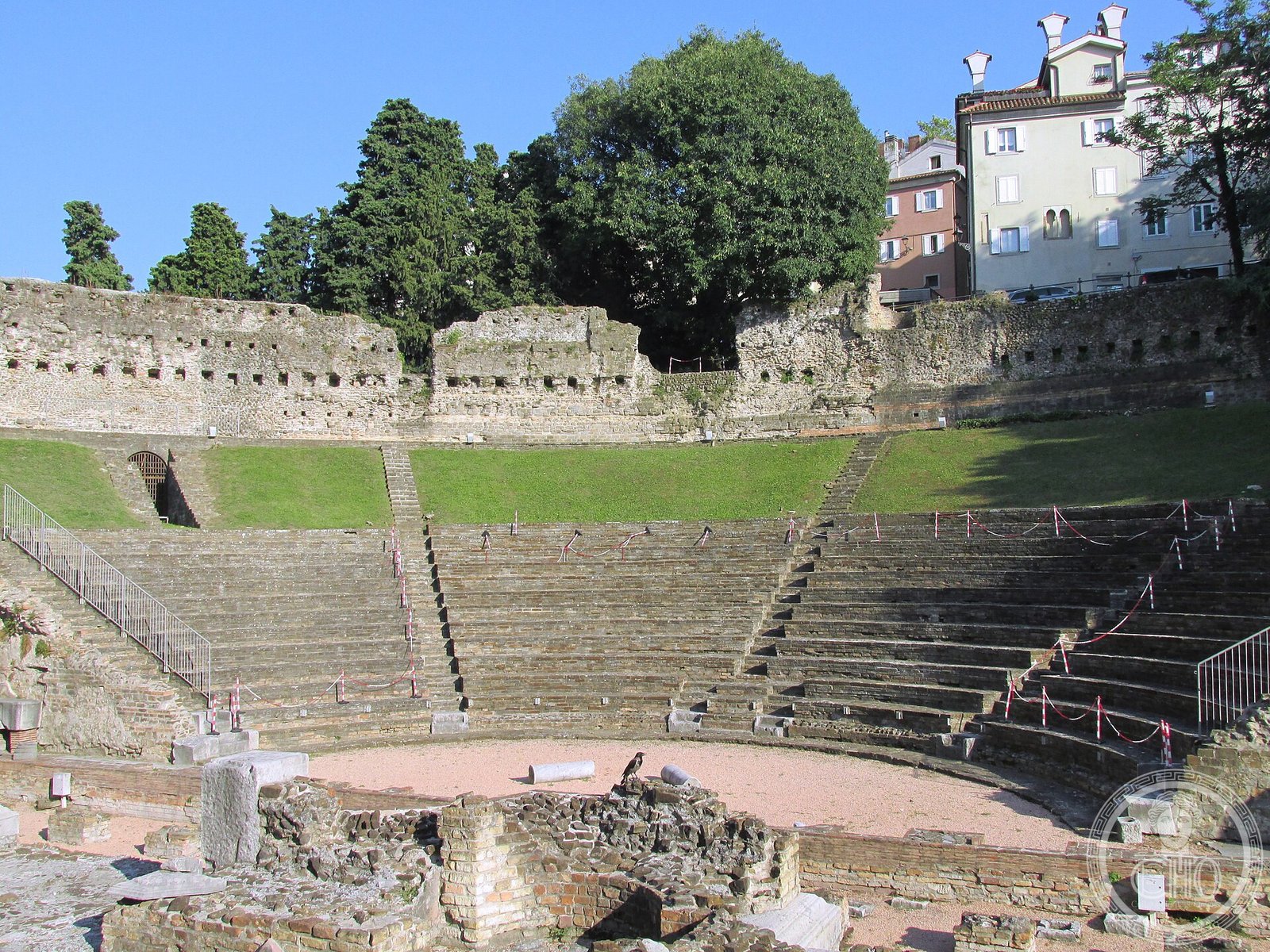
The Roman Theater of Trieste (Teatro Romano di Trieste) is a well-preserved ancient theater built in the 1st century AD at the base of the San Giusto hill in the heart of the old city. One of the largest Roman theaters in northeastern Italy, it was rediscovered in the early 20th century beneath layers of medieval construction and today stands as a visible monument to Trieste’s ancient identity as Tergeste, a prosperous city of the Roman Empire on the northeastern Adriatic shore.
At a glance
- Type
- Roman theater (theatrum)
- Period
- 1st–2nd century AD; excavated and restored in the early 20th century
- Style
- Roman imperial architecture
- Location
- Via del Teatro Romano, Trieste, Friuli-Venezia Giulia, Italy
- Coordinates
- 45.6492° N, 13.7715° E
Overview
Trieste’s Roman theater was built into the southern slope of the San Giusto hill, using the natural topography as a foundation for the cavea — the semicircular seating area — in the standard Roman manner. At its height the theater could seat several thousand spectators for dramatic performances, gladiatorial contests, and civic ceremonies. Today the excavated structure is one of the most atmospheric Roman remains in the upper Adriatic and an essential stop on any tour of ancient Trieste.
History
The city of Tergeste was colonised by Rome around 52–46 BC and became an important commercial hub on the route from the Italian peninsula into the Balkans and the Danube provinces. The theater was constructed during the 1st century AD, likely under the Flavian dynasty, as part of a broader programme of monumental public building. Over subsequent centuries it was gradually buried by accumulating debris and overlying medieval structures, and was only fully rediscovered during urban clearance works in 1938. Systematic excavation continued through the mid-20th century, revealing the orchestra, the stage wall foundations, and several tiers of the cavea.
What you see
Visitors today see a substantial portion of the semicircular cavea, with stone seating banks rising above the orchestra floor. The stage area (scaena) is partially preserved, and fragments of decorative stonework and architectural elements are displayed on site. The theater is set dramatically at the foot of the San Giusto hill, with the medieval cathedral and Venetian castle visible on the skyline above. Information panels explain the site’s history in Italian and English, and evening performances are occasionally staged in the ancient space.
Cultural significance
The Roman theater is one of the principal surviving monuments of ancient Tergeste and a key component of the archaeological heritage that distinguishes Trieste from other Italian cities. Its central location in the modern city — surrounded by 19th-century Habsburg architecture — creates a powerful juxtaposition of historical layers. The site is managed as a public monument and contributes to Trieste’s growing profile as a destination for cultural and archaeological tourism.
Practical information
- Address
- Via del Teatro Romano, 34121 Trieste TS, Italy
- Opening hours
- Generally open during daylight hours; check the Trieste municipality website for current access
- Admission
- Outdoor area typically free; check official sources for guided tour fees
Getting there
The Roman theater is located in the historic centre of Trieste, a short walk from Piazza Unità d’Italia and the waterfront. Trieste is served by the Trieste Centrale railway station with connections to Venice, Ljubljana, and Vienna. By car, take the A4 motorway to Trieste. Local bus lines stop near the San Giusto hill. Trieste Airport (Trieste – Friuli Venezia Giulia Airport) is approximately 35 km from the city centre.
Sources & resources
See the place
Find it on the map
See this place and what’s around it →📷 Become a Cultural Heritage Online photographer
Share your photos of places: they stay published under your name as the author. The more they're seen, the more you get noticed — and soon a contest will reward the most appreciated photos.
Log in or sign up free to add a photoIs this page about you?
This page is read by travellers and heritage enthusiasts who find it on Google. Tell us how you are connected to this place and we will take it from there.