
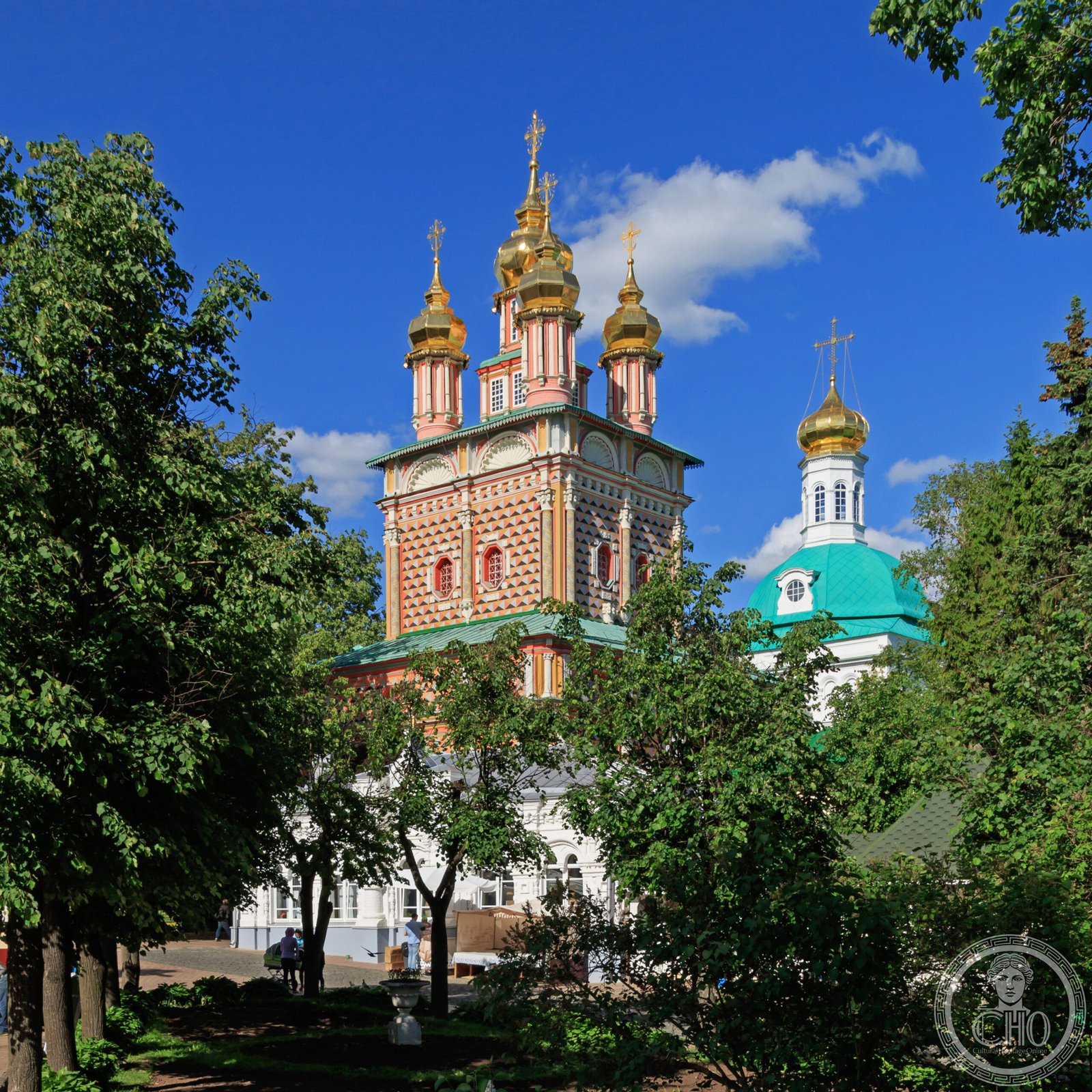
The Trinity Lavra of St. Sergius, known in Russian as Troitse-Sergieva Lavra, is Russia’s most important Orthodox monastery, founded in 1337 by Sergius of Radonezh on a forested hillside at what is now Sergiyev Posad, approximately 70 kilometres northeast of Moscow. A UNESCO World Heritage Site since 1993, the lavra encompasses cathedrals spanning five centuries of Russian ecclesiastical architecture, including the Trinity Cathedral housing Andrei Rublev’s famous icon of the Trinity, an 88-metre Baroque bell tower, and stone fortification walls with twelve towers. Over 300 monks live here today, and the complex functions simultaneously as a working monastery, a major pilgrimage centre, and a museum open to visitors.
At a glance
- Type
- Orthodox monastery (lavra), UNESCO World Heritage Site
- Period
- Founded 1337; major structures 1422–18th century
- Style
- Russian Orthodox ecclesiastical; includes early Russian, Baroque, and Neoclassical elements
- Location
- Sergiyev Posad, Moscow Oblast, Russia
- UNESCO
- World Heritage Site — Architectural Ensemble of the Trinity Sergius Lavra (1993)
- Coordinates
- 56.3103° N, 38.1306° E
Overview
The lavra’s skyline — a cluster of white-washed towers, golden domes, blue star-spangled cupolas, and the soaring silhouette of the Baroque bell tower — is one of the most recognisable in Russia, visible for miles across the surrounding countryside. Inside the fortified walls, the ensemble covers several hectares and contains six major churches, the Patriarch’s Palace, monastic cells, seminaries, and a refectory church, making it effectively a small town organised around the principles of Orthodox monastic life. The Trinity Cathedral, the oldest and most sacred building on the site, is a compact white-stone church (1422) whose austere exterior belies the spiritual and artistic importance of the Rublev icon preserved within.
History
Sergius of Radonezh retreated to this forested hilltop around 1337 and established a small wooden church dedicated to the Trinity, which gradually attracted disciples and grew into a monastery during his lifetime. Following Sergius’s death in 1392 and his canonisation in 1422, the monastery was rebuilt in stone to house his relics, and the Trinity Cathedral was completed in that year. The lavra survived a 16-month Polish-Lithuanian siege (1608–1610) during the Time of Troubles, an episode that elevated it to the status of a national symbol of Russian resistance. Closed by Soviet authorities in 1920 and converted in part into a museum, the monastery was allowed to resume religious activity in 1945 — one of the very first in the Soviet Union — and was fully restored to the Russian Orthodox Church after 1990.
What you see
The Trinity Cathedral is the spiritual heart of the complex, its interior surfaces covered with 15th-century frescoes and housing Rublev’s original icon of the Trinity (a copy is displayed; the original is in the Tretyakov Gallery in Moscow). The Assumption Cathedral (1559–1585), modelled on the Cathedral of the Dormition in the Moscow Kremlin, dominates the central courtyard with its massive drum and five gilded domes; its interior preserves a remarkable 16th–18th-century iconostasis. The 88-metre bell tower, built in stages between 1741 and 1769 in the Russian Baroque style, provides the complex with its most dramatic vertical accent and can be seen from the surrounding town.
Cultural significance
The Trinity Lavra of St. Sergius is the spiritual and administrative centre of the Russian Orthodox Church and the most visited pilgrimage site in Russia, drawing hundreds of thousands of Orthodox Christians annually. Its UNESCO inscription recognises an architectural ensemble of exceptional universal value that traces the full arc of Russian ecclesiastical building from the early 15th century through the Baroque period. The lavra’s survival through Soviet repression and its role in the revival of Russian Orthodox life after 1988 give it a symbolic weight that extends far beyond its architectural or artistic merits.
Practical information
- Address
- Sergiyev Posad, Moscow Oblast, Russia, 141300
- Opening hours
- Monastery grounds open daily from early morning; museum areas have paid entry — check official website for current hours
- Admission
- Monastery grounds free; museums within the complex are paid
- Dress code
- Modest dress required; women must cover heads inside churches
Getting there
The most convenient route from Moscow is by suburban train (elektrichka) from Yaroslavsky railway station to Sergiev Posad station, a journey of approximately 1 hour 20 minutes. The lavra is a 10-minute walk from the station. Express buses also run from the VDNKh metro station on the Moscow metro. By car, the monastery is reached via the Yaroslavskoye Highway (M8) northeast from Moscow.
Sources & resources
See the place
Find it on the map
See this place and what’s around it →📷 Become a Cultural Heritage Online photographer
Share your photos of places: they stay published under your name as the author. The more they're seen, the more you get noticed — and soon a contest will reward the most appreciated photos.
Log in or sign up free to add a photoIs this page about you?
This page is read by travellers and heritage enthusiasts who find it on Google. Tell us how you are connected to this place and we will take it from there.